Anchor Line Guide for Recreational Boaters: Buy Smart
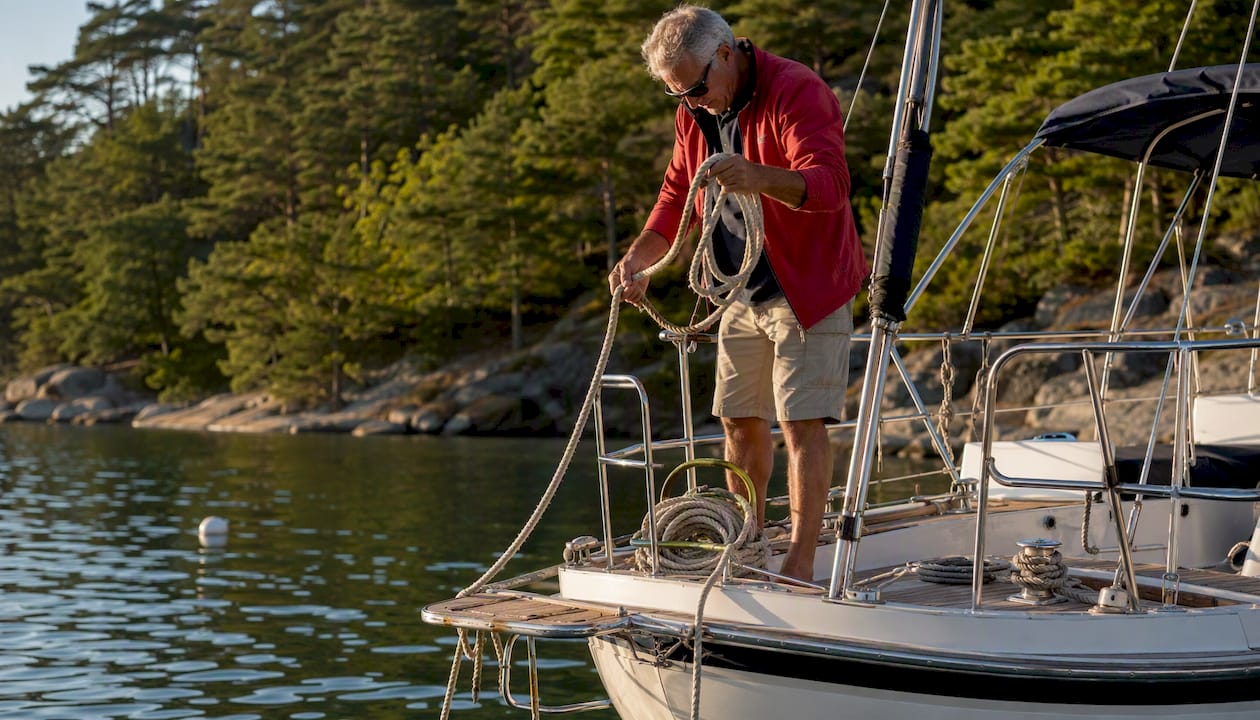
For most recreational boats, the right anchor rode is a short length of galvanized chain spliced to a long nylon anchor line, sized by boat length and windage. That combination protects the rope from bottom abrasion, absorbs shock loads, and gives you the elasticity needed to ride out wind and wave without dragging.
TL;DR:
- Day anchoring: 5:1 scope ratio (pay out 5 feet of rode for every 1 foot of water depth plus freeboard)
- Overnight or high wind: 7:1 or greater
- Best material for general use: nylon, either 3-strand or 8-strand Anchorplait, with at least one boat-length of chain
- Safety note: Never anchor with less than 5:1 scope; underscoping is the single most common cause of dragging
Table of Contents
- What does “anchor line” actually mean?
- What construction and material should you choose?
- How thick should an anchor line be?
- How much rode do you need, and how do you set scope?
- How much chain, and does it work with your windlass?
- What features matter when you shop for anchor line?
- How to attach, deploy, and use an anchor line safely
- When should you replace your anchor line?
- Which anchor lines should you buy, and where?
- Key Takeaways
- The anchor line mistake most boaters make
- Safeboatingamerica covers anchoring in its state-approved courses
- Useful sources and further reading
- FAQ
What does “anchor line” actually mean?
The terms get used interchangeably on product pages, which creates real confusion at the register. Here is the precise breakdown:
- Anchor line: — the rope portion of the anchoring system, connecting the anchor to the boat
Why rope matters: Nylon stretches under load, acting as a built-in shock absorber. Without that elasticity, every wave surge transmits directly to the anchor, increasing the chance of dragging.
Why chain matters: Chain sinks, which lowers the angle of pull on the anchor and improves holding. It also resists abrasion on rocky or shell-covered bottoms where rope would chafe through quickly.
Rode type trade-offs at a glance:
- Combination (chain + rope): best practical compromise for recreational use; chain protects the rope, rope provides elasticity and reduces overall weight
Pro Tip: When reading product pages, “anchor rode” usually means the full assembly is included (chain + rope + thimble). “Anchor line” typically means rope only. Check the product description before ordering.
What construction and material should you choose?
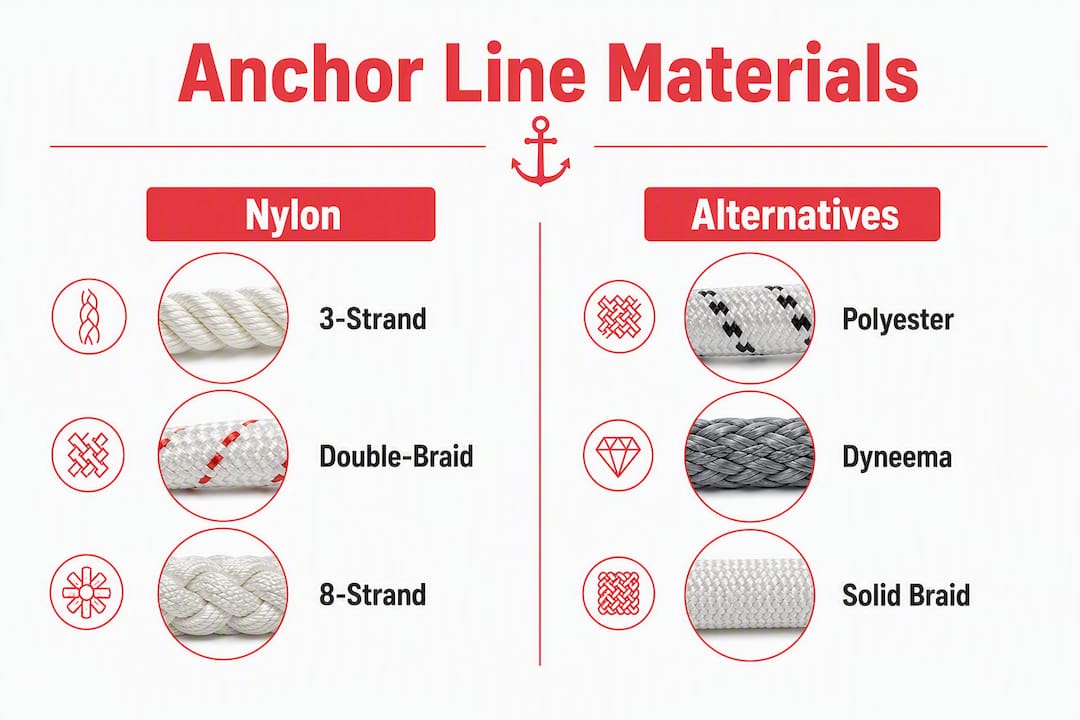
3-strand nylon
The most common and least expensive option. Twists under load, which can cause kinking if not managed, but splices easily and handles well for smaller boats. Widely available at every marine retailer.
Double-braid nylon
A braided core inside a braided cover. Stronger per diameter than 3-strand, resists kinking, and feeds more smoothly through a bow roller. Common on mid-size to larger recreational boats.
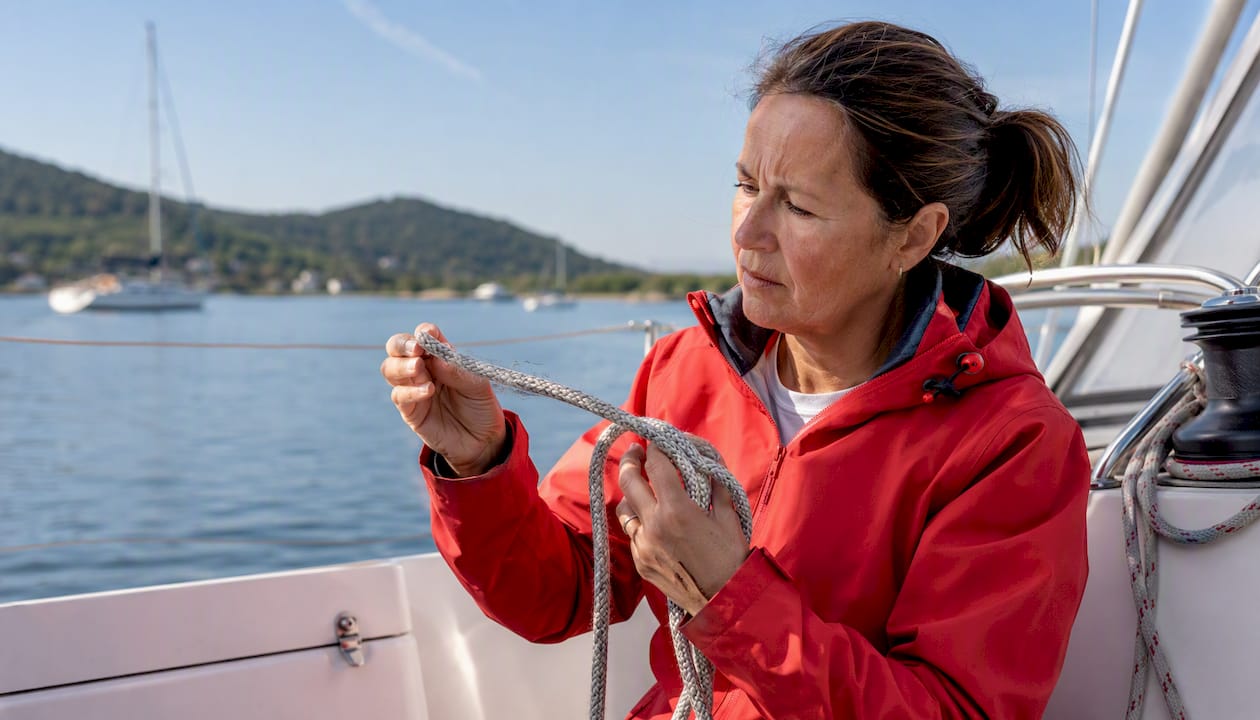
8-strand Anchorplait (nylon)
The preferred construction for experienced boaters who anchor frequently. Anchorplait flakes into a locker like chain, resists tangling, and stays flexible when wet — a real advantage in larger diameters where 3-strand nylon stiffens noticeably. Splicing is also cleaner. The trade-off is higher cost.
Solid braid nylon
Compact and smooth, often used for smaller boats and lighter anchors. Less common in full rode assemblies but available as a budget option (Mad Dog Products lists a solid braid anchor line).
Polyester
Stretches about 15% versus nylon’s 25%, stays suppler in cold water, and resists UV better. A reasonable choice for boats that anchor in high-sun environments, but the reduced elasticity means more shock load reaches the anchor.
Dyneema (UHMWPE)
Very high strength-to-weight, minimal stretch, excellent abrasion resistance. Because Dyneema transfers shock directly to the system rather than absorbing it, it requires a nylon snubber when used as primary rode. Best suited to weight-sensitive performance boats, not typical recreational use.
Chain grades
- BBB (Triple B): heavier, common on older windlasses; lower working load per pound
- G4 / High-Test: stronger and lighter than BBB for the same diameter; the current standard for most new installations
| Construction | Fiber | Stretch | Best for | Windlass-friendly |
|---|---|---|---|---|
| 3-strand | Nylon | ~25% | Budget builds, small boats | Yes (check gypsy) |
| Double braid | Nylon | 25% | Mid-size recreational boats | Yes |
| 8-strand Anchorplait | Nylon | ~25% | Frequent anchoring, larger boats | Yes |
| Solid braid | Nylon | 15% | Light-duty, small boats | Limited |
| Double braid | Polyester | ~15% | High-UV environments | Yes |
| Single/double braid | Dyneema | <5% | Performance/weight-sensitive | With snubber |
| Chain (G4/HT) | Steel | Minimal | Bottom protection, all-chain rode | Chain gypsy required |
How thick should an anchor line be?
A practical starting rule: 1/8 inch of line diameter for every 9 feet of boat length. Line diameter should be sized relative to boat length following practical rules; higher windage boats require thicker line. High-windage boats (tall cabins, flybridge, bimini top) should step up one diameter.
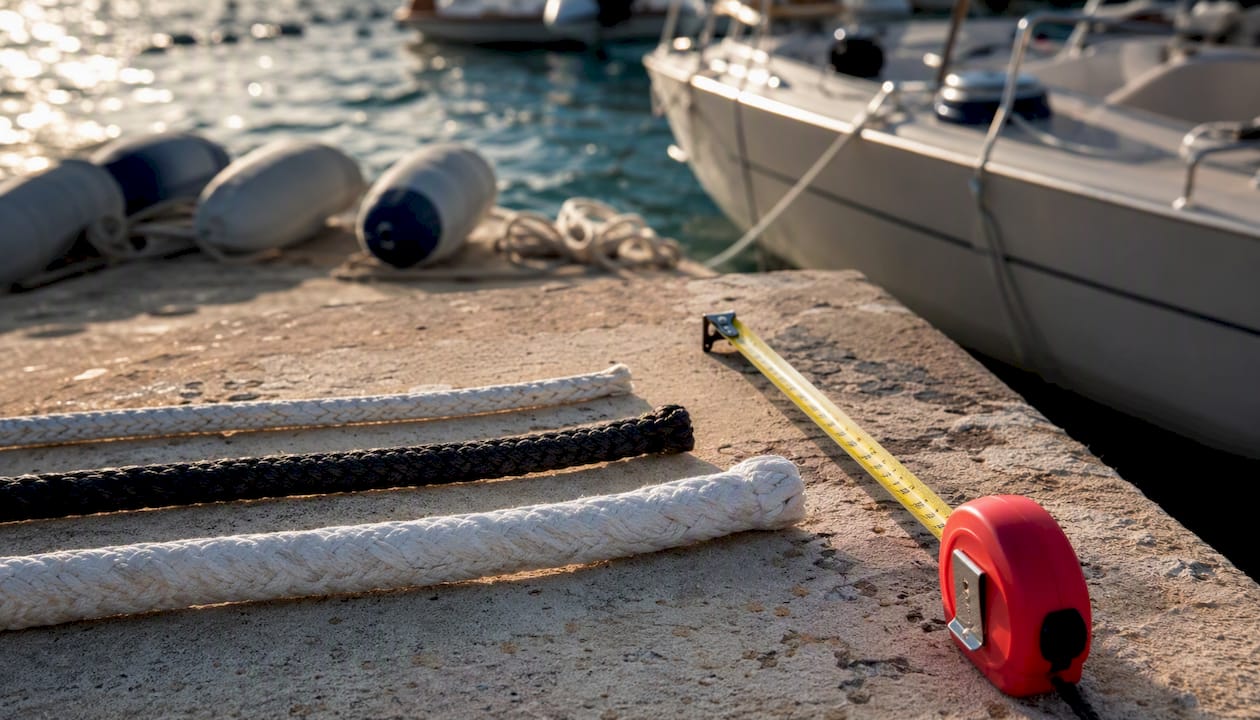
Always cross-check against the manufacturer’s breaking-strength chart for your vessel’s displacement. Diameter alone does not tell the full story; a 1/2" 12-strand nylon line from USA Rope carries an average breaking strength of 13,250 lbs, while a 3/8" line from Atwood Rope MFG rates at 2,200 lbs. Those are very different working loads for boats that may share the same length.
Chain diameter matching: pair your rope to chain of the same nominal diameter (3/8" rope to 3/8" chain, 1/2" rope to 1/2" chain). Shackles should be rated at or above the chain’s working load limit and should be moused (secured with wire or a zip tie) so the pin cannot back out.
Pro Tip: If you anchor in exposed anchorages or overnight regularly, size up one diameter from the rule-of-thumb minimum. The cost difference between 3/8" and 1/2" line is small; the safety margin is not.
How much rode do you need, and how do you set scope?
Scope is the ratio of rode length to the vertical distance from your bow chock to the bottom. That vertical distance equals water depth plus your freeboard (height of bow chock above the waterline).
Standard scope ratios:
- 5:1 for calm day anchoring in protected water
- 7:1 for overnight stays or when wind exceeds 15 knots
- 10:1 in storm conditions or very exposed anchorages
A quick example: anchoring in 10 feet of water with 3 feet of freeboard gives a vertical distance of 13 feet. At 7:1, you need 91 feet of rode in the water. Carry at least 150–200 feet of total rode on most recreational boats to handle unexpected depth changes or the need to re-anchor.
Color-coded and depth-marked anchor lines are a safety measure, not just a convenience. They allow accurate scope setting under stress and during night watches, when estimating paid-out length by feel is unreliable; see this fleet color-coding system for jet skis for principles of color coding and marking that apply to anchoring gear as well. Kits with pre-spliced thimbles and dashboard depth decals make scope monitoring straightforward for any crew member, not just the skipper.
Practical depth-marking methods:
- Factory color-coded rode (depth intervals marked at the factory)
- Whipping twine or cable ties at measured intervals (every 25 or 50 feet)
- Waterproof paint or marker on the chain links at known depths
Carry more rode than you think you need. Anchorages that chart at 8 feet can run 12–15 feet at high tide. A 200-foot rode on a 25-foot boat costs little extra and removes a real constraint.
How much chain, and does it work with your windlass?
A combination rode with at least one boat-length of chain spliced to nylon is the most practical setup for recreational boaters. A 25-foot boat carries 25 feet of chain; a 40-foot boat carries 40 feet. That length protects the rope from bottom abrasion, lowers the angle of pull on the anchor, and improves holding in most bottom types.
Even a short chain segment of 4 feet reduces chafe risk significantly on rocky or shell-covered bottoms. If weight is a concern on a small boat, 10–15 feet of chain is a reasonable minimum. For very rocky bottoms where chain-on-rock abrasion is the primary risk, some skippers prefer a shorter, heavier chain rather than a long light one.
Chain changes the geometry of anchoring. As the boat surges back, the catenary (sag) of the chain absorbs energy and keeps the pull angle low and horizontal at the anchor shank. A rope-only rode pulls at a steeper angle, which can break the anchor out of the bottom in surge conditions.
Windlass compatibility is non-negotiable. Gypsies are diameter- and construction-specific; a gypsy designed for 3/8" chain will not grip 1/2" chain reliably, and a rope gypsy will not handle chain at all. Before buying rode, confirm:
- The gypsy’s rated rope diameter and chain size
- Whether the windlass accepts combination rope-and-chain rode or chain only
- That the rope construction (3-strand vs. braid) matches the gypsy’s profile
Pro Tip: Buy your windlass and rode together, or at minimum pull the windlass manual and match the gypsy spec sheet before ordering rope and chain separately. Mismatched gypsies cause retrieval jams at the worst possible moment.
What features matter when you shop for anchor line?
Must-have features (check these on every product page):
- Pre-spliced eye with galvanized or stainless thimble: protects the splice from shackle wear; factory splices are stronger and more consistent than most field splices
- Breaking strength specification: must be listed; if it is not, skip the product
- UV treatment or UV-resistant fiber: nylon degrades in sunlight; treated lines last significantly longer in open-water use
- Abrasion-resistant cover: especially on double-braid; look for tight braid density
- Sinkability: nylon sinks, which is correct for anchor rode; floating lines (polypropylene) are not suitable
Practical extras worth paying for:
- Depth markings or color-coded intervals
- Included chain section (saves a separate purchase and ensures matched diameters)
- Windlass-ready packaging with gypsy compatibility notes
Price vs. performance:
- 3-strand nylon: lowest cost, widely available, adequate for most recreational use
- Double-braid nylon: moderate cost, better handling and strength per diameter
- 8-strand Anchorplait: higher cost, best handling and wet-flexibility for frequent anchoring
- Pre-spliced kits with chain: higher upfront cost, but eliminates field splicing and diameter-matching errors
| Feature | Why it matters | Look for |
|---|---|---|
| Pre-spliced thimble | Prevents shackle wear on the eye | Galvanized or stainless steel thimble |
| Breaking strength listed | Verifiable safety margin | Manufacturer spec sheet |
| UV treatment | Extends service life | “UV-resistant” in product description |
| Depth markings | Accurate scope setting | Color-coded or factory-marked intervals |
| Included chain | Matched diameters, ready to deploy | Chain length and grade specified |
| Windlass compatibility | Prevents retrieval jams | Gypsy diameter and construction noted |
How to attach, deploy, and use an anchor line safely
Deployment steps
- Inspect the rode before every trip: check for abrasion, soft spots in braided lines, and corrosion on chain links and shackles.
- Attach chain to anchor using a shackle rated at or above the chain’s working load; mouse the pin.
- Connect rope to chain via a rope-to-chain splice or a shackle through the thimble eye; a proper splice is stronger than a shackle connection.
- Secure the bitter end of the rode to a strong point below deck before paying out. Losing the rode over the bow is a real risk if the end is not secured.
- Motor to the spot, stop the boat, and lower (do not throw) the anchor to the bottom.
- Pay out rode to the calculated scope while backing down slowly.
- Set the anchor by applying reverse throttle briefly; watch a fixed reference point to confirm the boat is not moving.
- Monitor the ride for the first 15–30 minutes, especially as wind or current shifts.
Snubber use with chain rode
A snubber is a short length of nylon line (or a purpose-made elastic snubber) attached to the chain with a hook or rolling hitch, then cleated on deck so the chain hangs slack. The snubber absorbs surge loads that all-chain rode would transmit directly to the windlass and bow fitting. On any boat using a significant length of chain, a snubber is standard practice.
Pro Tip: For a quick visual on splice techniques and snubber rigging, the boat videos at Safe Boating America cover hands-on skills that complement the written steps above.
Splice vs. factory pre-spliced
A factory pre-spliced kit from a reputable manufacturer is the better choice for most boaters. Field splices require practice and the right tools to achieve full strength. If you do splice your own, use a proper fid and follow a published splice pattern for your specific construction (3-strand, double-braid, and 8-strand each use different techniques).
When should you replace your anchor line?
Anchor rode fails quietly. The line looks fine until it does not, and by then you are dragging. Inspect at the start of every season and after any hard anchoring event.
Replace the line when you see:
- Visible abrasion, cuts, or flattened sections anywhere along the rope
- A soft or spongy core in braided line (squeeze the rope; the core should feel firm)
- Stiffness or brittleness, especially near the thimble and at the bow chock
- Fading or chalky surface texture (UV degradation)
- Missing or illegible breaking-strength tags
- Corrosion, cracks, or elongated links in chain; bent or worn shackle pins
Storage and cleaning:
- Rinse with fresh water after saltwater use; salt crystals accelerate abrasion internally
- Dry completely before stowing to prevent mildew and core rot in braided lines
- Store loosely coiled or flaked, not compressed under heavy gear
- Keep out of direct sunlight during long-term storage
Replace splices when the thimble shows wear grooves or the splice eye has softened. Replace chain and shackles on the same schedule as the rope; a new rope on corroded chain is a weak link waiting to fail.
Which anchor lines should you buy, and where?
The table below covers the four retailers and product lines that appear consistently in U.S. searches for anchor line rope. Specs reflect publicly listed product information.
| Retailer / Product | Best for | Construction | Pre-spliced / Thimble | Windlass compatibility | UV / Abrasion |
|---|---|---|---|---|---|
| Right Rope | Custom lengths, multiple constructions | 3-strand, double braid, 12-strand | Yes | Varies by diameter | UV-resistant options |
| Mad Dog Products | Pre-spliced kits, accessory bundles | Solid braid nylon | Yes, with thimble | Light-duty / small boats | Standard nylon UV rating |
| T-H Marine | Full-system buyers (line + chain + windlass parts) | Nylon (multiple) | Varies by product | Yes, windlass accessories stocked | Standard |
| Norestar | Windlass-ready rope-and-chain combos | Double-braid nylon + chain | Yes | Designed for windlass gypsies | UV-resistant double braid |
Right Rope suits boaters who need a specific length or construction not available off the shelf. The site lists 3-strand, double-braid, and 12-strand options with customizable lengths, which removes the common problem of buying a 100-foot line when you need 150 feet.
Mad Dog Products focuses on pre-spliced solid braid kits. Solid braid is compact and easy to handle on smaller boats, and the factory splice removes a step for boaters who do not splice their own lines.
T-H Marine stocks the broadest range of components: nylon lines, chain, windlass parts, and accessories in one catalog. Boaters building or upgrading a full anchoring system can match gypsy, chain, and rope in a single order.
Norestar builds rode assemblies specifically for windlass use, combining double-braided nylon with chain in pre-measured configurations. If you have a windlass and want a drop-in rode that is confirmed compatible, Norestar’s assemblies reduce the guesswork.
Shopping tips:
- Always download the manufacturer’s spec sheet and verify breaking strength against your vessel’s displacement
- Confirm the gypsy diameter and construction match before ordering rope or chain separately
- Novice boaters: choose a pre-spliced kit with a stainless or galvanized thimble; it removes the most common installation error
- Check whether the listed length includes chain or rope only; product pages vary on this
Key Takeaways
A nylon anchor line combined with at least one boat-length of chain is the correct setup for most recreational boats, sized at 1/8 inch of diameter per 9 feet of boat length and deployed at a minimum 5:1 scope for day use and 7:1 for overnight.
| Point | Details |
|---|---|
| Size by boat length | Use 1/8" of line diameter per 9 feet of boat length; step up for high-windage boats. |
| Chain + nylon combination | At least one boat-length of chain protects rope from chafe and improves anchor hold angle. |
| Scope discipline | 5:1 for calm day anchoring; 7:1 or more for overnight or wind above 15 knots. |
| Key shopping checks | Verify pre-spliced thimble, published breaking strength, and gypsy compatibility before buying. |
| Safeboatingamerica training | Hands-on anchoring skills, including scope setting and rode handling, are covered in state-approved courses. |
The anchor line mistake most boaters make
The conventional wisdom says “buy more rope.” That is not wrong, but it misses the real failure point: boaters who buy the right rope and then anchor with the wrong scope. Holding security depends significantly on scope ratio; more rode at correct scope is safer than less rode at insufficient scope. The math matters more than the gear.
The second overlooked issue is gypsy compatibility. Boaters spend time comparing rope constructions and breaking strengths, then order a line that will not feed through their windlass. The gypsy spec is the first thing to check, not an afterthought.
On the material question: nylon is the right choice for the vast majority of recreational boaters, not because it is the strongest or the most UV-resistant, but because its elasticity does the work that would otherwise require a perfectly set anchor and a perfectly calm anchorage. That 25% stretch is a real safety buffer. Dyneema and polyester have their places, but they require the boater to compensate for what they lack in shock absorption, usually with a snubber or a more careful scope calculation.
The anchoring guide at Safe Boating America covers deployment steps in detail, including how to read bottom type and adjust scope accordingly.
Safeboatingamerica covers anchoring in its state-approved courses
Knowing the right gear is one part of safe anchoring. Knowing how to use it under real conditions is the other. Safeboatingamerica’s state-approved boating safety certification courses cover anchoring procedures, scope discipline, and emergency protocols as part of NASBLA-approved curricula taught by USCG-Licensed Captains and State Certified Instructors.
Courses are available online, via live Zoom, and in person across all U.S. states, with same-day certification options in many locations. Whether you are a first-time boat owner or an experienced boater completing a state-required course, the instruction covers the practical skills that product pages cannot teach: reading an anchorage, setting scope correctly, and knowing when to re-anchor before conditions change. Register at Safeboatingamerica.com to find a course in your state.
This article provides general educational information. For state-specific boating law requirements and hands-on anchoring practice, consult a certified instructor or your state’s boating authority.
Useful sources and further reading
The sources below were used to verify sizing rules, material trade-offs, and product specifications in this article. Manufacturer and retailer pages are included for readers who want to review spec sheets and gypsy compatibility charts directly.
- Selecting the correct anchors and anchor rope — Spade Anchor USA: combination rode guidance, chain length recommendations, and trade-off analysis
- Anchor rope (nylon, Dyneema, or double braid) — Savwinch: Dyneema vs. nylon comparison and snubber guidance
- 1/2" Premium 12-Strand Anchor Line — USA Rope: product spec sheet with breaking strength and weight data
- Premium single braid anchor line — USA Rope: diameter sizing rule source
- 5/8" Anchor Line Kit with pre-spliced stainless steel thimble — Good Windlass: depth-coded kit specs and dashboard decal system
- 3/8" Anchor Line — Atwood Rope MFG: breaking strength data for 3/8" factory-spliced line
- Small boat anchors: types, sizes, and best practices — Safe Boating America: anchor selection guidance to pair with rode sizing
Consult manufacturer pages for windlass/gypsy compatibility tables before purchasing rope and chain separately. Gypsy specifications vary by windlass model and are not standardized across brands.
FAQ
What is an anchor line?
An anchor line is the rope portion of an anchor rode, connecting the anchor to the boat. The full rode may include chain, rope, or both.
How thick should an anchor line be?
A practical rule is 1/8 inch of diameter for every 9 feet of boat length. High-windage boats should size up one diameter from that baseline.
What is the best line for an anchor?
Nylon is the standard choice for recreational boats because its roughly 25% elongation absorbs shock loads. Eight-strand Anchorplait nylon offers the best handling and wet-flexibility for frequent anchoring.
What is the best rope for anchor lines?
Double-braid or 8-strand Anchorplait nylon gives the best balance of strength, handling, and shock absorption for most recreational boaters. Pair it with at least one boat-length of chain for a complete rode.
Do I need chain on my anchor line?
At least a short chain section is strongly recommended. Even 4 feet of chain reduces chafe on rocky bottoms, and a boat-length of chain improves the angle of pull and overall holding.
Recommended
- How to Anchor a Ship: Recreational Boater’s Guide - Safe Boating America
- Essential Sailboat Parts: A New Owner’s Safety Guide - Safe Boating America
- Small Boat Anchors: Types, Sizes, and Best Practices - Safe Boating America
- Top Boat Manufacturers: 2026 Buyer’s Guide by Category - Safe Boating America