What Is a Marine Protected Area: Key Facts Explained
Many people assume that a marine protected area is simply a stretch of ocean where all human activity is banned. That assumption is wrong, and it shapes how millions of people relate to ocean conservation. A marine protected area, known in policy circles as an MPA, is a geographically defined marine space designated to achieve long-term conservation of biological diversity while potentially allowing sustainable use consistent with those conservation goals. This article breaks down what MPAs actually are, how they are managed, what science says about their effectiveness, and what you can do as someone who uses and values the ocean.
Key Takeaways
| Point | Details |
|---|---|
| MPAs are not total no-access zones | Most marine protected areas allow some human activity within clearly defined management frameworks. |
| Legal backing is non-negotiable | True MPAs require legal designation and dedicated governance, not just informal fishing restrictions. |
| Benefits grow with age and protection level | Research shows fully protected, older MPAs deliver substantially stronger ecological outcomes than newer or partial designations. |
| Stakeholder involvement matters | Effective MPA management includes Indigenous groups, local communities, and public consultation at every stage. |
| Climate context limits short-term gains | MPAs alone cannot overcome large-scale environmental pressures; they work best within broader conservation strategies. |
What is a marine protected area: definitions and legal frameworks
The phrase “marine protected area” covers a wide spectrum of designations, and that breadth is exactly what causes confusion. The International Union for Conservation of Nature defines a protected area as a clearly defined geographic space, recognized, dedicated, and managed through legal or other effective means, to achieve long-term conservation of nature. Apply that to the ocean, and you get the working definition of an MPA.
Norway’s 2025 legislation under the UN Convention on the Law of the Sea offers one of the clearest modern examples. That law defines MPAs by specific conservation objectives tied to biological diversity, alongside allowances for sustainable use where it does not undermine those objectives. The dual emphasis on conservation and sustainable use is the key distinction most people miss.
“MPAs require more than just designation; they must be clearly defined, recognized, dedicated, and managed through legal or other effective means for long-term conservation.” — IUCN protected-area criteria
This matters practically. A zone where a government simply reduces fishing pressure is not technically an MPA unless it has legal recognition, defined boundaries, a management authority, and a long-term governance structure. That distinction separates temporary policy measures from genuine marine conservation areas with enforceable protections.
Types of marine protected areas and use zones
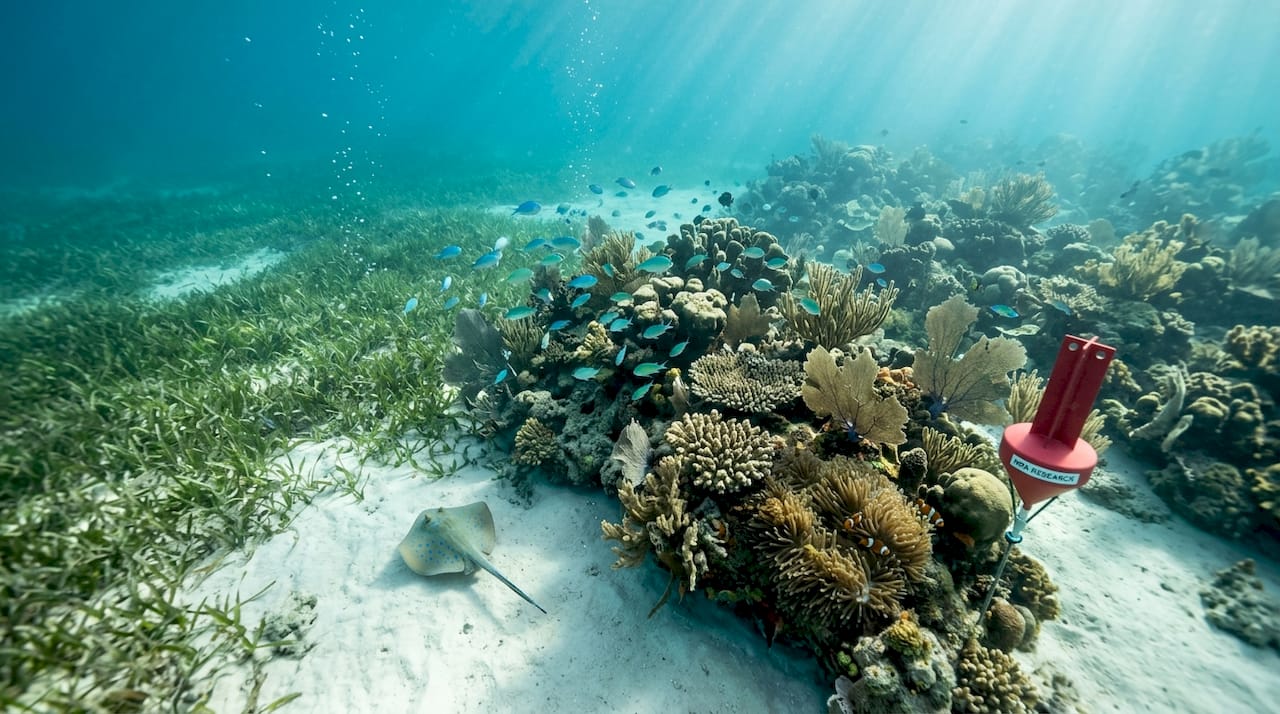
Not all MPAs operate the same way. They exist on a spectrum from highly restrictive no-take reserves to multiple-use zones that permit fishing, recreation, and tourism alongside conservation objectives.
| MPA Type | Allowed Activities | Protection Level |
|---|---|---|
| No-take reserve | Scientific research, wildlife viewing only | Highest |
| Marine national park | Non-extractive recreation, ecotourism, limited fishing | High |
| Multiple-use MPA | Sustainable fishing, boating, tourism with zoning | Moderate |
| Conservation area reserve | Provisional protection pending governance resolution | Moderate to high |
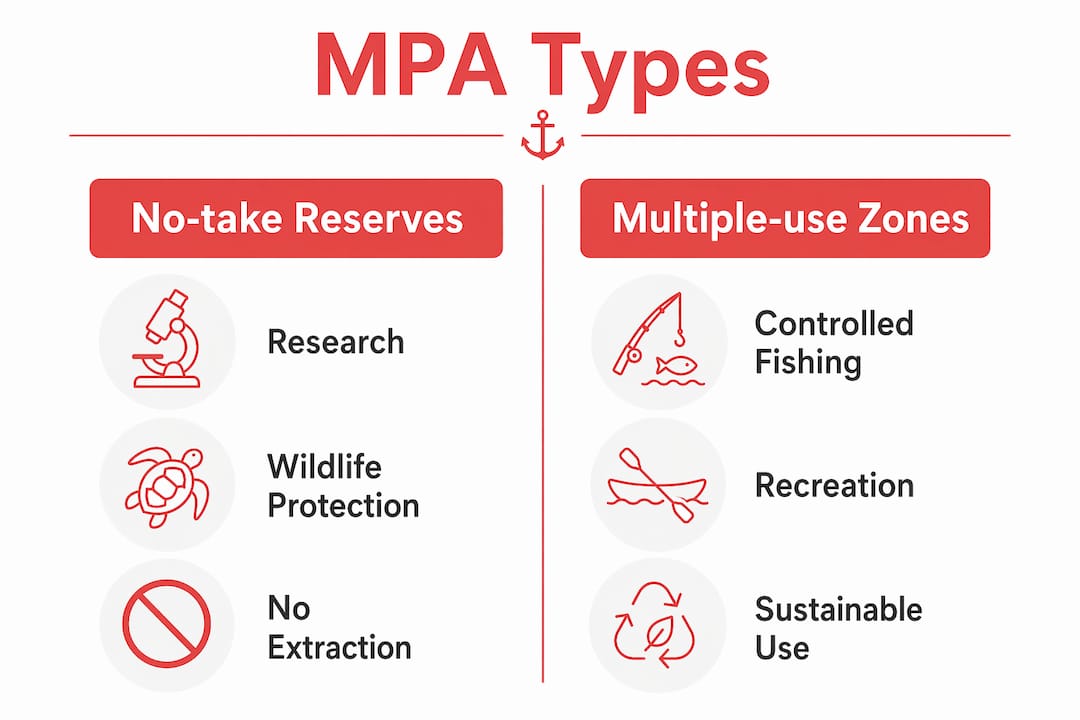
Canada’s National Marine Conservation Areas (NMCAs) illustrate the multiple-use model well. These areas balance ecosystem protection with sustainable activities, meaning recreational boaters, fishers, and ecotourism operators can still access the water, but under management rules that put ecosystem health first.
Canada also recognizes a separate category: National Marine Conservation Area Reserves. These exist in regions with active Indigenous land claims under negotiation, operating like NMCAs on a provisional basis until those claims are resolved. That model reflects a growing global recognition that marine protection cannot succeed without addressing Indigenous rights and titles simultaneously.
Key categories you will encounter in the United States and globally include:
- No-take zones: All extractive activity is prohibited. Papahānaumokuākea Marine National Monument in Hawaii is one of the world’s largest examples.
- Marine parks: Allow non-consumptive recreation such as diving and kayaking, but restrict fishing and mining.
- Multiple-use MPAs: Zoned internally, so some sections allow commercial fishing while others exclude it entirely.
- Seasonal closures: Time-limited protections that function like MPAs during critical periods such as spawning seasons.
Pro Tip: When visiting a new marine area, look up its specific zone classification before fishing, diving, or anchoring. The rules vary significantly between zones within the same MPA, and violations carry real legal consequences.
How marine protected areas work in practice
Knowing that an MPA exists is one thing. Understanding how it actually functions day-to-day is another. Governance structure and management plans are what separate effective MPAs from those that exist only on paper.
- Legal designation: A government authority formally establishes the MPA with defined boundaries, creating the legal basis for enforcement and management.
- Management plan development: Under Canada’s NMCA model, a management plan must be completed within five years and must cover zoning, ecosystem protection objectives, cultural heritage, and sustainable use provisions.
- Stakeholder consultation: Management plans are not created in isolation. They require input from advisory groups, Indigenous communities, local residents, and the public. This step directly shapes which activities are permitted and where.
- Zoning and activity rules: Different zones within an MPA carry different rules. A no-take core zone might be surrounded by a buffer zone where recreational fishing is allowed under permit.
- Monitoring and enforcement: Rangers, vessel monitoring systems, and satellite technology track activity inside MPAs. Enforcement capacity varies widely between countries and regions.
- Adaptive management: The best-managed MPAs revise their plans based on ecological monitoring data. If fish stocks recover, zones may be adjusted. If pressures increase, rules tighten.
The distinction between a legally governed MPA and an area with reduced fishing restrictions but no formal management structure is not semantic. Without dedicated governance, the “protection” dissolves the moment political priorities shift.
Pro Tip: If you want to understand the specific rules for a particular MPA, the management plan is a public document. Most national parks agencies publish them online, and they are more readable than you might expect.
Benefits and limitations of marine protected areas
The science on MPA effectiveness is genuinely encouraging in some areas and more sobering in others. Understanding both sides matters if you want an accurate picture.
Ecological and economic benefits
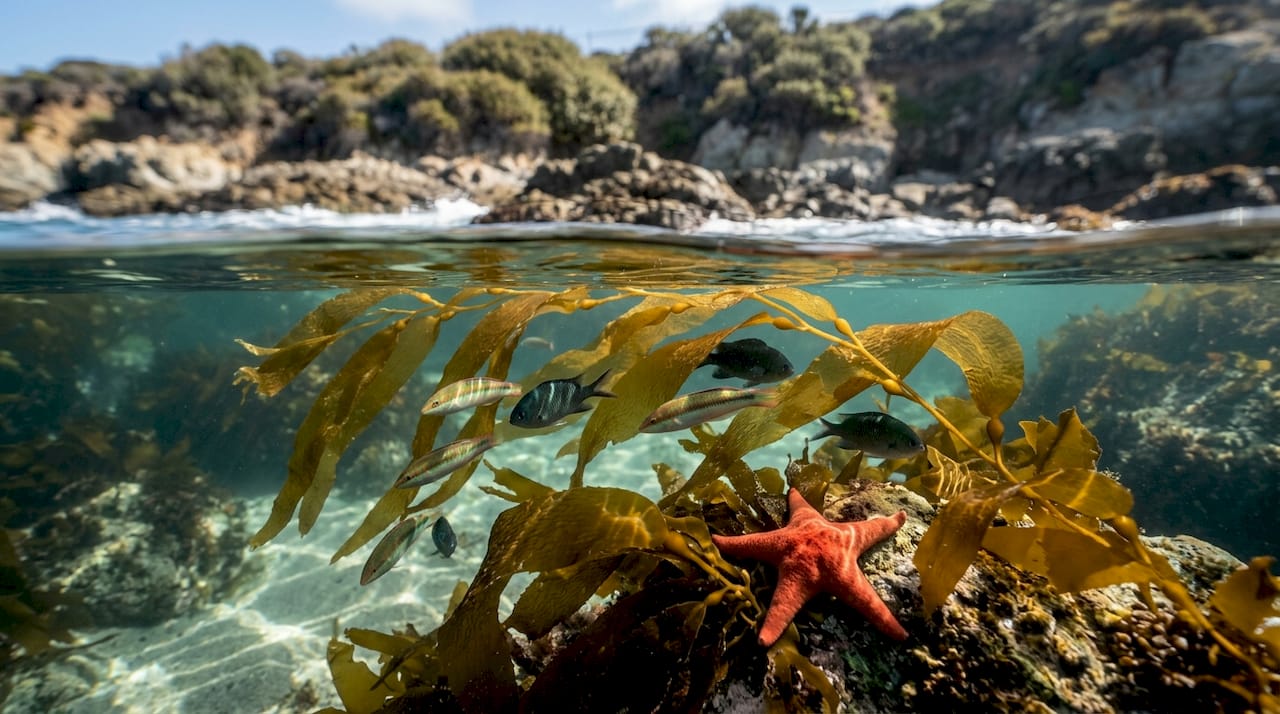
Marine biodiversity preservation is the core ecological rationale for MPAs. Protected zones allow fish populations to recover from overfishing, give coral reefs respite from physical disturbance, and provide refugia for species under climate stress. Fully protected no-take reserves consistently show higher fish biomass, greater species diversity, and healthier habitat structure than adjacent unprotected waters.
Economically, that recovery spills over. Fish from protected areas migrate into surrounding waters, replenishing stocks that support commercial and recreational fisheries. Ecotourism built around healthy reef systems generates revenue for local communities. Cultural heritage protection is another benefit that gets less attention but matters significantly in coastal communities where traditional fishing practices and spiritual connections to the sea are tied to specific marine areas.
Limitations the data reveals
The picture is not uniformly positive. Research published in Nature Ecology and Evolution found that MPAs offset only about 5% of fish population declines in the short term. Benefits are substantially stronger in older, fully protected MPAs, while partial protections and recently designated areas show more modest outcomes.
Climate change compounds this challenge. Broader environmental pressures like ocean warming, acidification, and coastal pollution can reduce MPA effectiveness even where protection is strict. This has led researchers to argue that MPAs should be evaluated within wider seascape management frameworks rather than treated as isolated solutions.
Research from Nature Ecology and Evolution underscores that short-term socio-ecological gains from MPAs are limited, and protecting marine ecosystems effectively requires changes that go beyond simply increasing protected area coverage.
The takeaway is not that MPAs are ineffective. It is that they work best as part of a system rather than as standalone fixes.
How individuals can engage with marine protected areas
You do not need to be a marine biologist or a policymaker to contribute to marine protection. The way you use the water makes a direct difference.
- Know the rules before you go: Whether you are fishing, diving, or boating near protected waters, look up the specific regulations for the area. MPA rules are posted by the managing agency and are often available as downloadable maps.
- Practice catch-and-release in sensitive zones: Even where recreational fishing is permitted, voluntary restraint in ecologically sensitive areas helps maintain the population dynamics that MPAs are designed to protect.
- Choose certified ecotourism operators: Businesses that operate in or near MPAs with certified sustainable practices put a portion of their revenue back into conservation. Operations like those explained through Crab Island marine ecosystem examples show how healthy protected environments directly support wildlife viewing and tourism.
- Get certified before you operate a vessel: A boating safety certification is one of the most practical steps any recreational boater can take. It covers marine environmental awareness, navigation rules, and the legal framework governing protected waters.
- Support MPA expansion advocacy: Many conservation organizations run citizen science programs and advocacy campaigns. Participating adds real data and public weight to protection proposals.
- Report violations: If you observe illegal fishing or environmental damage inside an MPA, report it to the managing agency. Enforcement capacity is limited, and observer reports fill a genuine gap.
My take on what MPAs actually accomplish
I’ve spent time reading through MPA designations and talking to people who work near them, and the most persistent mistake I see is treating “marine protected area” as synonymous with “no-fishing zone.” That framing drives unnecessary opposition from fishing communities and obscures the genuine conversation about what protection actually needs to deliver.
What I’ve found is that the governance structure matters far more than the label. An MPA with a strong management plan, genuine community buy-in, and real enforcement capacity outperforms a strictly designated no-take zone that exists only on a map. The Canadian model, where collaborative management plans require Indigenous participation and public input, is closer to what effective protection looks like in practice.
The climate problem is where I think the field is still catching up. It is genuinely difficult to demonstrate MPA effectiveness in a decade when the water is two degrees warmer than it was when the MPA was designated. Attributing outcomes becomes complicated. That does not mean protection is futile. It means we need to be honest that MPAs are a necessary but insufficient tool, and pairing them with emissions policy, coastal pollution controls, and sustainable fisheries management is not optional.
Expanding MPA coverage is the right direction. But the quality of that coverage matters as much as the quantity.
— Richard
Boating safely in and around marine protected areas
If reading about marine protected areas has made you more curious about how you can use the ocean responsibly, getting certified is the most direct step you can take. Safe Boating America provides state-approved boating certification courses that cover marine environmental awareness, navigation rules near protected zones, and the legal responsibilities every recreational boater carries on the water.
Understanding why boating safety education is mandatory goes beyond passing a test. Certified boaters know how to read restricted-area markers, understand speed limits near sensitive habitats, and operate responsibly in shared waters. Safe Boating America offers online boating courses nationwide, including state-specific programs for Florida, New York, Connecticut, and more. Whether you are new to boating or returning to the water after years away, certification is the practical foundation for responsible marine recreation.
FAQ
What is a marine protected area in simple terms?
A marine protected area is a legally defined section of ocean or coastal water managed to protect its biodiversity while potentially allowing sustainable human activities within specific rules.
Are all marine protected areas no-fishing zones?
No. Most MPAs allow some level of fishing or other activity. Only fully protected no-take reserves prohibit all extractive uses, and they represent a subset of the broader MPA category.
How do marine protected areas benefit fish populations?
Protected zones allow fish stocks to recover from overfishing, and that recovery spills over into adjacent waters, benefiting commercial and recreational fisheries outside the MPA boundaries.
Who manages marine protected areas?
Management varies by country and designation type. In the United States, agencies like NOAA and the National Park Service manage different MPA types. In Canada, Parks Canada oversees National Marine Conservation Areas with mandatory community and Indigenous participation.
Can boaters enter marine protected areas?
Often yes, but under specific rules. Boaters should check the zone classification and local regulations before entering any MPA, as speed limits, anchoring restrictions, and access rules differ by area and vary by region.