Vermont Boating License Requirements: Who Needs a Certificate

Vermont does not issue a “boating license” in the way a driver’s license works. It requires a boating-education certificate. Under Vermont law, a person born after January 1, 1974 may not operate a motorboat on public waters without first obtaining that certificate. You earn it by completing an approved boating-safety course of at least eight hours, or by passing an authorized equivalency exam. The certificate is separate from vessel registration, and you need both.
Below: who is covered, who is exempt, the age limits for boats and personal watercraft, how to get or replace a card, and a short section for readers asking about New Mexico.
TL;DR
- Born after January 1, 1974? You need a Vermont boating-education certificate to operate a motorboat on public waters.
- The course must provide at least eight hours of instruction. The certificate is a lifetime certificate.
- Operators must be 16 to run a personal watercraft (PWC) in Vermont, with or without a certificate.
- Certificate and registration are two different documents. A motor-propelled vessel also needs a Vermont certificate of registration and validation stickers.
- New Mexico uses a boater-education card for operators born on or after January 1, 1989.
Table of Contents
- Do you need a boating license in Vermont?
- Age limits for boats and personal watercraft
- Personal watercraft rules in Vermont
- Certificate versus registration
- How to get a boating license in Vermont
- Replacing a lost certificate
- What if you hold an out-of-state certificate?
- Perspective: why we push for certification before the first launch
- Get certified with Safe Boating America
- New Mexico boating license requirements
- Quick comparison: Vermont and New Mexico
- FAQ
- Sources
Do you need a boating license in Vermont?
If you were born after January 1, 1974 and you operate a motorboat on Vermont’s public waters, yes. The state calls the proof a boating-education certificate. Most people say “boating license” or “boating card,” and all three terms point to the same document in practice.
The rule is tied to your birth date, not to the size of your boat. A small motor on a fishing skiff falls under the same certificate requirement as a larger runabout, as long as the boat is a motorboat on public waters. The statute, 23 V.S.A. § 3305b, is the controlling text.
Who is exempt
The same statute lists exemptions. The requirement does not apply to:
- a U.S. Coast Guard commercial vessel licensee
- a person operating a motorboat on private property
- others the Department of Public Safety exempts
If you were born on or before January 1, 1974, the education requirement does not apply to you by birth date. That does not remove any other rule on safety equipment, registration or operation.
A quick self-check
| Your situation | Certificate needed in Vermont? |
|---|---|
| Born after January 1, 1974, operating a motorboat on public waters | Yes |
| Born on or before January 1, 1974 | Not by the birth-date rule |
| Holding a Coast Guard commercial vessel license | Exempt |
| Operating on private property only | Exempt |
For an age-specific walkthrough, our guide to the January 1, 1974 cutoff and Vermont boating age rules covers the same-day card in more detail.
Age limits for boats and personal watercraft
The certificate is only one part of who may operate what. Vermont also sets minimum ages.
- Motorboats: a person under 12 may not operate a motorboat powered by more than six horsepower on public waters, per 23 V.S.A. § 3305a.
- Personal watercraft: a person under 16 may not operate a PWC, regardless of whether that person has completed boating education, per 23 V.S.A. § 3312a.
The PWC rule matters for families. A teenager who finishes a course at 14 holds a valid certificate, but still cannot ride a Jet Ski or WaveRunner until age 16. Adult supervision does not change that.
For a national comparison of age ranges, see our overview of boating license age rules by state.
Personal watercraft rules in Vermont
PWC operators face a few rules beyond the certificate. Under Vermont’s PWC statute:
- Operators and riders must wear properly secured, Coast Guard-approved wearable life jackets (PFDs).
- A PWC may not operate between sunset and sunrise.
- An installed cutoff-switch lanyard must be attached as appropriate for the craft.
- The operator must be at least 16.
None of these rules depends on whether you hold a certificate. Having the certificate gets you legal to operate. Following the equipment and time-of-day rules keeps you legal on the water. Our PWC safety rulebook summarizes PFD, engine cutoff and certification points that apply across the U.S.
Certificate versus registration
Readers often mix these up. They are different documents with different jobs.
- Boating-education certificate: proves the operator completed safety education.
- Vessel registration: identifies the boat. Vermont Fish & Wildlife states that a Vermont certificate of registration and validation stickers are required to operate a motor-propelled vessel legally on public waters.
Having one does not replace the other. A new boater with a fresh certificate still needs the boat registered, and a registered boat does not make an uncertified operator legal.
How to get a boating license in Vermont
The path is short.
- Confirm you need it. Check your birth date against January 1, 1974 and the exemptions above.
- Choose an approved course. Vermont’s statute says the course must provide at least eight hours of instruction. The law allows offering by approved government agencies, schools, the Coast Guard Auxiliary, U.S. Power Squadrons, or other approved providers.
- Complete the course, or pass an authorized equivalency exam. Either route meets the statute.
- Receive your certificate. Vermont issues a lifetime certificate, so there is no renewal cycle.
- Register the boat separately and display the validation stickers.
Course length varies across states, and what counts toward the hours differs. Our guide to boating course length by state explains how those hours add up.
Online, live and in-person options
Because the statute allows approved providers, many boaters choose the format that fits their schedule. Safe Boating America offers online computer-based courses nationwide, live Zoom classes and in-person classes. Our Vermont boating and PWC certification course online is built for operators who need the Vermont certificate and want to finish from home.
Replacing a lost certificate
Vermont replaces a lost or destroyed certificate without charge when it issued the certificate or has a record of issuance, according to the statute. The state’s replacement page for boating and snowmobile certifications says it issues them to Vermont residents, and submissions generally take 30 to 45 business days to process. The phone number listed there is 802-244-8727. Because processing is not quick, request a replacement well before the season if your card is missing.
What if you hold an out-of-state certificate?
States differ on whether and how they accept cards from elsewhere. The Coast Guard’s state boating law reference is the starting point for the rules of any state you plan to visit. For Vermont, confirm acceptance with Vermont Fish & Wildlife or the Department of Public Safety before you launch, especially if you are a Vermont resident, because the Vermont statute is written around a Vermont certificate. NASBLA approval, shown by the logo on the card or certificate, is the standard many states look for. For example, New Mexico’s guidance accepts NASBLA-approved courses carrying the logo.
Perspective: why we push for certification before the first launch
We teach boating safety for a living, and we see the same pattern in every state. Boaters who wait until a ranger or a marine patrol officer asks for a card are the ones scrambling to find a class in peak season.
Our view is simple. If your birth date puts you under a certificate requirement, finish the course before the boat is in the water. Our instructors are State Certified Instructors and USCG-Licensed Captains, and our courses use NASBLA-approved material. We designed our formats, online, live Zoom and in-person, so a first-time boat owner can pick the one that fits a real schedule.
We also tell families to treat the PWC age rule as a plan, not an obstacle. A teen can complete education early, build knowledge on a boat with an adult, and be ready on the day they turn 16. Education first makes every season on Lake Champlain, Lake Bomoseen or any Vermont lake easier to enjoy.
Richard
Get certified with Safe Boating America
If the Vermont rule applies to you, our online Vermont course is the direct route to the certificate. We also offer live Zoom classes and in-person options for boaters who prefer an instructor.
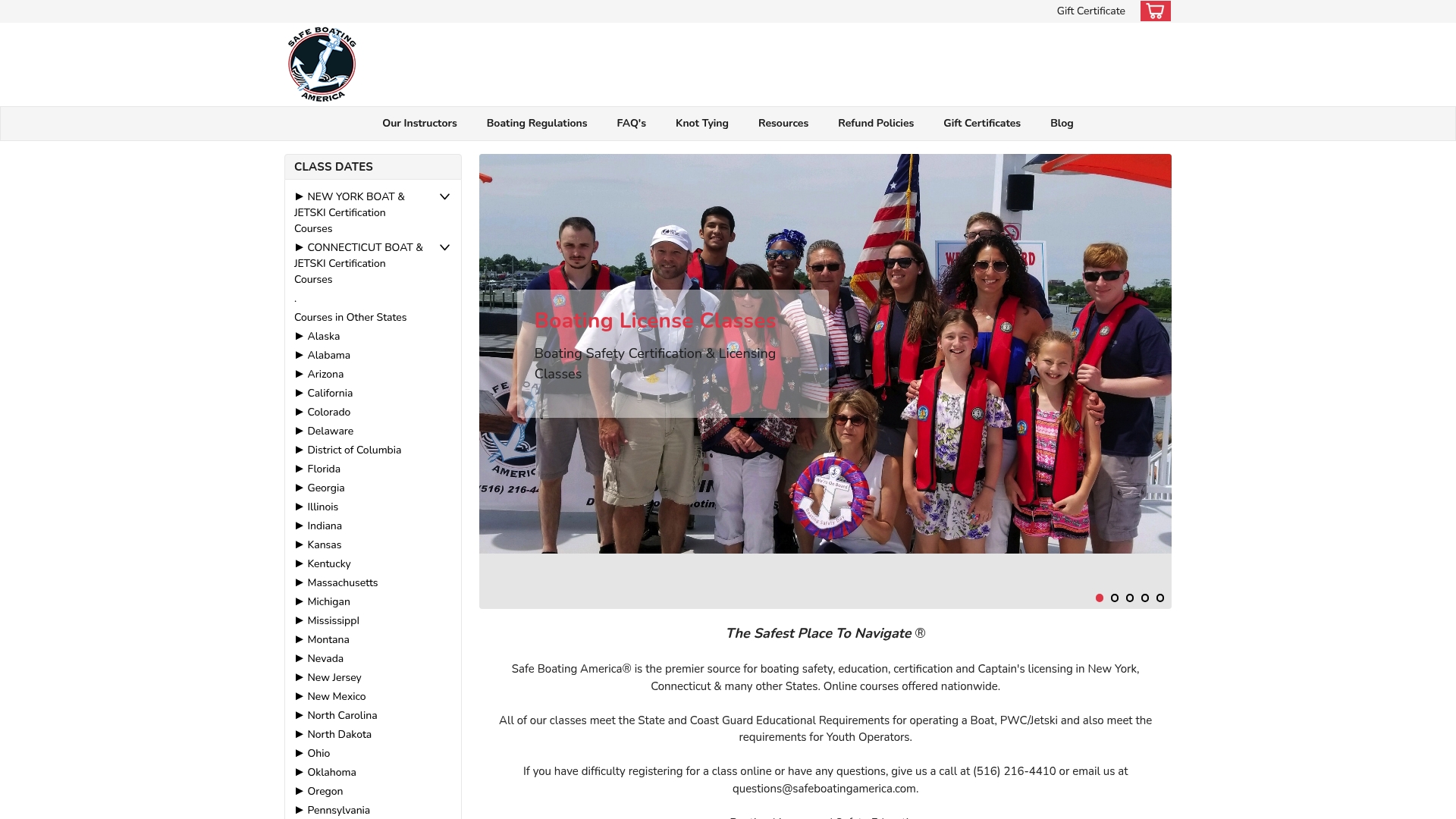
Our Zoom Online 1-Day Class is $75, and details on live and private formats are on the Zoom class page. For nationwide online options, see our online boating safety courses. Know a new boater? A gift certificate for boating education ranges from $75 to $85.
New Mexico boating license requirements
Some readers searching for Vermont rules are also checking New Mexico. The two states take different approaches.
Who needs the card
New Mexico requires a person born on or after January 1, 1989 who operates a motorboat on state waters to possess and carry a division-issued boater-education card, subject to exemptions, under 18.17.4 NMAC. The requirement applies to operators of motor-propelled vessels, including gasoline and electric, and State Parks guidance also lists sailboat operators.
Exemptions
The card is not required for:
- a qualifying U.S. Coast Guard marine operator license holder
- official government operation
- a nonresident carrying a current NASBLA-standard card or certificate
- a boat purchased within the prior 30 days, with proof of purchase
- an authorized rental operation of no more than 30 consecutive days, after receiving the required rental information
These come from the same New Mexico rule.
Getting the card
Pass a state-approved boating-safety course and you receive a completion certificate. State Parks says it serves as temporary proof for 45 days from completion, and the official card is mailed by the online provider or, for a ranger-led classroom course, generally within four weeks. The exam requires at least an 80 percent passing score, per the state rule. The state lists approved providers, and provider fees are set by the provider.

Age and PWC rules in New Mexico

A person under 13 may not operate a motorboat unless an adult is supervising on board, according to 18.17.2 NMAC. The same rule defines a PWC as a class A motorboat under 16 feet designed for the operator to sit, stand or kneel on, such as a Jet Ski, Sea-Doo or WaveRunner. On the water, State Parks’ equipment guidance requires every person on a PWC to wear a Coast Guard-approved wearable PFD, requires the operator to use the engine-cutoff link when equipped, and requires a PWC rated for at least three people plus an onboard observer for towing. It also treats registration, certificate of number, registration numbers and the education card as separate onboard requirements.
Quick comparison: Vermont and New Mexico
| Item | Vermont | New Mexico |
|---|---|---|
| Who needs education | Born after January 1, 1974 | Born on or after January 1, 1989 |
| Course length | At least eight hours | Approved course or exam, 80 percent to pass |
| Document | Lifetime certificate | Division-issued card, 45-day temporary proof |
| PWC minimum age | 16 | Under 13 needs adult supervision |
| Registration | Separate, with validation stickers | Separate |
FAQ
Do I need a boating license in Vermont if I was born before 1974?
Not under the birth-date rule. Vermont’s education requirement applies to people born after January 1, 1974. You still must follow registration, equipment and PWC rules, and a PWC operator must be at least 16.
How long does the Vermont boating course take?
The course must provide at least eight hours of instruction, per Vermont statute. You can also qualify by passing an authorized equivalency examination. Approved providers include government agencies, schools, the Coast Guard Auxiliary, U.S. Power Squadrons and other approved providers.
Does the Vermont certificate expire?
No. Vermont issues a lifetime certificate. If you lose it, Vermont replaces it without charge when it issued the certificate or has a record of issuance. Allow 30 to 45 business days for processing.
Can a 15-year-old run a Jet Ski in Vermont?
No. A person under 16 may not operate a personal watercraft in Vermont, even with a certificate and even with adult supervision. A 15-year-old can complete boating education now and be ready at 16.
Is boat registration the same as a boating license?
No. The certificate shows operator education. Registration identifies the vessel, and Vermont requires a certificate of registration and validation stickers for motor-propelled vessels on public waters.
Sources
- 23 V.S.A. § 3305b, Boating safety education
- 23 V.S.A. § 3305a, Privilege to operate a vessel
- 23 V.S.A. § 3312a, Operation of personal watercraft
- Boating in Vermont, Vermont Fish & Wildlife Department
- State Boating Laws, U.S. Coast Guard
- 18.17.4 NMAC
- 18.17.2 NMAC
- Boating Education, New Mexico State Parks
- Required Safety Equipment, New Mexico State Parks