Get RIDEM Certified Fast: Who Needs a Rhode Island Boating Certificate
Rhode Island requires a Certificate of Boating Safety Education, not a traditional “license,” for anyone born on or after January 1, 1986 operating a motorboat over 10 horsepower. Every personal watercraft operator needs one too, regardless of birth year or residency. Your next move: enroll in an RIDEM-approved course or confirm eligibility for the proctored challenge exam.
TL;DR:
- If you were born on or after January 1, 1986, you need a Certificate of Boating Safety Education to operate a motorboat over 10 HP or any personal watercraft in Rhode Island.
- The certification process requires completing a RIDEM-approved course or passing a proctored challenge exam, with a passing score of at least 70%.
- Online courses may involve a separate scheduling step for the proctored exam, which is crucial for certification validity.
- Non-residents boating more than 90 days must meet Rhode Island’s certification requirements, regardless of out-of-state credentials, especially for PWC operators.
- The certification is generally quick and affordable, with most providers issuing the official certificate the same day after passing the exam.
Table of Contents
- How Do I Get a Rhode Island Boating License?
- Who Actually Needs This Certificate?
- What Are the Approved Paths to Certification?
- How Does the Proctored Challenge Exam Work?
- Does an Out-of-State License Count in Rhode Island?
- What Does Certification Cost and How Long Does It Take?
- How Should I Study for the Rhode Island Boating Exam?
- Why Approved Instruction Matters Beyond the Legal Requirement
- Get Certified Through Safe Boating America
- Sources
- FAQ
How Do I Get a Rhode Island Boating License?
Getting certified follows a predictable path. Here’s the sequence most people follow, from zero to certificate in hand:
- Choose your course format. Pick a classroom session or a NASBLA-approved online course through a state-recognized provider.
- Complete the required material. Work through the full curriculum, whether that’s a single classroom day or self-paced online modules.
- Pass the exam. Classroom courses typically test at the end of the session; online students may need to schedule a proctored challenge exam separately.
- Get your certificate. RIDEM issues the official Certificate of Boating Safety Education once you pass, and you’ll need to carry proof of it whenever you’re on the water.
Skipping step three because you finished the online lessons is the most common mistake. Rhode Island’s requirement isn’t satisfied until the exam is actually proctored and passed.
Who Actually Needs This Certificate?
The birthdate rule is the foundation of Rhode Island’s boating law, but a few edge cases trip people up every season.
- Anyone born on or after January 1, 1986 needs certification to operate a motorboat over 10 HP.
- Every PWC operator needs the certificate, with no exception for age or where you live.
- Minors can sometimes operate under direct, on-board supervision of a certified adult, but that supervisor must stay present and hold valid certification.
- Non-residents boating in Rhode Island waters for more than 90 days must meet the same state certification requirement as residents.
If you were born before 1986 and only operate a traditional motorboat, you’re exempt from the classroom or exam requirement, though PWC use still requires certification no matter your age.
What Are the Approved Paths to Certification?
Rhode Island accepts two education routes, and RIDEM requires both to meet NASBLA standards.
- Classroom courses run in-person under instructor supervision, cover the required hours in a single condensed session, and end with a test administered on-site.
- NASBLA-approved online courses let you study at your own pace, often with automatic completion reporting, though many still require a separately scheduled proctored exam before certification is final.
- Approved providers coordinate directly with RIDEM to issue the durable, NASBLA-compliant certificate once you pass, so there’s no separate paperwork step on your end.
Classroom instruction suits younger or less experienced boaters best, since hands-on discussion tends to stick better than a screen. Online courses win on flexibility for adults juggling work schedules, but they demand more self-discipline to actually finish.
Pro Tip: Confirm with your provider whether the proctored exam is bundled into your course or scheduled as a separate appointment. Assuming it’s automatic is how people show up at the marina without valid certification.
How Does the Proctored Challenge Exam Work?
If you’re skipping formal coursework, Rhode Island allows a challenge exam administered under certified instructor supervision.
- Schedule your exam through a certified instructor or approved testing site.
- Bring valid photo ID and any documentation your provider requires at check-in.
- Sit for the test. Rhode Island statute §46-22-9.8 sets a required passing score of 70%.
- Retake if needed. Most providers allow rescheduling within days rather than weeks if you don’t pass on the first attempt.
Proctors administer the exam the same way whether you challenged it cold or finished an online course first.
Does an Out-of-State License Count in Rhode Island?
Reciprocity in Rhode Island has real limits, especially for personal watercraft.
- Holders of a valid USCG commercial license (master, mate, or similar) are exempt from the state certificate for non-PWC operation, but must carry that commercial license as proof.
- Non-residents boating in Rhode Island past the 90-day mark must obtain Rhode Island certification, even if their home state already certified them.
- PWC operators get no exemption at all. Rhode Island requires its own certificate regardless of what credential you’re carrying from another state.
- If you’re trailering a boat or PWC into Rhode Island for a trip, keep your certificate or commercial license physically accessible; enforcement officers can ask for it on the water.
What Does Certification Cost and How Long Does It Take?
Budgeting time and money for certification is straightforward once you know the moving parts.
- Online courses generally run cheaper than classroom sessions, though proctoring or processing fees sometimes apply on top of the base course price.
- Classroom formats often compress everything into a single day; online courses spread study time across several hours you can split up over days or weeks.
- Scheduling a proctored exam adds a step, but most testing sites offer sessions weekly.
Statistic Callout: Rhode Island’s statute sets the passing threshold at 70%, one of the clearer benchmarks in state boating law and a useful number to know before you sit down for any exam format.
Once you pass, RIDEM typically issues the durable certificate soon after, and many approved providers can confirm completion electronically the same day.
How Should I Study for the Rhode Island Boating Exam?
RIDEM publishes a free electronic study guide covering everything the exam draws from, and it’s worth working through before test day regardless of which path you chose.
- Focus study time on navigation rules, PWC-specific operation, required safety equipment, and emergency response procedures. These topics dominate the exam.
- Run through practice tests if your provider offers them; repetition on rules-of-the-road questions tends to matter more than raw study hours.
- A short hands-on session with an experienced boater before your exam builds practical confidence that pure reading can’t.
Pro Tip: Ask your provider for a proctoring checklist ahead of time. Knowing exactly what ID and paperwork to bring eliminates the single most common reason people get turned away at test sites.
Why Approved Instruction Matters Beyond the Legal Requirement
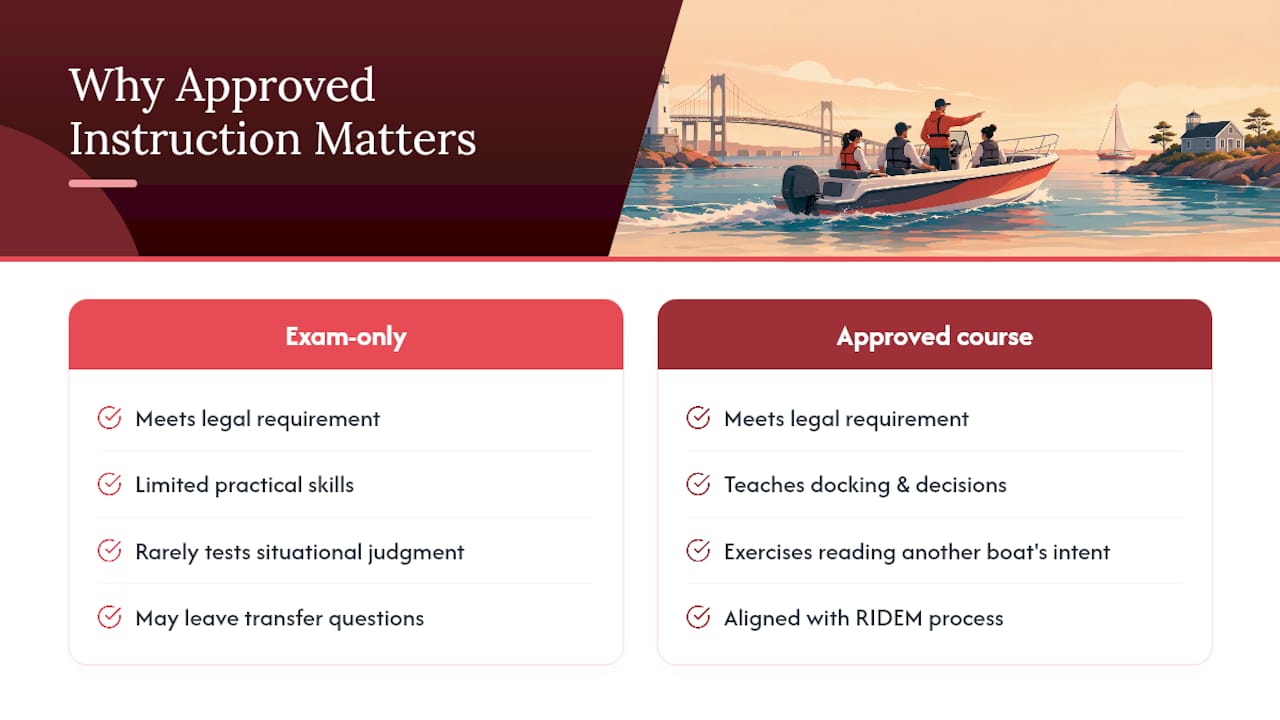
Passing an exam gets you legal on the water. It doesn’t automatically make you a safe operator, and that gap is where structured courses earn their value. Classroom instruction forces contextual decisions, docking under pressure, reading another boat’s intent, that a challenge exam alone rarely tests.
Rhode Island’s strict PWC rule, no exceptions for age or residency, reflects where enforcement attention actually concentrates. Working with a provider aligned to RIDEM’s process also means fewer surprises: no wondering if your certificate transferred correctly or your exam counted.
— Richard
Get Certified Through Safe Boating America
Safe Boating America gives you a direct path through Rhode Island’s certification requirements without the guesswork of piecing together course and exam logistics yourself. Our state-approved Rhode Island course meets RIDEM and NASBLA standards, and we coordinate the proctored exam scheduling so you’re not left figuring out where or when to sit for it.
Courses run online, via live Zoom instruction, or in-person, taught by state-certified instructors and USCG-licensed captains who know Rhode Island’s specific requirements cold. Many students complete their course and exam in a single session and receive same-day certification confirmation. Visit our Rhode Island boating license page to pick a schedule that fits your timeline, whether that’s this weekend or before your next trip to the water.
Sources
For direct verification, RIDEM’s boating safety certification page covers requirements and exemptions, while its boating exams page details proctoring standards. The governing statute, Rhode Island General Laws §46-22-9.8, codifies the certificate requirement, passing score, and exemptions. Rhode Island State Parks also publishes boating and fishing safety guidance covering non-resident rules.
- Boating Safety Certification | Rhode Island Department of Environmental Management
- 2024 Rhode Island General Laws Title 46 - Certificate of boating safety education
- Boating & Fishing Safety | Rhode Island State Parks
FAQ
Do I need a boating license in Rhode Island?
You need a Certificate of Boating Safety Education if you were born on or after January 1, 1986 and operate a motorboat over 10 HP, or if you operate any personal watercraft regardless of age or residency.
How do I get a boating license in Rhode Island?
Complete a classroom or NASBLA-approved online course, pass the required exam with a score of at least 70%, and RIDEM will issue your certificate once you pass.
What states have boating license reciprocity with Rhode Island?
Rhode Island generally honors other states’ NASBLA-approved certificates for the first 90 days you’re in state waters, but PWC operators must hold Rhode Island’s own certificate regardless of any out-of-state credential.
What states don’t require a boating license?
Requirements vary widely by state and mostly hinge on birth year, vessel horsepower, and whether you’re operating a personal watercraft; Rhode Island applies its rule to anyone born on or after 1986 plus all PWC operators, so check each state’s specific cutoff before assuming an exemption applies.