Texas Boating License: Who Needs One and How to Get It
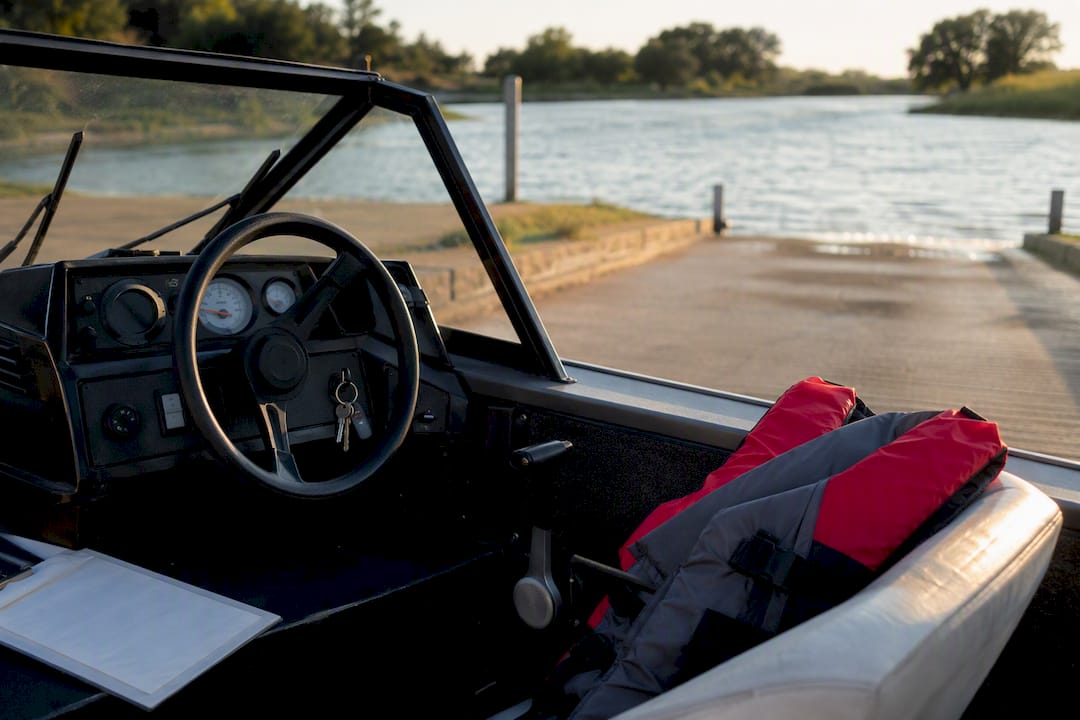
If you were born on or after September 1, 1993, Texas law requires you to complete boater education before operating a personal watercraft (PWC), a motorboat over 15 horsepower, or a windblown vessel over 14 feet. The fastest way to comply is to finish a TPWD-approved boater education course online, via Zoom, or in person, or to present a U.S. Coast Guard vessel operator license as equivalency.
Once you’re certified, you need to carry proof while underway.
- Your birthdate determines whether the law applies to you, not your experience level.
- A TPWD-approved course or USCG license equivalency satisfies the requirement.
- You must carry your boater ID card (or USCG proof) plus valid photo ID on the water.
Quick fact: Texas’s education mandate applies specifically to PWCs, motorboats over 15 hp, and sailboats or windblown vessels longer than 14 feet, according to the Texas Parks and Wildlife Department (TPWD).
Key Takeaways
Texas requires boater education for anyone born on or after September 1, 1993 who operates a PWC, a motorboat over 15 horsepower, or a windblown vessel over 14 feet, and carrying proof while underway is legally required, not optional.
| Point | Details |
|---|---|
| Check your birthdate first | The September 1, 1993 cutoff, not your boating experience, determines whether you legally need certification. |
| Complete a TPWD-approved course | Online, Zoom, and in-person formats all count as long as the provider carries TPWD and NASBLA approval. |
| Carry proof every time | Bring your boater ID card or USCG license proof plus a valid photo ID whenever the vessel is underway. |
| Don’t rely on rental exemptions | The requirement follows the operator, not the boat’s owner or the rental counter’s assumptions. |
| Register with Safe Boating America | Safe Boating America offers TPWD-accepted, NASBLA-aligned courses with instant temporary certification. |
Table of Contents
- Who Needs a Texas Boater Certificate?
- How to Enroll and Get Your Texas Boater ID
- What to Carry on the Water and How Long It Takes
- Penalties for Skipping Texas Boater Education
- How Safe Boating America Gets You Certified Fast
- Do Rentals and Guests Need Their Own Certification?
- Does the Vessel Type Change What License You Need?
- What the Conventional Advice Gets Wrong
- Get Certified Through Safe Boating America
- Sources
- FAQ
Who Needs a Texas Boater Certificate?
The birthdate cutoff is the whole ballgame. If you were born on or after September 1, 1993, and you plan to operate a PWC, a motorboat rated above 15 horsepower, or a sailboat or windblown vessel longer than 14 feet, Texas requires you to hold a boater education certificate before you touch the throttle. Anyone born before that date is exempt from the education requirement, though nothing stops them from taking a boating safety course in Texas anyway.
Age rules stack on top of the birthdate rule. According to TPWD’s own guidance, operators must generally be at least 13 years old to run a covered vessel alone, and no one under 13 may operate a PWC unless a person 18 or older who has completed boater education rides along and stays within arm’s reach. There’s no minimum age to ride as a passenger.
A few situations still trip people up:
- Renting a boat does not exempt you. The requirement follows the operator, not the vessel owner.
- Courts can order boater education as a condition of resolving a citation, even for someone who claims exempt status.
- Guests operating someone else’s boat still need certification if they meet the age and birthdate criteria.
- Sailboats and windblown vessels under 14 feet fall outside the mandate, but larger sailboats do not.
How to Enroll and Get Your Texas Boater ID
Getting certified takes less time than most people assume. Here’s the sequence that gets you legally compliant with the least friction.
- Pick a TPWD-certified, NASBLA-approved course. Not every course marketed online meets Texas standards. TPWD only recognizes courses that pass its review and meet National Association of State Boating Law Administrators (NASBLA) benchmarks, so confirm the provider’s Texas approval before you pay for anything.
- Choose your format. Online self-paced, live Zoom instruction, and in-person classroom sessions are all accepted, provided the course carries TPWD certification. Pick whichever fits your schedule; the state doesn’t rank one format above another.
- Complete the coursework and pass the final test. Expect content on navigation rules, required safety equipment, emergency procedures, and Texas-specific boating law.
- Receive your temporary certificate immediately. Once you pass, TPWD-certified providers issue a temporary completion certificate valid for about 60 days, which you can print or save to your phone right away.
- Wait for your permanent record. TPWD typically adds your permanent certification to its system within about two weeks. After that, your boater ID card is on file and doesn’t expire.
If you already hold a U.S. Coast Guard vessel operator license, you can skip the course entirely. TPWD accepts that credential as equivalency, but you still need to carry proof of the license along with photo ID whenever the vessel is underway.
Pro Tip: If you need to get on the water before you can finish a full course, Texas allows a one-time 15-day boater education deferral, purchased anywhere fishing and hunting licenses are sold. It buys you time. It doesn’t replace the requirement.
What to Carry on the Water and How Long It Takes
Two documents matter every time you launch: a valid photo ID and either your TPWD boater ID card or proof of USCG license equivalency. Game wardens can and do check both during routine stops, so a temporary certificate saved as a photo on your phone works just as well as a printed copy.
Timing matters here too. Your temporary certificate covers you for roughly 60 days after course completion, and your permanent record lands in TPWD’s system in about two weeks. Renew nothing after that. The Texas boater ID card doesn’t expire once it’s issued, so this is a one-time certification, not an annual renewal like a fishing license.
Rental counters are where compliance breaks down most often. Marina staff renting you a boat aren’t verifying your certification status, and their willingness to hand you the keys doesn’t mean you’re covered. The obligation follows the operator, not the vessel’s owner or renter, which is exactly the misunderstanding that generates the most citations.
- Photo ID plus boater ID card (or USCG proof) is non-negotiable while underway.
- A phone photo of your temporary certificate satisfies the carry requirement.
- Rental agreements don’t override the state’s education mandate.
- The 15-day deferral is a stopgap, not a substitute for certification.
- Courts may grant up to a 90-day window to complete a course after a citation.
Penalties for Skipping Texas Boater Education
Operating without required documentation isn’t a paperwork technicality. Failing to carry your boater ID card and photo ID, or operating a covered vessel without completing education at all, is a Class C misdemeanor under Texas Parks and Wildlife Code §31.109. That statute also gives courts room to work with first-time violators: a judge can defer proceedings for up to 90 days, letting you complete an approved course and get the charge dismissed instead of paying a fine.
The mistakes that land people in that situation are predictable:
- Leaving the certification card at home or never saving a digital copy.
- Assuming a rented boat comes with an automatic exemption.
- Enrolling in a course that isn’t TPWD-certified or NASBLA-approved, which won’t satisfy the requirement no matter how official it looks.
- Waiting until a citation forces the issue instead of certifying ahead of time.
Getting certified before you ever need the 90-day court window is simpler than betting on leniency.
How Safe Boating America Gets You Certified Fast
Safe Boating America delivers TPWD-accepted, NASBLA-aligned boater education courses nationwide, with Texas-focused registration built for exactly this requirement. Courses run online, through live Zoom sessions, or in person, taught by state-certified instructors and USCG-licensed captains who cover navigation rules, required safety equipment, and Texas-specific law.
Boater education isn’t just a legal checkbox. NASBLA-approved training consistently covers the navigation rules, emergency procedures, and state-specific laws that keep operators and passengers safer on the water, which is why TPWD encourages certification even for boaters who fall outside the mandatory age window.
Here’s what to expect after you register for a Texas-accepted boating safety course:
- Complete the coursework at your own pace or in a scheduled Zoom or classroom session.
- Pass the final exam covering safety equipment, navigation, and Texas law.
- Receive your temporary certificate the moment you pass, valid for about 60 days.
- Your permanent certification lands in TPWD’s system in roughly two weeks.
Pro Tip: Save your temporary certificate to your phone the day you finish. It’s the document you’ll actually be showing a game warden, not the permanent card that arrives later.
Do Rentals and Guests Need Their Own Certification?
Beyond the education certificate itself, Texas ties several equipment rules to the same statute that governs who must be certified. Every vessel covered by the education mandate also falls under required safety equipment rules: PWCs must carry a Coast Guard-approved life jacket for every rider, and PWC operators and passengers must wear one at all times, not just stow it onboard. Motorboats above 15 horsepower need fire extinguishers, sound-producing devices, and navigation lights for operation after dark or in reduced visibility.
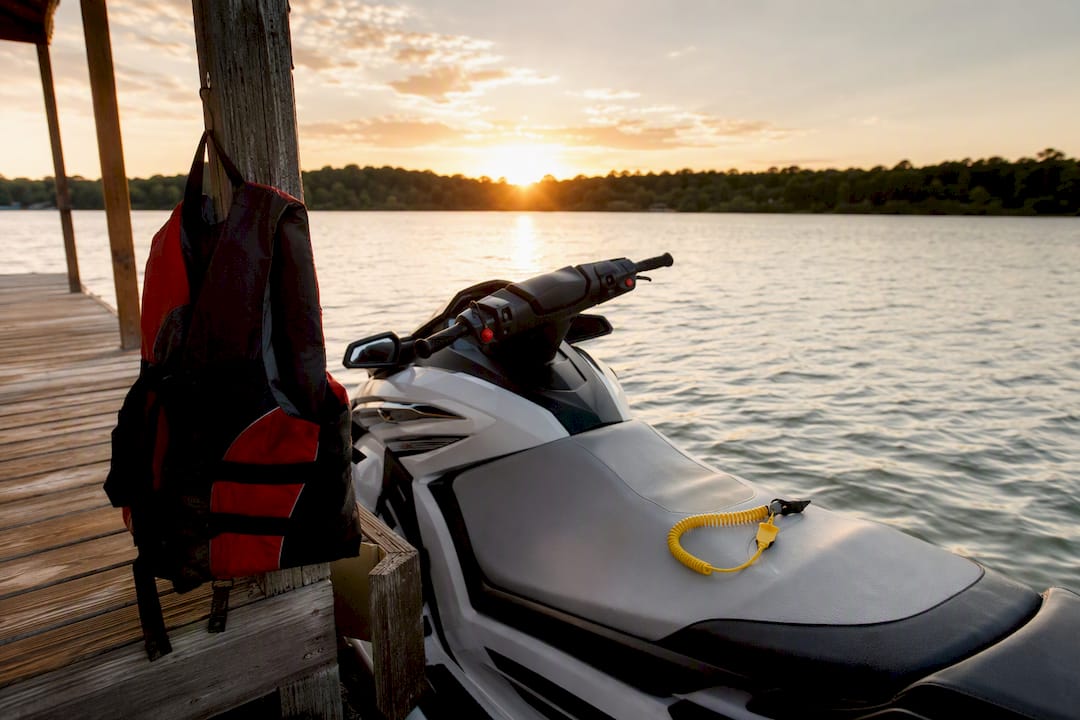
None of this is separate from your certification. TPWD-approved courses build these safety equipment requirements directly into the curriculum, so completing the course means you already know what has to be aboard before you leave the dock. Game wardens checking your boater ID card during a water stop will often check equipment compliance in the same encounter, so treating the two as connected rather than separate obligations saves you a second violation on top of a documentation one.
Kill switches deserve a specific mention. Federal rules now require an engine cutoff switch lanyard on many smaller motorboats built after 2017, and Texas enforces that alongside its own education mandate. If your course covered general equipment rules but you bought your boat used or secondhand, double check that the kill switch is present and functional. It’s a five-dollar part that generates real citations when it’s missing.
Does the Vessel Type Change What License You Need?
Texas doesn’t issue different certification levels for different boats. One boater education certificate, once earned, covers every vessel type the mandate applies to: PWCs, motorboats over 15 horsepower, and sailboats or windblown vessels over 14 feet. There’s no separate “PWC-only” card and no advanced tier for larger motorboats.
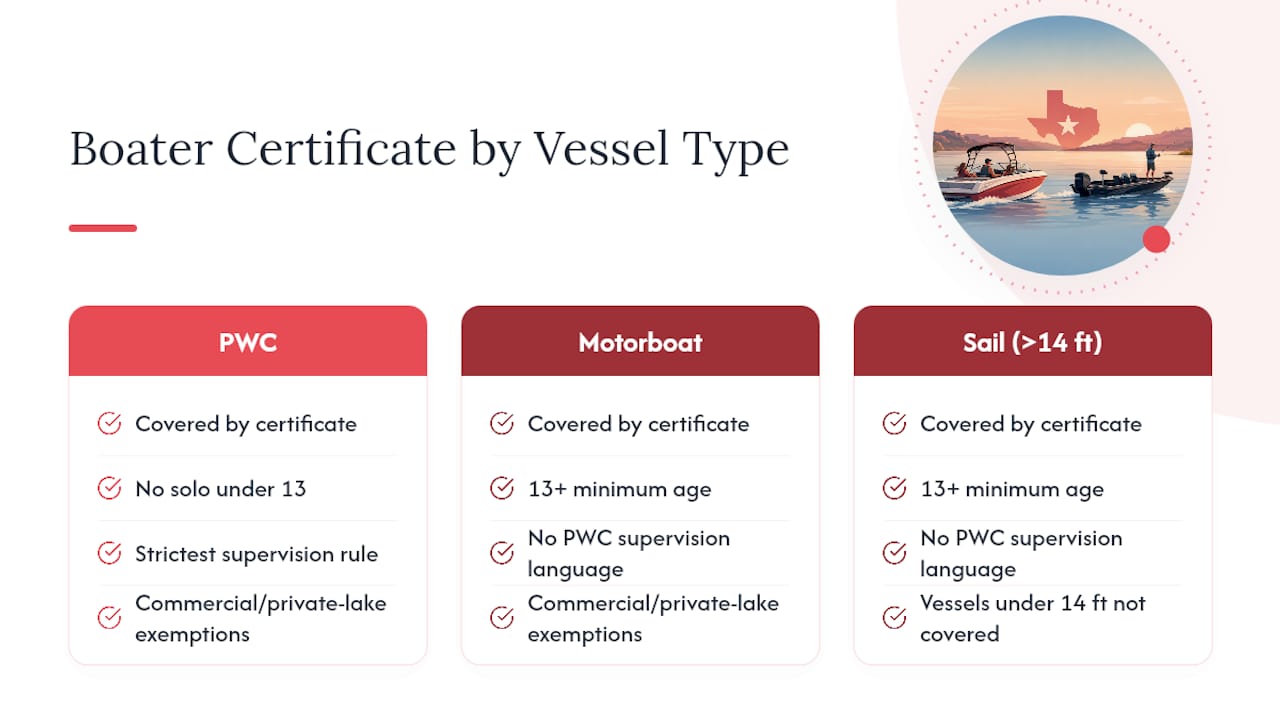
Where the rules genuinely diverge is age and supervision, not licensing tier. PWC operators face the strictest supervision requirement: no one under 13 may run one solo, period. Larger motorboat operators face the general 13-year minimum but without the PWC-specific supervision language. Sailboats and windblown vessels under 14 feet aren’t covered by the mandate at all, regardless of the operator’s age or birthdate, which surprises people who assume all sailing requires certification.
Commercial vessels and vessels used exclusively on private lakes may carry separate exemptions, but for the recreational motorboats, PWCs, and sailboats most Texans actually own or rent, one course and one certificate cover the requirement completely. If you’re unsure whether your specific vessel qualifies, TPWD’s boater education FAQ addresses edge cases like antique boats, documented vessels, and out-of-state visitors bringing their own watercraft into Texas waters.
What the Conventional Advice Gets Wrong
Most guidance on this topic treats Texas boater education like a bureaucratic hurdle to clear once and forget. That framing misses what actually causes trouble on the water: people treat the certificate as the finish line instead of the documentation habit. You can be fully certified and still get cited under §31.109 simply because you left your card in a truck console or never saved a digital copy after your temporary certificate expired.
The overlooked variable is timing discipline, not eligibility confusion. Almost everyone born after 1993 already knows the rule applies to them. What trips people up is the gap between finishing a course and having usable proof on the water, especially during that 60-day temporary window before the permanent record posts. My honest read: don’t wait for a rental counter, a court deadline, or a citation to force the issue. Get certified before the season starts, screenshot the certificate the day you receive it, and treat the card the same way you treat your driver’s license, something you check for before you leave, not after a warden asks for it.
Get Certified Through Safe Boating America
Safe Boating America is a direct way to knock out your Texas boater education requirement without hunting through unverified course listings or guessing which provider actually meets TPWD’s certification standards. Courses run online, live via Zoom, or in person, taught by state-certified instructors and USCG-licensed captains, and you can complete the coursework on your own schedule instead of blocking out a weekend for a classroom session.
The moment you pass the final test, you get a temporary certificate you can save or print immediately, so you’re covered on the water while your permanent TPWD record processes over the following two weeks. That means no waiting period between finishing the course and being legally allowed to operate. If you’re weighing your options for completing boater education, the online format gets you certified fastest without sacrificing the NASBLA-approved content Texas requires. Register for the Texas-accepted online boating course today and have your temporary certificate in hand before your next trip to the lake.
Sources
- Mandatory Boater Education — Texas Parks & Wildlife Department
- Boater education online courses — Texas Parks & Wildlife Department
- Tex. Parks & Wild. Code §31.109 — Boater education course required for certain persons
FAQ
Do You Need a Boating License in Texas?
Texas doesn’t issue a traditional license, but anyone born on or after September 1, 1993 needs a boater education certificate to operate a PWC, a motorboat over 15 horsepower, or a windblown vessel over 14 feet.
What Is the Texas Boating License Age Requirement?
Operators generally must be at least 13 to run a covered vessel alone, and no one under 13 may operate a PWC solo under any circumstances.
How Long Does It Take to Get a Texas Boating Certificate?
You receive a temporary certificate immediately after passing your course, valid for about 60 days, while your permanent TPWD record typically posts within two weeks.
Can I Rent a Boat in Texas Without a Boater Certificate?
No. The certification requirement follows the operator regardless of whether the vessel is owned or rented, and rental counters don’t verify your compliance for you.
What Happens if I Get Caught Boating Without Certification?
Operating without required documentation is a Class C misdemeanor under Texas Parks and Wildlife Code §31.109, though courts can grant up to a 90-day window to complete a course and dismiss the charge.
Does a USCG License Count as a Texas Boating Certificate?
Yes. TPWD accepts a U.S. Coast Guard vessel operator license as equivalency, provided you carry proof of that license along with photo ID while underway.
Where Can I Take a TPWD-Approved Boating Safety Course?
Safe Boating America offers TPWD-accepted, NASBLA-aligned courses online, via Zoom, and in person, taught by state-certified instructors and USCG-licensed captains.
Recommended
- Boat Captain License: Requirements and How to Get One - Safe Boating America
- Illinois Boating License: Requirements and How to Get Certified - Safe Boating America
- 50-State Boating License & Jet Ski Certification Guide (2026) - Safe Boating America
- License for a Jet Ski: State Requirements and How to Get Certified - Safe Boating America