NASBLA-Approved States: Where Your Boating Course Counts

There is no single list of “NASBLA-approved states.” NASBLA, the National Association of State Boating Law Administrators, approves courses. Each state then decides which approved courses it accepts, who must take one, and whether it honors a certificate earned elsewhere. This guide explains both layers, gives verified examples from state agencies, and shows how to confirm that your certificate is valid before you launch. Safe Boating America offers state-approved boating license and PWC courses online, on Zoom and in person for every state.
TL;DR
- NASBLA approves courses against a national standard. States approve providers separately, so approval in one state does not automatically mean acceptance in all.
- Who must be certified depends on the state: by birth date, engine horsepower, vessel type, age, or all operators.
- Reciprocity is decided state by state. Some accept any NASBLA-approved certificate, others add conditions such as a proctored exam.
- PWC (Jet Ski, WaveRunner) rules are often stricter than boat rules, even in states with no general requirement.
- Check your state agency’s page for the course and the rule before you pay for a class.
Table of Contents
- What NASBLA approval means
- Which states require boating education
- States with no general requirement
- Reciprocity: will your certificate travel?
- How to confirm your course is accepted: step by step
- PWC, Jet Ski and WaveRunner operators
- Choosing a format
- Get certified with Safe Boating America
- Our view on approval
- FAQ
- Sources
What NASBLA approval means
NASBLA sets the national standard for recreational boating education. Every NASBLA-approved course must meet the ANSI/NASBLA Basic Boating Knowledge Standards, including ANSI/NASBLA 100-2022 (Core) and 103-2022 (Plus Power), both effective June 1, 2022. The same page explains that a provider launching an already-approved course in additional states must submit its materials to each state’s boating agency for that state’s own review.
That is the second layer. Virginia shows how it works: its wildlife agency says the requirement is met by completing a NASBLA-approved course that the agency accepts. Classroom NASBLA courses there run 6 to 8 hours, and the state keeps its own list of accepted classroom and internet providers.
In practice, a course carries two checks:
| Layer | Who decides | What it confirms |
|---|---|---|
| National | NASBLA | Content meets the ANSI/NASBLA standard |
| State | Your state boating agency | The provider is accepted for that state’s requirement |
For more on the meaning of the approval, see our guide to what a NASBLA-approved course means and what counts as an approved boating course.
Which states require boating education
Most states require education for some operators, and the trigger differs. The common triggers are:
- Birth date: operators born after a set year must be certified, which phases the rule in over time.
- Horsepower: the rule applies above a motor size.
- Vessel type: PWCs, and sometimes sailboats above a length.
- Age: youth operators must be certified or supervised.
- All operators: no exemption by age or experience.
The examples below come from state agencies, so you can see how much the rules vary.
| State | Who must hold a certificate | Source |
|---|---|---|
| Hawaii | Anyone operating a motorized vessel in state waters, with a NASBLA- and state-approved course and proof on demand; PWC operators must be certified and no one under 15 may operate a PWC | Hawaii DOBOR |
| North Carolina | Anyone born on or after January 1, 1988 operating a vessel with a motor of 10 HP or more | NC Wildlife Resources Commission |
| Texas | Anyone born on or after September 1, 1993 operating a motor over 15 horsepower or a windblown vessel over 14 feet | Texas Parks & Wildlife |
| Louisiana | Anyone born after January 1, 1984 operating a motorboat over 10 hp or a PWC | Louisiana Wildlife and Fisheries |
Texas adds details worth knowing. No one may operate a PWC or a motorboat over 15 hp unless they are at least 13 and have completed the course, or are supervised by a qualified adult 18 or older on board. A USCG vessel operator’s license also satisfies the course requirement. Louisiana exempts USCG-licensed captains, and youth under 10 may take the course but not be certified.
New York is a case where the rule is broad. Brianna’s Law brought New York’s boating safety certificate requirement to operators of motorized vessels, and our New York courses are built to meet it. Many New York students can also add a boating endorsement to their NYS driver’s license.
Rules also change. The national summary table of mandatory education, last marked current as of January 1, 2016, is a useful map of birth-date triggers and PWC-all-ages states, but your state agency’s page is the authority for today’s rule.
States with no general requirement
Some states have no general boater education requirement. NASBLA’s course dashboard, for example, lists Wyoming as having no state requirement. That does not always mean no rules apply. The Personal Watercraft Industry Association’s state rules page shows how PWC rules can differ from boat rules:
- Alaska: no age restriction and no boater education requirement.
- Wyoming: minimum PWC age of 16, no boater education requirement.
- Montana: PWC education required only for persons 13 to 14.
- South Dakota: PWC education required for persons born after 1/1/89.
Utah is another example. It requires a youth certification course for PWC operators ages 12 to 17, and an annual mussel awareness course applies to all boaters, resident or nonresident, motorized or not, according to Utah Outdoor Recreation.
Even where nothing is required, a course remains a practical step for anyone who will trailer a boat to another state, charter, or rent a PWC. A NASBLA-approved certificate is the document most other states look for.
Reciprocity: will your certificate travel?
Reciprocity means one state recognizing a certificate issued by another. It is not uniform. The Coast Guard’s education reciprocity table shows each state answering individually. Alabama accepts any NASBLA-approved certificate from any state in lieu of its own. Colorado accepts a certificate if the course was proctored.
Two more official examples:
- Hawaii: a NASBLA-approved basic boating safety course from another state, a U.S. territory or Canada may qualify for reciprocity.
- Ohio: any boater certificate or card is accepted, including from another state or U.S. territory, if it shows the holder’s name, address, date of birth and the NASBLA logo with language indicating NASBLA and USCG approval.
Two practical points follow. First, the certificate’s details matter: name, date of birth and the NASBLA mark. Second, the rule that counts is the rule of the water you are on. Our guide to verifying NASBLA reciprocity before you launch covers the check in detail.
Outside the U.S., requirements and passenger rules differ again. Even basics such as safety gear for the youngest passengers are handled differently abroad, as this overview of newborns on boats in Italy shows. Treat each jurisdiction’s rules as their own.
How to confirm your course is accepted: step by step
- Identify the state where you will operate. The rule follows the water, not your home address. If you boat in two states, check both.
- Find out whether you are covered. Check your birth date, the engine horsepower, the vessel type (PWC, sailboat) and your age against the state agency’s rule. Triggers like those in the table above are why two boaters on the same lake can have different obligations.
- Confirm the course is NASBLA-approved and accepted by the state. NASBLA approval is the national layer. The state agency’s list is the second. A course that carries both is the one to take.
- Choose the format. Online self-paced, live Zoom, or in person. Some states set limits on format or require a proctored exam, so check this before you register.
- Complete the course and exam. State agencies set the content through the NASBLA standard: navigation rules, equipment, emergencies and operating laws.
- Carry proof. Hawaii, for example, requires proof of certification on demand. Keep your card or certificate on the vessel, and confirm whether your state also accepts a digital copy.
- Re-check when you travel. Verify reciprocity for each new state before you launch.
Our instructors are State Certified Instructors and USCG-Licensed Captains, and the courses use NASBLA-approved boating safety material. At steps 3 and 4 we match the course to your state, so you do not have to compare provider lists on your own.
PWC, Jet Ski and WaveRunner operators
Personal watercraft rules are often tighter than boat rules, so PWC operators should check them separately. The PWIA’s rules page tells riders to check each state’s minimum age, the education requirement and any access restrictions. It cites Connecticut requiring both a boating course and a PWC course, Maine banning PWCs on many lakes under the Great Ponds Act, New Hampshire banning PWCs on lakes and ponds under 75 acres plus 15 named waters, and Oregon restricting or prohibiting PWCs on rivers.

The national summary table lists PWC-all-ages education requirements in Connecticut, Hawaii, New York, Pennsylvania and Rhode Island. Our Jet Ski and PWC certification classes cover Long Island, New York City, Buffalo and Connecticut, and online courses are available for other states. State-specific online options include Oregon, Ohio and Arizona.
Choosing a format
| Format | Fit | Our listing |
|---|---|---|
| In-person class | New York residents who want a classroom with a certified instructor | NYS Safe Boating Class, $85 |
| Live Zoom class | Boaters who want an instructor-led session from home | Zoom Online 1-Day Class, $75 |
| Online course | Self-paced, computer-based courses for states across the country | Online boating safety courses |
| Private Connecticut course | Connecticut boaters who want a private session | PRIVATE Connecticut Boating Course |
Prices are as published on our site. Whichever format you pick, the certificate has to match the state where you boat.
Get certified with Safe Boating America
If you boat in New York, the NYS Safe Boating Class costs $85, and the Zoom Online 1-Day Class costs $75. Both lead to the official boating safety certificate that is often called a boating license. Boaters in other states can start from our nationwide online courses. Gift certificates for boating education, priced at $75 to $85, are also available for a new boater in the family.
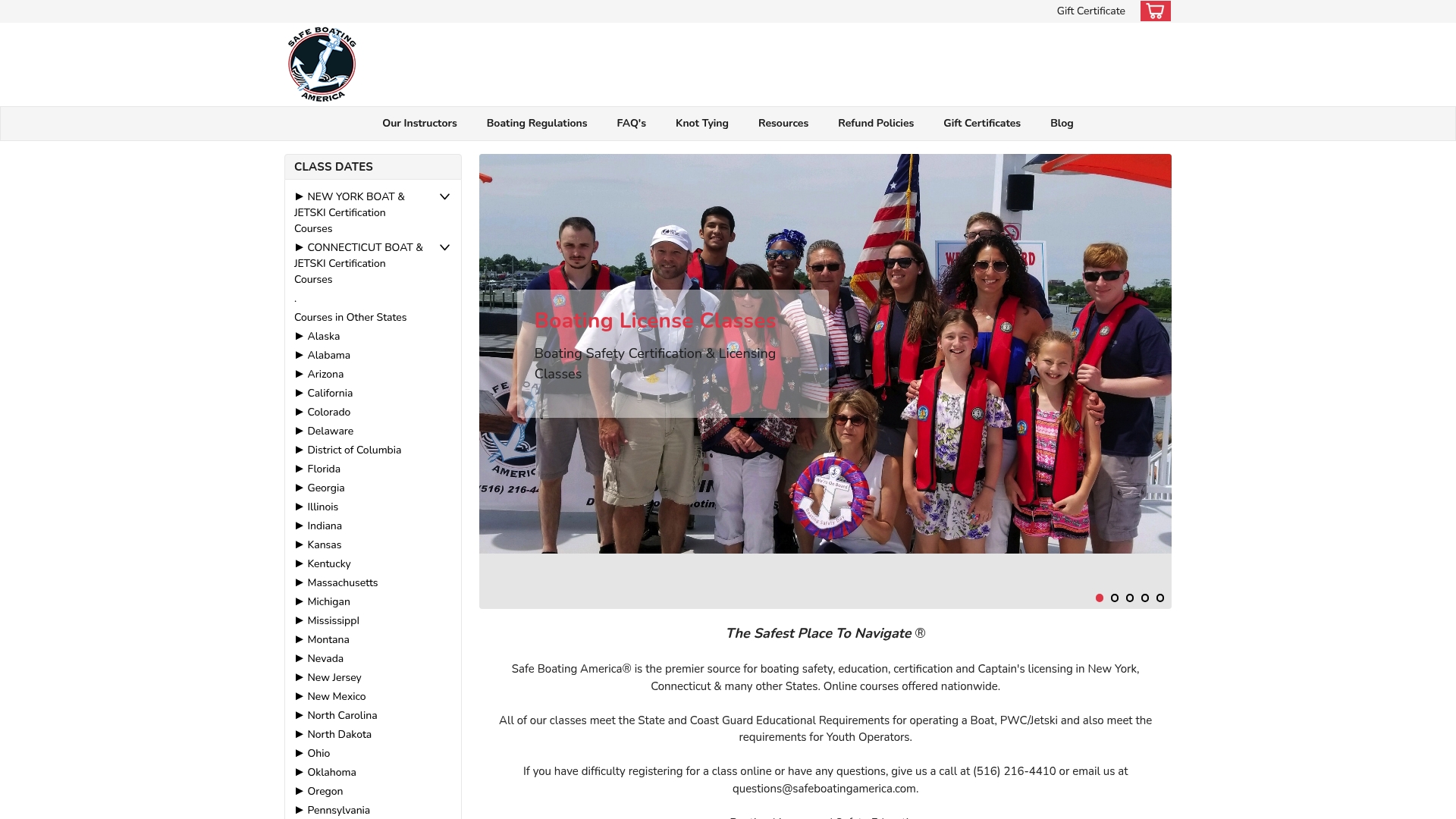
Our positioning is simple: state and USCG-approved instructors, same-day certification, online, Zoom and in-person formats, and compliance with state laws such as New York’s Brianna’s Law.
Our view on approval
We hear one question more than any other: “Is this course approved?” The honest answer has two parts. NASBLA approval tells you the content meets the national standard. State acceptance tells you the certificate counts where you boat.
That is why we build our classes around state requirements. A boater in Nassau County, a Jet Ski rider in Connecticut and a new owner in Arizona need different things, and a course should be chosen for the water, not the price.
Our classes are taught by State Certified Instructors and USCG-Licensed Captains. A live instructor can answer the practical questions a rulebook cannot: what a bridge clearance looks like, how a PWC operator should approach a wake, what to do when a passenger goes overboard.
Take the course once, take it properly, and carry the card. The rest is time on the water.
Richard
FAQ
Which states require a boating license?
Most states require boater education for some operators, but few call it a license. The requirement is usually a safety certificate tied to birth date, horsepower, vessel type or age. Check your state agency’s rule, as the examples above show how widely it varies.
Will my NASBLA-approved certificate work in another state?
Often, but not always. Reciprocity is decided state by state. Alabama accepts any NASBLA-approved certificate, Colorado requires a proctored course, and Ohio asks for specific details on the card. Verify the destination state before you launch.
Which states do not require boater education?
NASBLA lists Wyoming with no state requirement, and Alaska has no general requirement either. PWC-specific rules can still apply in states like South Dakota and Montana, so check before you ride.
Does a USCG captain’s license replace a boating course?
In some states, yes. Texas accepts a USCG vessel operator’s license in place of the course, and Louisiana exempts USCG-licensed captains. Confirm your own state’s rule.
Sources
- NASBLA Course Approval
- Virginia DWR, Frequently Asked Questions
- Hawaii DOBOR, Boating in Hawaii
- NC Wildlife Resources Commission, Boating Regulations
- Texas Parks & Wildlife, Mandatory Boater Education
- Louisiana Wildlife and Fisheries, Boater Education
- NASBLA, Mandatory Education
- PWIA, Rules & Regulations
- Utah Outdoor Recreation, Boating Education
- USCG, State Boating Laws: Education Reciprocity
- Hawaii DOBOR, Motorized Vessels
- Ohio DNR, Meeting the Requirements of Ohio’s Boater Education Law