Marine Frequencies: The VHF Channel Chart Every Boater Needs
Know these channels before you leave the dock: Channel 16 (156.800 MHz) handles distress calls and initial hailing. Channel 70 (156.525 MHz) runs Digital Selective Calling only, no voice. Channel 13 (156.650 MHz) covers bridge-to-bridge navigation safety. NOAA WX channels (162.400–162.550 MHz) broadcast continuous weather. AIS channels (161.975 and 162.025 MHz) transmit vessel identification data automatically.
Each of these marine frequencies has one job, and mixing them up creates real safety problems on the water.
- Channel 16: Distress, safety, and initial calling. Keep it clear.
- Channel 70: DSC distress alerts only. No voice traffic.
- Channel 13: Bridge-to-bridge navigation safety, mandatory watch for larger vessels.
- WX1–WX7: Continuous NOAA weather broadcasts, no license needed to receive.
- AIS 1/2: Automatic vessel tracking, not for voice communication.
A complete channel chart with every frequency and its official use follows below.
Key Takeaways
Channel 16 governs distress and calling, channel 70 handles DSC exclusively, and a correctly registered MMSI is what makes automated distress alerts actually work.
| Point | Details |
|---|---|
| Monitor channel 16 | Keep your radio tuned to 156.800 MHz whenever it’s on, except during active use of another channel. |
| Keep channel 70 digital-only | Never transmit voice on 156.525 MHz; it’s reserved entirely for DSC distress signaling. |
| Register your MMSI | Program and test your MMSI so DSC alerts on channel 70 carry accurate identity and location. |
| Respect VHF’s range limits | Expect roughly 5 to 10 miles ship-to-ship and about 20 miles to a Coast Guard station. |
| Move off 16 after contact | Shift to a working channel like 68, 69, or 72 once you reach the other vessel. |
Table of Contents
- What Are the Full Marine VHF Frequencies and Their Uses?
- How Do Marine Frequencies Work for Channels 16, 70, 13, and 9?
- How Do You Set Up VHF Radio for Safe, Legal Operation?
- What Other Maritime Frequencies Should Boaters Know?
- A Boater-First Take on Marine Radio Reference Charts
- Sources
- FAQ
What Are the Full Marine VHF Frequencies and Their Uses?
The U.S. Coast Guard Navigation Center maintains the definitive U.S. VHF channel chart, and it’s the reference every boater should bookmark before matching a working channel to a task. Ship transmit and receive frequencies match on simplex channels; duplex channels (marked below) use different frequencies for sending and receiving, mostly for ship-to-shore telephone-style calls that are increasingly rare in recreational use.
A few notes on how to read this. Channels marked with an “A” suffix are U.S. simplex-only assignments and differ from the international duplex versions used elsewhere, which matters if you’re comparing a chart printed abroad to what’s programmed into a U.S. radio. WX channels are receive-only; you’ll never transmit on them, and no license is required to monitor NOAA broadcasts. The complete channel chart covers dozens more designations, including harbor-specific and government-use channels that vary by region, so cross-check your local Coast Guard district if you’re boating somewhere unfamiliar.
Regulatory numbering has shifted over the past decade as the ITU folded in new digital services, so older paper charts sometimes list frequencies that no longer match current channel assignments. When in doubt, defer to the current NavCen chart rather than a printed reference from a prior season.
How Do Marine Frequencies Work for Channels 16, 70, 13, and 9?
Channel 16 is the backbone of maritime safety communication, and the rules around it are strict for good reason. Regulations require monitoring channel 16 whenever your radio is on, unless you’re actively transmitting on another channel. The Coast Guard treats it as a lifeline that has to stay open, which is why extended conversations on 16 are both against the rules and dangerous for everyone else listening for a real emergency.
Here’s how the four most consequential channels actually function:
- Channel 16 handles distress calls, urgent safety broadcasts, and the first few seconds of routine hailing. Once you reach another vessel, you’re expected to move the conversation elsewhere immediately.
- Channel 70 is reserved exclusively for Digital Selective Calling. No voice traffic is permitted, ever. DSC lets your radio send an automated distress signal with your vessel’s identity and GPS position, but only if your MMSI is programmed correctly.
- Channel 13 is dedicated to bridge-to-bridge navigation safety. Vessels over 20 meters in length are required to maintain a listening watch on it, which makes it essential for coordinating passing arrangements in narrow channels or busy harbors.
- Channel 9 serves as an alternative calling channel for recreational boaters in some regions, taking pressure off channel 16 for non-emergency hailing.
Once contact is made on 16 or 9, boaters typically shift to a working channel like 68, 69, or 72 to keep talking. This isn’t optional courtesy; it’s the practice that keeps the distress frequency usable when someone actually needs it.
Pro Tip: Program your most-used working channel as a preset alongside 16 and 70. Fumbling through a channel list during an actual hail wastes time you don’t have in a close-quarters situation.
How Do You Set Up VHF Radio for Safe, Legal Operation?
A VHF radio only protects you if it’s set up correctly before you ever leave the marina. Watchkeeping comes first: keep the radio tuned to channel 16, or channel 9 where local practice favors it, and switch back the moment your working-channel conversation ends. The Coast Guard’s own guidance calls a properly monitored VHF radio the single most cost-effective safety device a boater can own.
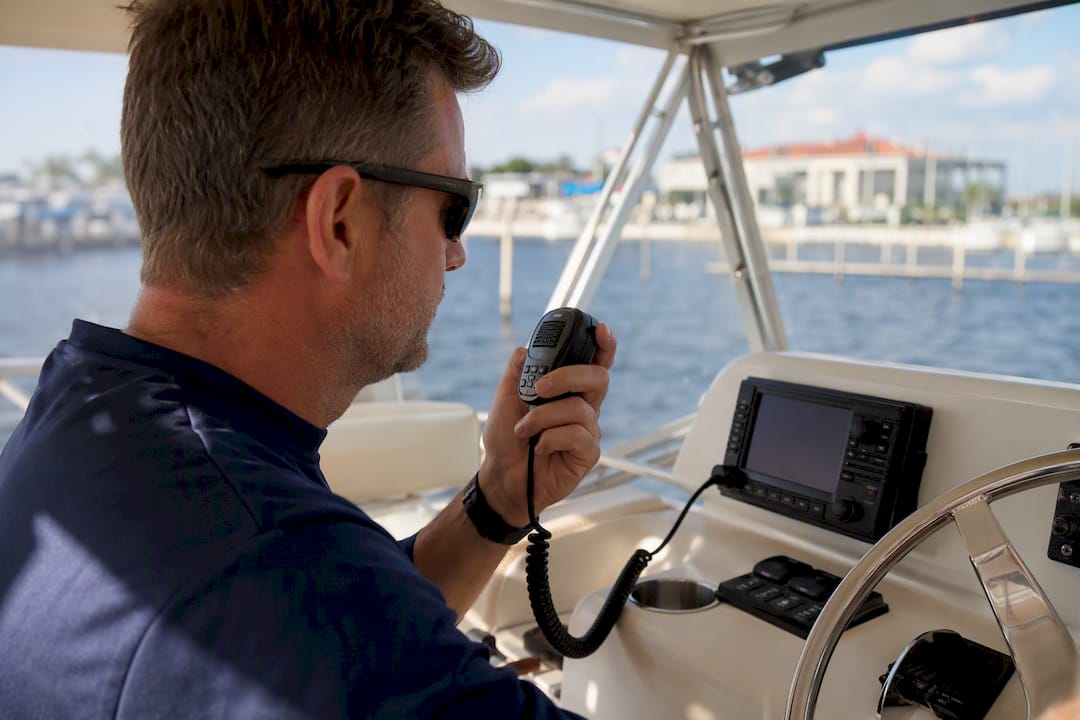
MMSI registration is the piece most recreational boaters skip, and it’s the one that matters most in a real emergency. Your Maritime Mobile Service Identity number links your DSC distress button to your vessel’s identity and location. If it’s unregistered or entered wrong, an automated alert on channel 70 may not carry your vessel identity at all, or may route improperly. Verify your MMSI is programmed correctly, test your DSC function during calm conditions, and re-check it every season.
Range is where expectations often outpace physics. VHF is strictly line-of-sight.
- Handheld radios: roughly 5 miles ship-to-ship in typical conditions.
- Fixed-mount radios with a proper antenna: 5 to 10 miles ship-to-ship.
- Reaching a Coast Guard shore station: up to about 20 miles, depending on antenna height and terrain.
For offshore trips beyond that range, VHF alone isn’t enough. Carry an MF/HF radio, a satellite phone, or an EPIRB as backup, and confirm whether your setup requires an FCC ship station license, which most domestic recreational boaters don’t need but international voyagers often do.
What Other Maritime Frequencies Should Boaters Know?
VHF isn’t the only band on the water, and knowing where it stops helps you understand when to reach for something else. AIS operates on 161.975 and 162.025 MHz, automatically broadcasting vessel identity, position, course, and speed. It’s data, not voice, so you can’t hail another boater through it.
- AIS 1/2: Automatic vessel tracking, always on, no operator input required.
- VDES/ASM: An expanding digital data layer in the VHF band, formalized under ITU Recommendation M.2092-1, used for exchanging navigational and weather data between ships and shore.
- MF/HF radiotelephone: Long-range bands for offshore voyages and high-seas weather, documented by the Navigation Center, used when VHF’s line-of-sight limit leaves you out of range.
- Underwater acoustic bands: Marine science tools like passive acoustic monitors operate between roughly 10 Hz and 100 kHz, an entirely different regime built for underwater sound rather than surface radio.
A Boater-First Take on Marine Radio Reference Charts
Most VHF guides online read like they were written for radio hobbyists, not people about to take a boat out for the first time. They bury the channel that actually saves lives, channel 16, under paragraphs of frequency trivia nobody needs mid-emergency. That’s backwards.
The conventional advice also underplays MMSI registration badly. Plenty of boaters buy a DSC-equipped radio, assume it works out of the box, and never register the number. That gap turns an automated distress feature into a silent button. If there’s one thing worth fixing before this article closes, it’s that: register your MMSI, program it correctly, and test it.
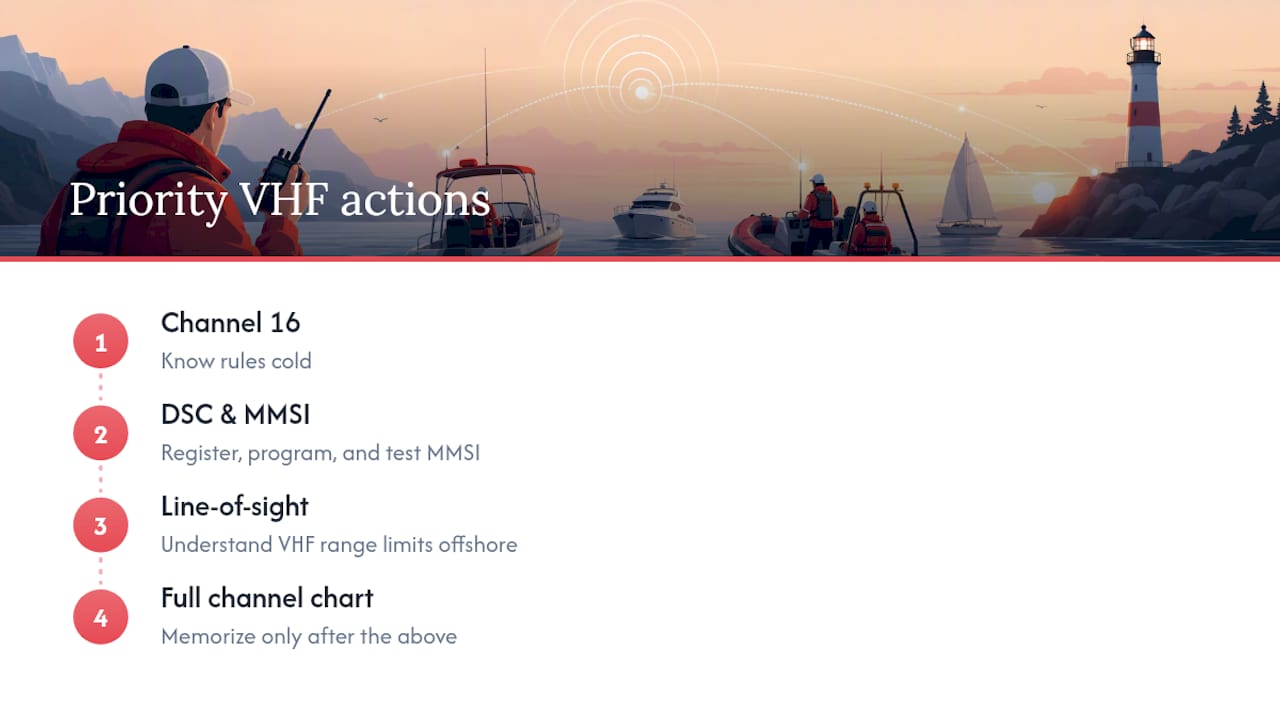
What actually matters, in order: know channel 16’s rules cold, get your DSC and MMSI working, understand VHF’s line-of-sight ceiling so you don’t overtrust it offshore, and only then worry about memorizing the full channel chart. Everything else is reference material you look up when you need it, not something you have to carry in your head.
Getting comfortable with these channels and rules matters, but knowing the material is only half the requirement. Every state sets its own boating education mandate, and completing a state-approved boating safety course is often the fastest legal path to operating a boat or personal watercraft at all. Safe Boating America runs NASBLA-approved courses online, live via Zoom, and in person, taught by state-certified instructors and USCG-licensed captains who cover VHF procedure alongside navigation rules, emergency response, and required safety equipment. If you’re studying this channel chart because you’re new to boating, pairing it with a certification course gets you legally on the water faster than piecing the rules together on your own.
Sources
- U.S. VHF Channel Information | Navigation Center
- Recommendation ITU-R M.2092-1 (VDES technical characteristics)
FAQ
What Is the Forbidden Radio Frequency for Boaters?
There isn’t a single “forbidden” frequency, but channel 70 comes closest: it’s reserved exclusively for Digital Selective Calling, and transmitting voice on it violates FCC rules and can interfere with distress alerts.
Can You Listen to Marine Radio on Land?
Yes. Anyone can legally listen to marine VHF frequencies on land using a scanner, but transmitting on those frequencies without proper licensing or a vessel-mounted radio is not permitted.
What Is VHF Channel 70 Used For?
Channel 70 (156.525 MHz) is used exclusively for Digital Selective Calling, the automated system that sends distress alerts containing your vessel’s MMSI and GPS position.
What Is Channel 69 Used For?
Channel 69 (156.475 MHz) is a recreational working channel, commonly used for routine conversation between boaters after they’ve made initial contact on channel 16 or 9.
Do I Need a License to Use a Marine VHF Radio?
Most recreational boaters operating domestically don’t need an FCC license, but vessels required to carry a radio, commercial operators, or those traveling internationally typically do.