Avoid Rental Denials: Washington Boating Age 12, 14, 60 Day Card Grace
In Washington, you must be at least 12 years old to operate a motorboat with a motor of 15 horsepower or greater, and you need a Washington Boater Education Card unless a supervisor 16 or older who holds one is directly overseeing you. Personal watercraft have a separate minimum operator age of 14. Anyone born before January 1, 1955, is exempt from the card requirement, and visitors or new boat buyers get a 60-day grace period before the card becomes mandatory.
TL;DR:
- Children under 12 cannot operate boats with motors rated at 15 horsepower or more unless directly supervised by an adult with a Boater Education Card.
- Personal watercraft operators must be at least 14 years old, while rental companies generally require renters to be 16 or older for Jet Skis, regardless of supervision.
- Out-of-state visitors and new boat owners have a 60-day grace period before the card is mandatory, using existing credentials or bill of sale as temporary proof.
- The horsepower rating, not boat size or type, determines when a boat operator needs the card, and supervision must be immediate and capable of taking control instantly.
- Getting certified through an approved course is quick and practical, as the lifetime card can be obtained online, via Zoom, or in person within a few hours.
Table of Contents
- Who Must Carry a Washington Boater Education Card?
- What Do RCW 79A.60.640 and the 15 HP Rule Actually Require?
- How Old Do You Have to Be to Operate a Jet Ski in Washington?
- Do Out-of-State Visitors and New Boat Owners Need the Card Right Away?
- How Do You Get the Washington Boater Education Card?
- Are There Exemptions or Special Cases to the Age Rule?
- Why an Approved Course Matters Beyond the Legal Minimum
- What New Boat Owners Get Wrong About the Age Rule
- Get Certified Before You Cast Off
- Sources
- FAQ
Who Must Carry a Washington Boater Education Card?
The Boater Education Card is the state’s proof that an operator has completed approved boating safety training. The legal trigger is horsepower, not boat size or type. Once a motor produces 15 horsepower or more, the operator falls under the education requirement, regardless of whether the vessel is a bass boat, a pontoon, or a hand-me-down runabout.
Renters and charter customers need to carry the card too, or present an acceptable substitute at the counter. Most rental outfits and marinas ask for it before handing over keys.
- A 12-year-old driving the family’s 40 HP runabout needs the card or a qualifying supervisor aboard.
- A kayaker or canoeist paddling without a motor is not subject to the card requirement at all.
- A renter without a card usually completes a state equivalency exam on-site or shows out-of-state proof within the 60-day window.
Local jurisdictions can layer on additional restrictions, so it pays to check county rules before launching, especially on lakes near state parks with posted horsepower limits.
What Do RCW 79A.60.640 and the 15 HP Rule Actually Require?
Washington’s operator-age framework lives in RCW 79A.60.640, the statute that sets the 12-year floor and the supervision terms for motorized vessels.
A person under the age of 12 may not operate a motor-driven boat with a motor rated at 15 horsepower or greater unless a person 16 years of age or older who possesses a boater education card is aboard and directly supervising the operation.
That single clause carries most of the practical weight. “Directly supervising” is not a technicality. Enforcement and the courts expect the supervising adult to be positioned to physically take the wheel or throttle within seconds, not lounging at the bow with a phone. A supervisor who cannot reach the controls quickly does not satisfy the rule.
A few clarifications that trip people up:
- The horsepower threshold applies to the motor’s rating, not the boat’s size. A compact 14-foot aluminum boat with an 18 HP outboard crosses the line just as a bowrider does.
- Boats under 15 HP, including most electric trolling motors and small kicker engines, fall outside the card requirement entirely.
- The 12-year floor is absolute. No amount of supervision permits an 11-year-old to operate a covered vessel.
How Old Do You Have to Be to Operate a Jet Ski in Washington?
Personal watercraft, meaning Jet Skis, WaveRunners, and Sea-Doos, run on their own age rule separate from general motorboats. According to the state’s boating law portal, operators must be at least 14 years old, and renting or leasing a PWC to anyone under 16 is against the law regardless of who is supervising.
- Confirm the renter is 16 or older before any Jet Ski rental agreement is signed. Rental businesses that skip this step risk their own liability.
- Verify the Boater Education Card at check-in, since most marinas require it on the spot rather than accepting a promise to get one later.
- Review PWC-specific handling basics before departure. Personal watercraft steer differently at low throttle than a boat does, and that surprises first-timers every season.
Parents planning a family PWC outing should treat the 14-plus operator rule and the 16-plus rental rule as two separate gates. A capable 14-year-old may run the machine once it’s rented, but the paperwork still has to clear a 16-year-old’s name first.
Do Out-of-State Visitors and New Boat Owners Need the Card Right Away?
Not immediately. Washington gives out-of-state operators and newly purchased vessels a 60-day temporary exemption from the card requirement.
- Visitors from other states can operate for 60 consecutive days using their home-state credential or none at all, depending on their origin state’s rules.
- New owners can use the bill of sale as temporary proof of the exemption clock instead of a physical card.
- After 60 days, the exemption ends. Continuing to operate without a Washington card at that point exposes you to a citation.
- Keep the bill of sale or out-of-state card in the boat, since officers checking compliance on the water will ask to see it.
Because enforcement practices vary by county, it’s worth confirming with local marine patrol if your visit runs close to that 60-day mark.
How Do You Get the Washington Boater Education Card?
Getting certified takes a handful of straightforward steps, and the card you earn never expires once issued.
- Pick your course format. State-approved options include self-paced online courses, live Zoom classes, and in-person classroom sessions.
- Pass the final exam. Courses end with a proctored or open-book test depending on the format; an equivalency exam is also available for experienced boaters who skip the coursework.
- Receive your card. Washington issues the Boater Education Card as a lifetime credential, so there’s no renewal cycle to track later.
If your card is lost or damaged, the state processes replacement requests through its own form rather than requiring a retake of the course. Carry a photo of the card on your phone in the meantime, since some marinas accept that as interim proof while a physical replacement is in transit.
Pro Tip: Book your course at least two weeks before a planned trip or rental. Processing and card delivery take time, and showing up at the dock without proof can end a rental reservation on the spot.
Are There Exemptions or Special Cases to the Age Rule?
A few categories of operators fall outside the standard card requirement.
- Anyone born before January 1, 1955, is exempt from carrying the Boater Education Card.
- Commercial vessel operators and government employees operating in an official capacity typically fall under separate licensing, often satisfied by a U.S. Coast Guard credential instead.
- Sanctioned race participants may operate under event-specific waivers rather than the standard card rule.
- Replacement cards are requested directly through Washington State Parks rather than by repeating the course.
Why an Approved Course Matters Beyond the Legal Minimum
The card itself never expires, but the reason to take a state-approved course goes beyond satisfying RCW 79A.60.640. Courses built on NASBLA standards cover the same core safety material nationwide, so a Washington-approved class teaches skills that transfer to any state’s waterways.
Safe Boating America offers Washington’s approved training through online, live Zoom, and in-person formats, and many students complete certification the same day they start. Beyond the paperwork, the practical value shows up on the water: young operators who’ve walked through emergency procedures and PWC handling in a structured setting tend to react faster when conditions turn.
What New Boat Owners Get Wrong About the Age Rule
The horsepower threshold trips up more families than the age minimum does. Plenty of parents assume a small boat is automatically safe for a preteen to run, without checking the motor’s rating first. An 18 HP outboard on a 14-foot boat crosses the same legal line as a 150 HP inboard.
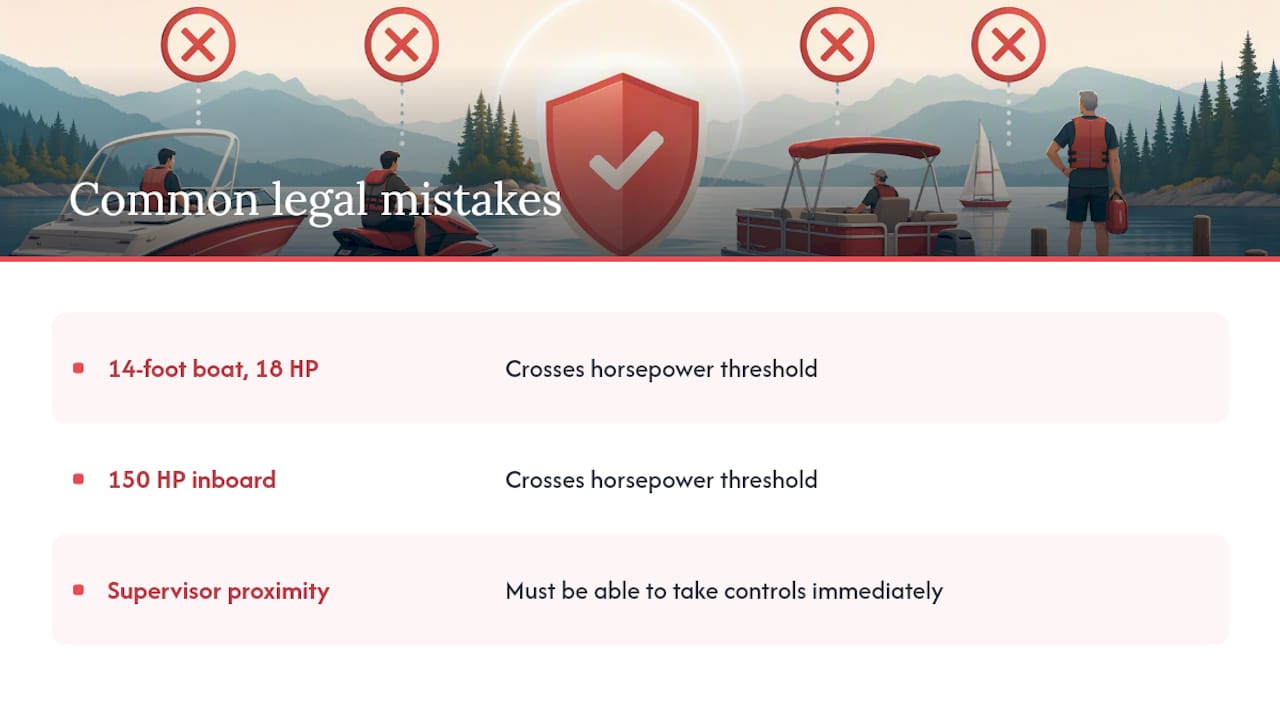
The other recurring mistake is treating “supervision” loosely. A 16-year-old sibling holding a card while sitting at the bow does not meet the standard. The supervisor needs to be close enough to the controls to take over immediately.
Book your course before you book the rental or plan the trip, not after. Certification takes days to process, and a dock reservation will not wait on it.
— Richard
Get Certified Before You Cast Off
Washington residents and visitors can obtain their Boater Education Card without the wait that comes with mailing in paperwork or hunting down a classroom seat months in advance.
Courses run online at your own pace, live over Zoom with a real instructor, or in person, and all three formats satisfy Washington’s education requirement once you pass the exam. Many students finish and receive same-day certification, which matters when a rental reservation or a weekend trip is already on the calendar. A step-by-step course walkthrough is available to cover what to expect before you start. Pick a format, register for a Washington course, and get your lifetime card handled before you’re standing at the dock without it.
Sources
- Boater Education Card - Washington State Parks
- RCW 79A.60.640
- Boating laws — Washington Recreation & Conservation Office
FAQ
How old do you have to be to get a boating license in Washington?
You must be at least 12 to operate a motorboat rated 15 horsepower or higher, either holding a Boater Education Card yourself or under direct supervision of someone 16 or older who has one.
Can a 14-year-old operate a Jet Ski in Washington?
Yes, 14 is the minimum operating age for personal watercraft, though rental companies cannot lease a PWC to anyone under 16 regardless of who will actually drive it.
What is the 60-day rule for boaters in Washington?
Out-of-state visitors and newly purchased vessels get 60 consecutive days before a Washington Boater Education Card becomes mandatory, with a bill of sale serving as temporary proof for new owners.
Do you need a boater card to rent a boat in Washington?
Most rental companies require the card or an accepted substitute like an out-of-state credential within the 60-day exemption window before they’ll hand over a boat.
Is the Washington Boater Education Card good for life?
Yes, once issued the card never expires, and Safe Boating America’s approved online and Zoom courses are one way to earn it without a classroom visit.