U.S. Boating Safety Certificate: State-Approved Guide
The fastest legal route to a U.S. state-approved boating safety certificate is enrolling in a NASBLA-compliant, state-approved course — online, live Zoom, or in-person — and submitting your completion to the issuing state agency. Searching “pcoc canada” often reflects a broader need: proof of boating competency required before you legally operate a motorized vessel. In the United States, that credential is a state-issued boating safety certificate, not a Canadian card, and the process is straightforward once you know the three steps.
To get certified now:
- Identify your state’s specific requirement (age, horsepower, vessel type)
- Choose your format: online self-paced, live Zoom with an instructor, or in-person classroom
- Complete the course, pass the assessment, and keep your electronic proof on the water
Many states issue same-day electronic proof upon passing. Some also mail a permanent card within a few weeks.
Key Takeaways
A state-approved boating safety certificate requires a NASBLA-compliant course, state-specific assessment questions, and same-day or mailed proof of completion accepted by your state agency.
| Point | Details |
|---|---|
| State requirements vary | Age cutoffs, horsepower rules, and approved-provider lists differ by state — verify before registering. |
| NASBLA/ANSI standards define content | Approved courses must cover Core domains plus state-specific material under Standard 8.2. |
| Same-day proof is available | Most approved online and Zoom providers issue electronic certificates immediately upon passing. |
| PWC rules are stricter | Many states set higher age minimums and require PWC-specific course content beyond general boating. |
| Safeboatingamerica covers all states | State-approved courses with USCG-licensed instructors, same-day certification, and online, Zoom, and in-person formats. |
Table of Contents
- Which boaters must carry a state-approved boating safety certificate?
- How do you get a state-approved boating safety certificate?
- What do approved courses actually cover?
- How do state rules differ, and will your certificate transfer?
- PWC and Jet Ski rules that differ from general boating
- What does the assessment look like, and what does certification cost?
- How do you pick a trustworthy, state-approved provider?
- Why Safeboatingamerica meets state and NASBLA requirements
- Why certified training matters beyond the legal requirement
- State-approved certification with Safeboatingamerica
- Sources
- FAQ
Which boaters must carry a state-approved boating safety certificate?
State-by-state boating education requirements vary on age cutoffs, horsepower thresholds, and residency rules. Common groups required to certify include:
- Youth operators: Most states require anyone under 16 (some under 18) to complete an approved course before operating a motorized vessel
- PWC operators: Personal watercraft rules often differ from general motorboat rules. Many states require certification regardless of age
- Horsepower thresholds: Several states trigger the requirement at 10 HP or higher, regardless of operator age
- First-time boaters: Some states require all new operators, regardless of birth year, to complete education
- Violation history: Operators with prior serious boating violations may face mandatory re-certification
Specific state examples illustrate the variation. Maryland requires certification for anyone born on or after a certain date. Michigan ties requirements to both age and horsepower. Washington uses a phased-in age rule. Tennessee applies its requirement to operators of vessels with motors above a specific horsepower threshold who are under 18.
Pro Tip: Before boating in another state, check that state’s boating agency directly. Nonresident rules vary — some states give visitors a limited number of days before requiring an in-state-approved certificate.
How do you get a state-approved boating safety certificate?
- Identify the state requirement. Confirm whether your state requires a state-approved course specifically, or whether any NASBLA-compliant course qualifies. Some states maintain their own approved provider lists.
- Choose your format. Online self-paced courses offer maximum flexibility. Live Zoom classes with a state-certified instructor add real-time Q&A. In-person classroom or on-water sessions suit hands-on learners. The U.S. Coast Guard notes that popular basic courses typically run 6–13 lessons across these formats.
- Complete the course content and pass the assessment. State-specific question sets are built into approved courses. You must answer a minimum number of state-specific questions correctly.
- Submit proof if required. Many states accept same-day electronic proof directly from the provider. Others require the provider to transmit completion data to the state agency.
Completing a course often yields a temporary certificate immediately. The permanent state-issued card may take several weeks to arrive by mail. Carry your electronic or printed temporary proof on the water until the permanent card arrives — relying on expired temporary proof during a patrol check creates a compliance risk.
What do approved courses actually cover?
NASBLA requires course materials to conform to ANSI/NASBLA Basic Boating Knowledge standards. The current framework separates content into Core and Plus domains.
Core domains (all approved courses):
- Rules of the road and navigation rules
- Boat handling and maneuvering
- Required safety equipment and PFD requirements
- Emergency procedures and accident reporting
- State-specific registration and licensing laws
Plus domains (power, PWC, or sailing add-ons):
- ANSI/NASBLA 103-2022 covers Basic Boating Knowledge for power vessels
- PWC-specific content addresses personal watercraft handling, speed restrictions, and rider rules
- Sailing modules address vessel-specific navigation and rigging
Pro Tip: Standard 8.2 of the National Boating Education Standards requires every approved course to include state-specific material and assessment questions. A course missing this section does not meet full approval criteria.
How do state rules differ, and will your certificate transfer?
States set their own age, horsepower, and format rules independently. Some allow nonresidents to operate for a limited number of days without an in-state card. Others require completion of a course from a state-approved provider before any operation.
| State | Age Requirement | Horsepower Rule | Nonresident Note |
|---|---|---|---|
| Maryland | Born on/after July 1, 1972 | All motorized vessels | Must carry valid certificate |
| Michigan | Under 16 unaccompanied | Varies by HP class | Reciprocity with approved cards |
| Washington | Phased-in by age group | All motorized vessels | Check current phase schedule |
| California | All operators (Boater Card, effective Jan 1, 2025) | All motorized vessels | Visitors: limited exemption period |
California’s Boater Card program, effective January 1, 2025, is one of the most recent state-level mandates — the California Division of Boating and Waterways lists approved courses and acceptable formats on its official page.
To verify acceptance before boating in another state:
- Contact the destination state’s boating or wildlife agency directly
- Check the NASBLA approved courses dashboard to confirm your provider’s approval status in that state
- Review the state’s approved course list for any additional state-question requirements
PWC and Jet Ski rules that differ from general boating
Personal watercraft operators often face stricter requirements than general motorboat operators. Key distinctions:
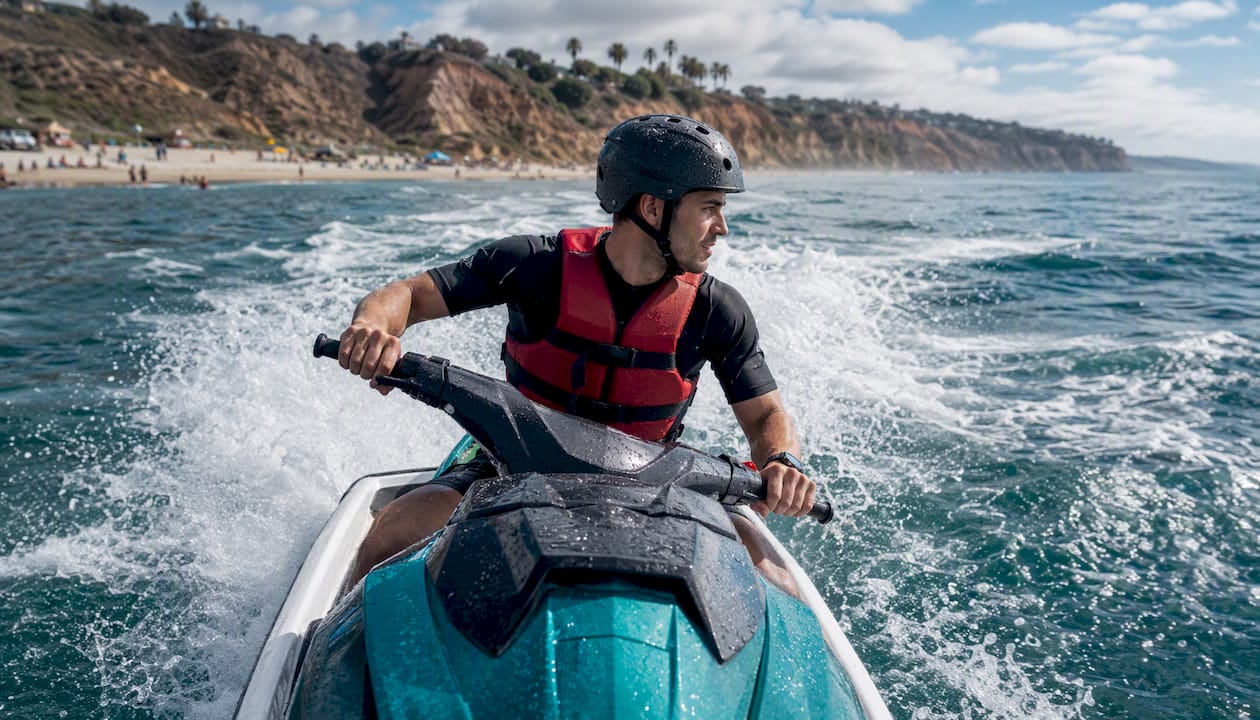
- Minimum age: Many states set a higher minimum age for solo PWC operation than for motorboats — commonly 14 or 16 versus 12 for general vessels
- Mandatory PWC course sections: Several states require the course to include PWC-specific content, not just general boating knowledge
- Rider restrictions: Some states prohibit passengers on PWC unless the vessel is specifically designed for multiple riders
- Speed and distance rules: PWC-specific no-wake zones and distance-from-shore rules appear in state-specific course content
Pro Tip: Before registering for a course, confirm it includes PWC-specific assessment items required by your state. A general boating course without the PWC module may not satisfy the full requirement for Jet Ski or WaveRunner operation.
What does the assessment look like, and what does certification cost?
Assessment format: Multiple-choice questions, with a required minimum of state-specific items. Most online and Zoom courses allow retakes within the same session.
Certificate delivery:
- Same-day electronic certificate: available from most approved online and Zoom providers upon passing
- Temporary printout: acceptable for patrol checks while waiting for the permanent card
- Permanent mailed card: issued by the state or provider; typical delivery runs two to four weeks
Typical costs: State-approved courses generally run $25–$75 for online formats. In-person or Zoom courses with a live instructor may run higher. Some states charge a separate processing or card-issuance fee.
Keep your electronic proof accessible on your phone or as a printed copy every time you operate a vessel. A permanent card that has not yet arrived is not a valid substitute during a patrol check.
How do you pick a trustworthy, state-approved provider?
Verification checklist:
- Provider appears on the state boating agency’s approved course list
- Course is mapped to ANSI/NASBLA standards (100-2022 and 103-2022 where applicable)
- Instructors hold state certification or a USCG captain’s license
- Course includes state-specific questions and content (Standard 8.2 compliance)
- Provider issues same-day electronic proof upon passing
- Clear refund and rescheduling policy is published before purchase
Pro Tip: Prefer providers that list their specific state approval ID or link directly to the state agency’s approval page. If a provider cannot point you to that listing, verify independently through the NASBLA education dashboards before registering.
Why Safeboatingamerica meets state and NASBLA requirements
Safeboatingamerica delivers state-approved boating safety courses across all U.S. states, with curriculum aligned to ANSI/NASBLA standards and instruction from state-certified instructors and USCG-licensed captains. Course formats include online self-paced, live Zoom, and in-person classroom options — each designed to satisfy the specific requirements of the student’s state.
Students who complete a Safeboatingamerica course receive same-day electronic certification, satisfying immediate proof-of-completion requirements for patrol checks while the permanent card is processed.
What to have ready when registering:
- Your state of residence and the state(s) where you plan to operate
- Vessel type (motorboat, PWC/Jet Ski, sailboat)
- Preferred format: online, Zoom, or in-person
- Valid email address for electronic certificate delivery
Safeboatingamerica’s NASBLA-aligned curriculum covers navigation rules, required equipment, emergency procedures, PWC-specific content, and state law — the full scope of what state agencies require. Thousands of students nationwide have completed certification through the program, including New York boaters under Brianna’s Law and Connecticut Safe Boating Certificate requirements.
Why certified training matters beyond the legal requirement
The legal requirement is the floor, not the ceiling. Boaters who complete a structured, NASBLA-aligned course consistently demonstrate better situational awareness on the water — they know right-of-way rules, recognize hazard signals, and respond to emergencies with a practiced sequence rather than guesswork.
Traveling between states adds another layer. A certificate that satisfies New York’s Brianna’s Law requirement may not automatically satisfy California’s Boater Card program or a state with a stricter approved-provider list. Verifying reciprocity before you trailer your boat across state lines takes ten minutes and prevents a citation.
The price argument for cutting corners on course quality is weak. The difference between a $25 non-compliant course and a $65 state-approved one is not meaningful against the cost of a boating violation, a failed patrol check, or an on-water emergency you were not trained to handle.
State-approved certification with Safeboatingamerica
Safeboatingamerica offers same-day certification, NASBLA-aligned curriculum, and instruction from USCG-licensed captains — the combination most state agencies look for when verifying compliance.
- Same-day electronic certificate upon passing, accepted for patrol checks
- Courses available in every U.S. state: online, live Zoom, and in-person formats
- State-certified instructors and USCG-licensed captains teaching to ANSI/NASBLA standards
Register for your state-approved boating safety course at Safeboatingamerica and receive your certificate the same day you complete the assessment.
Sources
Official resources for verifying state requirements and NASBLA course approval status:
- Boating Safety Courses
- State Boating Laws Details — Boating Education Requirements
- NASBLA Course Approval - NASBLA
- Classes and Courses — California Division of Boating and Waterways
FAQ
Who needs a boating safety certificate in the U.S.?
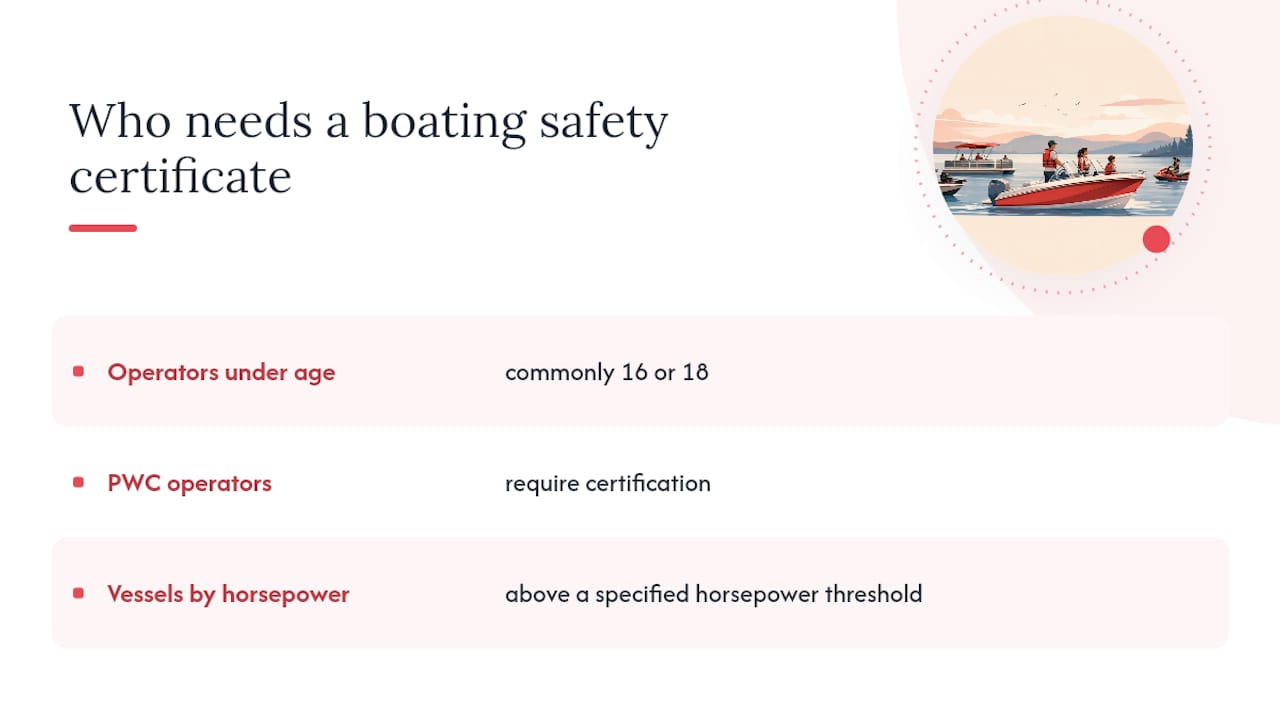
Requirements vary by state, but most states require certification for operators under a certain age (commonly 16 or 18), PWC operators, and anyone operating a vessel above a specified horsepower threshold. Check your state’s boating agency or the NASBLA requirements table for the exact rule.
Does a certificate from one state work in another state?
Some states accept certificates from other state-approved providers; others require completion of a course on their own approved list. Verify reciprocity with the destination state’s boating agency before you travel.
How long does it take to get certified?
Online and live Zoom courses can be completed in a single day, with same-day electronic proof issued upon passing. A permanent mailed card typically arrives within two to four weeks.
What is the difference between NASBLA approval and state approval?
NASBLA approval confirms a course meets the ANSI/NASBLA Basic Boating Knowledge standards nationally. State approval means the specific state agency has reviewed and accepted the course for its residents. Many states require both; some accept NASBLA-approved courses automatically.
Does Safeboatingamerica offer PWC-specific certification?
Yes. Safeboatingamerica offers Jet Ski and PWC certification courses that include the PWC-specific content required by state agencies, taught by state-certified instructors and USCG-licensed captains, with same-day electronic certification available.
Recommended
- BoatUS Foundation: Your Guide to Boating Safety Certification - Safe Boating America
- Boat Requirements: What Every U.S. Boater Must Know - Safe Boating America
- USCG License Explained: What Recreational Boaters Need - Safe Boating America
- USCG boating safety compliance: clear steps for safer boating - Safe Boating America