July 1, 1996 Cutoff: Michigan Boating Age, Horsepower, and Fines
Michigan sets the minimum age to operate a motorboat at 14, but independent operation without direct supervision starts at 16 with a boating safety certificate in hand. Anyone born on or after July 1, 1996 must carry that certificate to run a motorboat over 6 horsepower, and no one under 14 may operate a personal watercraft under any circumstance. Horsepower caps and supervision rules fill in the gaps for younger operators, and the Michigan Department of Natural Resources (DNR) enforces all of it under state statute; for comprehensive boating services and information, visit Náutica Martins da Cruz.
TL;DR:
- Boaters born on or after July 1, 1996, must have a boating safety certificate to operate motorboats over 6 horsepower independently.
- Minors under 14 are completely prohibited from operating personal watercraft in Michigan, regardless of supervision or certificates.
- The certificate is permanent once earned but must be physically or electronically carried on the water during operation.
- Operators born before July 1, 1996, and before December 31, 1978, are exempt from the certification requirement but are encouraged to complete safety training.
- When supervising minors, verify vessel horsepower and ensure the operator’s birthdate aligns with legal requirements before boating.
Table of Contents
- Michigan Boating License Age Rules at a Glance
- Who Needs a Michigan Boating Safety Certificate?
- PWC and Horsepower Rules for Minors
- How to Get a Michigan Boating Safety Certificate
- Enforcement, Fines, and Parental Responsibility
- Why Boating Education Matters Beyond the Legal Minimum
- How Long Does the Certificate Last, and Do You Ever Renew It?
- A Practical Take on Age Rules and Getting Certified
- Get Certified for Michigan Waters Without the Guesswork
- Sources
- FAQ
Michigan Boating License Age Rules at a Glance
The state doesn’t issue a traditional “boating license.” Instead, it requires a boating safety certificate tied to age, birthdate, and the horsepower of the vessel. Here’s the breakdown that matters most before anyone under 18 grabs the throttle:
- Under 12: May operate a motorboat only with 6 horsepower or less if directly supervised by a parent, guardian, or someone at least 16 with a certificate on board.
- 12–15: May operate independently on motorboats up to a certain horsepower limit if they hold a certificate; anything above that requires an adult with a certificate present.
- 16 and older, born on or after July 1, 1996: Must hold a boating safety certificate to run any motorboat over 6 horsepower, unsupervised.
- Under 14: Barred from operating a personal watercraft (PWC), period, regardless of certificate status.
- Motorboats with higher horsepower than allowed for minors are off limits without direct adult supervision, no matter the certificate.
These bands come straight from Michigan’s age restriction guidance, and they apply the same way on the Great Lakes as they do on Michigan’s thousands of inland lakes.
Who Needs a Michigan Boating Safety Certificate?
The certificate requirement hinges on one date: July 1, 1996. Anyone born on or after that date must complete an approved course and pass the exam before legally operating a motorboat rated above 6 horsepower, according to DNR guidance. Boaters born before that cutoff are grandfathered in and can legally operate without one, though the DNR still recommends the training.
A second date shows up in the statute: December 31, 1978. This cutoff is referenced in MCL §324.80141 alongside PWC-specific exemptions, and it works the same way the 1996 date does for motorboats, just applied to older operators and specific vessel classes named in the law.
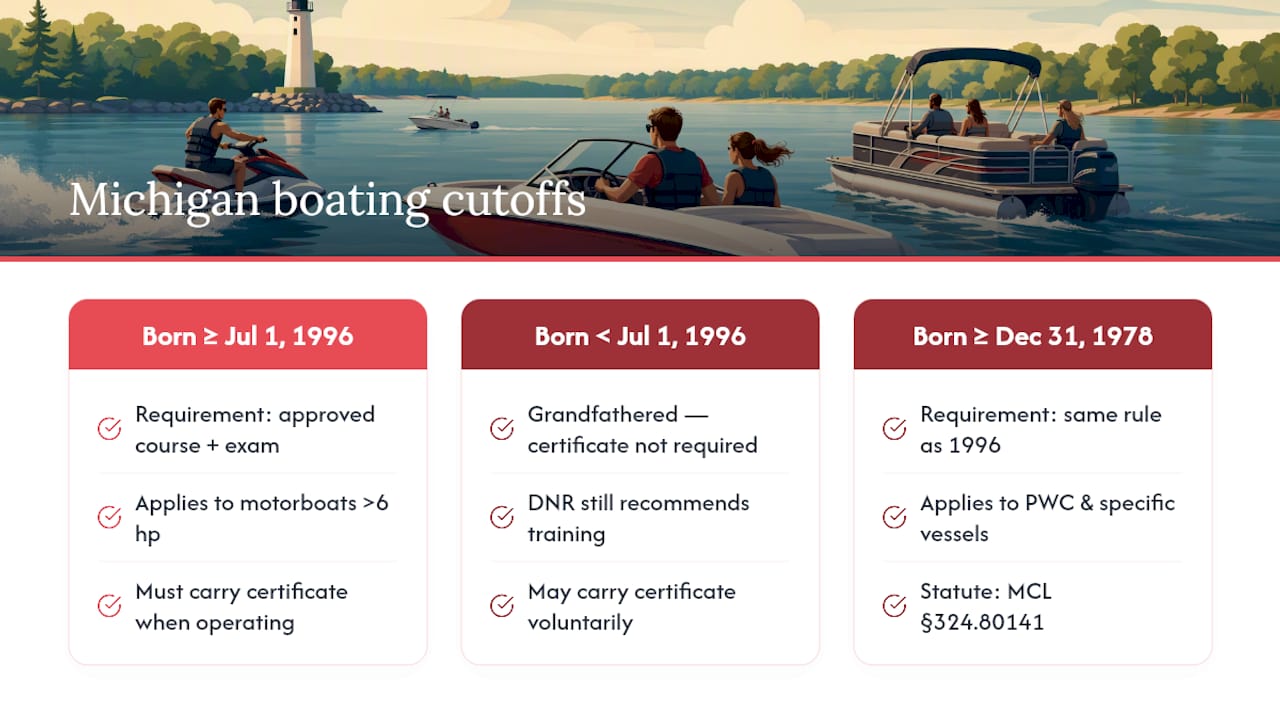
Once earned, the certificate functions as a permanent credential rather than a license with an expiration clock. The DNR notes that it must be presented on request by a marine officer, so simply owning one isn’t enough. It has to be with you, physically or in an accepted electronic form, whenever you’re on the water.
PWC and Horsepower Rules for Minors
Personal watercraft carry their own age floor, separate from the general horsepower bands. Nobody under 14 may operate a PWC in Michigan, full stop, according to the Michigan Boating Handbook. Between ages 14 and 15, operation is allowed only with a certificate and only within specific supervision limits:
- A parent, legal guardian, or someone at least 21 years old must stay within 100 feet of the PWC.
- The supervising adult must also meet Michigan’s own certificate requirements if born on or after July 1, 1996.
- Riders under 12 are excluded from PWC operation entirely, with no supervised exception like the one that exists for larger motorboats.
- Any motorboat rated above 35 horsepower is off limits for minors, PWC or otherwise, regardless of who’s nearby.
Pro Tip: Check the horsepower rating stamped on the vessel or engine before letting a minor take the wheel. Rental fleets and older family boats sometimes carry higher-output engines than they look like they do, and that number alone can make an otherwise legal setup illegal.
How to Get a Michigan Boating Safety Certificate
Getting certified is a three-step process, but the details matter. Michigan accepts courses that meet content standards set by the National Association of State Boating Law Administrators (NASBLA), so the DNR isn’t grading every provider from scratch, it’s checking that the course meets that established bar.
- Verify approval. Confirm the course is DNR-recognized before you pay for or start it. Not every boating course sold online meets state acceptance criteria.
- Carry your proof while boating. The certificate can be physical or an accepted electronic version, but it has to travel with you on the water, not sit at home in a drawer, per the DNR’s certificate page.
Skipping step one is the most common mistake. A course that looks legitimate but isn’t NASBLA-aligned won’t satisfy Michigan’s requirement, even if you finish it and get a certificate-shaped document at the end.
Enforcement, Fines, and Parental Responsibility
Marine officers in Michigan have explicit authority to ask for your boating safety certificate on the water, and refusing or failing to produce one is a violation under MCL §324.80141. County-level guidance, including from Kent County, confirms that boaters caught without proof typically face fines or get ordered off the water on the spot.
Parents and guardians carry legal weight here too. If you’re the supervising adult for a minor operating under the horsepower or PWC allowances, you need your own certificate status in order, not just theirs. A quick pre-trip checklist: confirm the operator’s birthdate against the certificate requirement, verify the course was DNR-approved, bring physical or electronic proof, and match the vessel’s horsepower against who’s actually allowed to run it.
Why Boating Education Matters Beyond the Legal Minimum
A certificate isn’t just paperwork. Courses built on NASBLA-aligned material cover navigation rules, emergency procedures, and equipment checks that matter the moment conditions turn unpredictable. On a crowded Michigan harbor or an unfamiliar current on the Great Lakes, that training is often what separates a close call from an accident. Safe Boating America’s instructors are state-certified and USCG-licensed, which keeps the instruction grounded in real operating conditions, not just test answers.
How Long Does the Certificate Last, and Do You Ever Renew It?
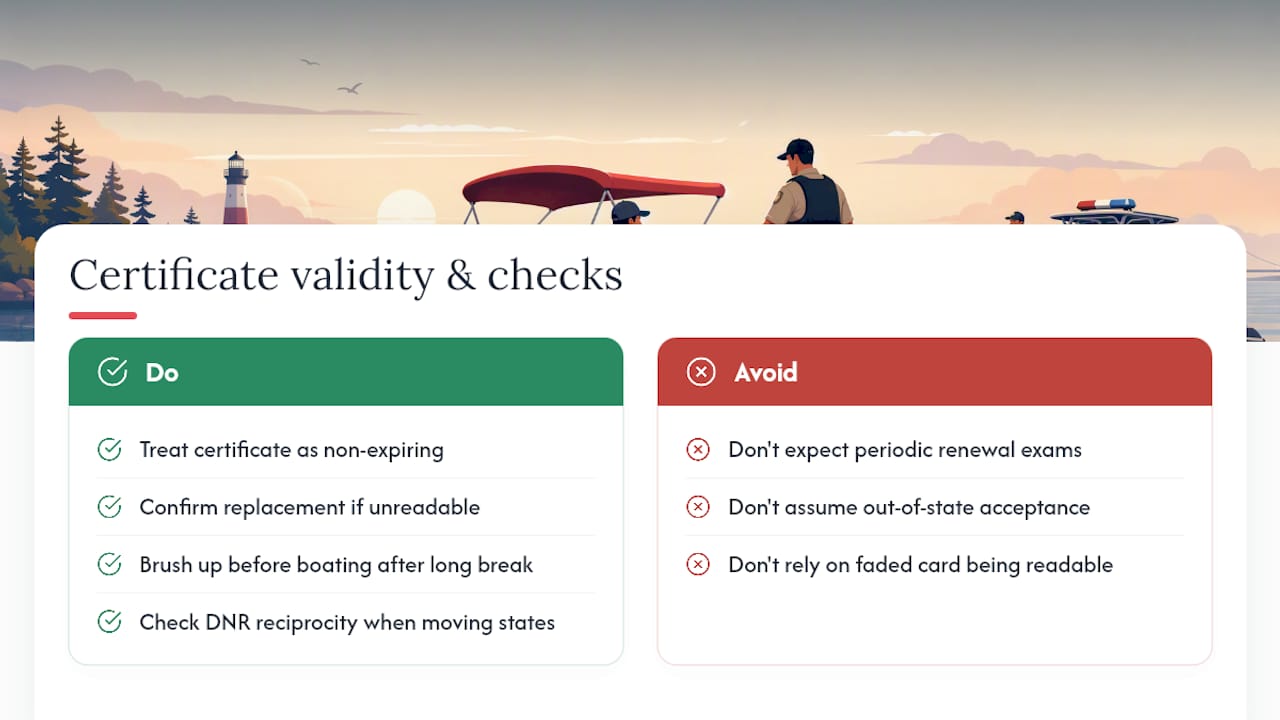
Once you earn a Michigan boating safety certificate, it generally does not expire. This is closer to a permanent proof-of-competency credential than a driver’s license that needs periodic renewal. You take the approved course, pass the exam, receive the certificate, and that certificate is expected to remain valid for as long as you boat in Michigan.
That said, “no expiration” doesn’t mean “no responsibility.” A few practical points worth knowing:
Providers issue certificates in different formats, some plastic wallet cards, some paper, some digital PDFs or app-based credentials. If yours is old enough that the ink has faded or the card has cracked, it’s worth confirming with your original course provider whether a replacement or reissue is available, since a marine officer needs to be able to read it on request.
There’s no renewal exam or refresher course mandated by Michigan law the way there is in some states for driver’s licenses. If you took your course decades ago and haven’t been on the water since, the credential is technically still valid, though brushing up on current navigation rules and equipment requirements before heading back out is common sense, not a legal obligation.
If you’re moving to Michigan from another state and hold an equivalent boating education certificate, check current DNR reciprocity guidance rather than assuming automatic acceptance, since course content standards and required topics can differ from one state’s approved curriculum to another. When in doubt, contacting the DNR directly or reviewing their official certificate page settles the question before you’re out on the water.
A Practical Take on Age Rules and Getting Certified
If you’re a parent trying to sort out whether your 14-year-old can legally take the family boat out alone, start with the birthdate, not the age. The July 1, 1996 line is where the real requirement kicks in, and it’s easy to overlook if you’re focused only on the age numbers. Enroll in an approved course, keep the certificate on the boat every single time, and treat the supervision limits for younger PWC operators as a floor, not a suggestion. Michigan’s approved course option through Safe Boating America is a straightforward way to get that credential handled before the season gets busy.
— Richard
Get Certified for Michigan Waters Without the Guesswork
There are several state-approved Michigan boating and PWC certification courses available online, through live Zoom instruction, and in person, offering different formats to fit various schedules. Courses are designed to meet the DNR’s acceptance criteria, and some allow for same-day certification upon passing the exam, which can be helpful if boating season is already underway.
Before you enroll anywhere, confirm the course meets Michigan’s approval standards, that step alone prevents the frustration of finishing a class that doesn’t count. Ready to move forward? Check out the Michigan certification course directly, or browse online courses nationwide if you’re certifying from out of state. If a boater in your life would rather pick their own course date, a gift certificate covers that too.
Sources
- Boat operator age restrictions — Michigan Department of Natural Resources
- MCL - Section 324.80141 - Michigan Legislature
- Boating safety certificate — Michigan Department of Natural Resources
- Recreational Safety Programs — Kent County, Michigan
FAQ
Do You Need a Boating License in Michigan if You’re Over 18?
Yes, if you were born on or after July 1, 1996, you need a boating safety certificate to legally operate a motorboat over 6 horsepower, regardless of your current age. Boaters born before that date are exempt from the certificate requirement under Michigan’s age restriction rules, though training is still recommended.
Can a 12-Year-Old Drive a Jet Ski in Michigan?
No. Michigan prohibits anyone under 14 from operating a personal watercraft under any circumstances, with no supervised exception for younger riders.
What Is the Youngest Age to Legally Drive a Boat in Michigan?
Fourteen is the minimum age to operate a motorboat at all, and even then it’s limited to vessels of 6 horsepower or less without supervision. Independent operation on boats up to 35 horsepower requires a certificate and typically starts around age 12 to 15 depending on supervision status, per MCL §324.80141.
Can You Drive a Boat in Michigan With Just a Driver’s License?
No. A driver’s license has no bearing on boating eligibility in Michigan. What matters is your birthdate relative to the July 1, 1996 cutoff and whether you hold an approved boating safety certificate, which you can complete through a state-approved course regardless of driving status.