Docking in Current: Approach, Spring Lines and Control
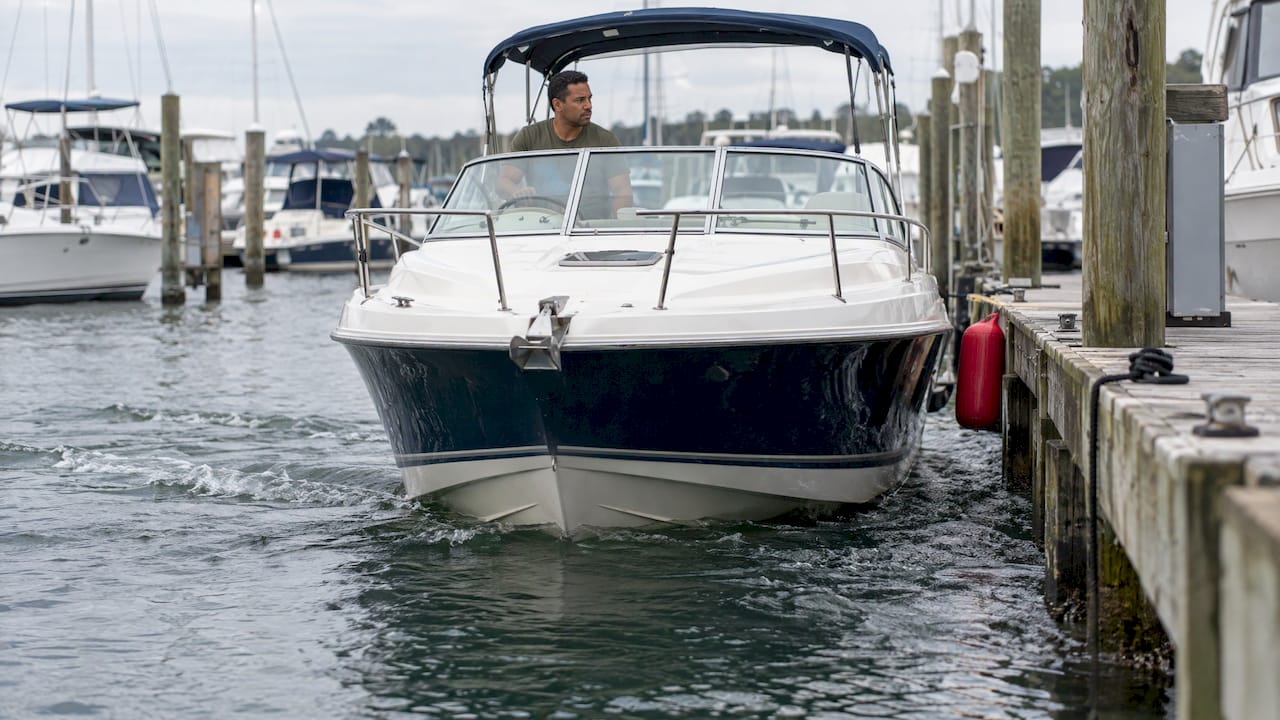
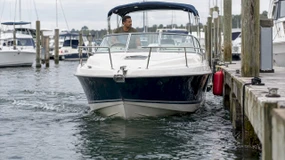
To dock in current, point the bow into the flow, approach at the slowest speed that still steers, and get a spring line on the dock first. Current moves the whole hull, so the boat keeps drifting even in neutral. The boat that arrives with the current behind it is the one that hits the dock. This guide covers how to read the water, which approach fits each situation, how spring lines hold the boat, and what crews get wrong.
TL;DR
- Current acts on the underwater hull and moves the boat at roughly the speed of the water, whichever way the bow points. Wind acts on the part above the waterline.
- When you have a choice, dock with the current coming from ahead. It brakes the boat and puts more water over the rudder or lower unit.
- Approach at minimum steerage speed, use short bursts of power with neutral glides, and abort and reset if the approach is wrong.
- Rig bow, stern and spring lines before you approach. The first line ashore is usually a spring line.
- Brief the crew before the maneuver. Hand lines to someone on the dock instead of jumping across open water.
Table of Contents
- Why current changes everything at the dock
- Read the current before you commit
- Choosing the approach: where is the current pushing you?
- Docking step by step
- Spring lines: the lines that hold the boat
- Calm water versus current
- Safety and common mistakes
- Our view: practice where it counts
- Get certified and train on the water
- FAQ
- Sources
Why current changes everything at the dock
Boaters learn docking in calm water, where the boat stops when the throttle comes back. Current removes that. The Boat Docker explains that current pushes on the submerged hull and carries the boat at about the speed of the water. A boat in neutral in a one-knot current drifts at about one knot.
That has two consequences for steering and stopping:
- Bow into the current: shifting to neutral slows you over the ground. The rudder or drive still sees water flowing past it, so you keep steering control at very low ground speed.
- Current behind you: the boat is carried along, so you need more reverse to stop. This is the classic setup for hitting the dock too fast.
Boat Trader notes that current often has its strongest influence near the dock, while wind works on the above-water profile. Its rule is to point the bow into the stronger force and let the current act as a brake.
For a personal watercraft the lesson is the same, with one addition. A PWC steers only with thrust, so it has little control when the throttle is off. Keep a little power on through the final approach and let the current do the slowing.
Read the current before you commit
Before you turn toward the dock, spend a minute learning what the water is doing.
Set and drift
Current has two measurements. As ALL AT SEA describes, set is the direction it flows and drift is its speed. You can confirm both by watching water stream past buoys, day marks and dock pilings.
Lenny Rudow at Right Boat adds other clues: a crab or lobster pot float, a drifting boat, or the way water piles against pilings.
Let the boat tell you
Slow down short of the dock and sit in neutral for a moment. The Boat Docker suggests watching which way the boat drifts, how fast, and which way the bow swings. Then ask three questions:
- Is the current pushing me onto the dock, off it, or along it?
- Which is stronger, the wind or the current?
- Where does the boat end up if I lose control for a few seconds?
The third question matters most. If the answer is “in the next boat’s stern,” choose a different approach or a different slip.
Check the water level
The Oregon State Marine Board tells boaters to check where they intend to tie up, where other boats are, what wind and current are doing, and how much room there is to maneuver. In tidal water, consult the tide tables. Current can make docking impossible at low water in some places.
Wind and current together
When the two disagree, deal with the one that moves your boat more. Per Boat Trader, heavy, deep-draft hulls are more current-driven. Light center consoles and pontoons are more wind-driven. Adjust your angle to match. Our guide to docking a boat in wind covers the wind side in detail.
Choosing the approach: where is the current pushing you?
| Current direction | What it does | Approach |
|---|---|---|
| Against the bow (head current) | Brakes the boat, improves steering | Best case. Approach slowly, bow into the flow, secure the up-current line first. |
| Behind the stern (following current) | Carries you forward, makes reverse less effective | Avoid if you can. Otherwise back into the current so the propellers lead into the flow. |
| Pushing you onto the dock | Closes the gap by itself | Shallow angle, or parallel a few feet out, and let it finish the job. |
| Pushing you off the dock | Opens the gap | Steeper angle of about 20 to 30 degrees, and get a line ashore fast. |
| Running parallel to the dock | Slides you along the face | Approach into it and use a bow line or forward spring. |
The angles come from Boat Trader. Rudow also says an approach angle near 45 degrees is about right for wheel-and-throttle docking, depending on conditions. He recommends a shallower angle when the boat is pushed away from the dock and a wider one when it is pushed toward it.
The common thread is simple. If you can choose which way to arrive, arrive against the current. A flow coming over the bow is the safest brake you will ever get.
Docking step by step
This sequence applies to a single-engine boat coming alongside a dock with current running parallel to it.
- Prepare the boat. Set at least three fenders on the docking side (bow, midship, stern), per Boat Trader. Hang them lower for floating docks and higher to meet the rub rail on fixed docks. Keep a spare on the other side in case the boat gets set off angle.
- Rig the lines. Cleat and coil the bow line, stern line and spring lines before you approach. A tangled line is a common reason a docking goes wrong.
- Brief the crew. The Oregon State Marine Board lists briefing everyone on the plan and knowing where each person is among its safety rules.
- Line up against the current. Turn the bow into the flow and hold position a few boat widths off the dock.
- Slow to minimum steerage speed. Boat Trader puts it plainly: never approach faster than you are willing to hit the dock.
- Use short bursts and neutral glides. Power up to steer, then coast. In a head current the water keeps the rudder working while the boat’s speed over the ground falls.
- Get the first line ashore. Secure the up-current bow line or a spring line first. Then take the second spring and the stern line.
- Stop, then tidy up. Adjust fenders, tension the lines and shut down.
If the approach is wrong, abort. Back off, circle and set up again. Boat Trader lists refusing to reset the approach among its eight common docking mistakes.
Ferry gliding for a sideways approach
When current is strong and you need to cross to the dock, use the technique Capt. Jeff Werner calls ferry gliding. Position the boat parallel to the dock a few boat widths off, facing into the current. Keep the centerline aligned with the flow using engine and steering. Pick a fixed object on the dock, such as a shore power station, to judge when you are steady. The faster the current, the faster the sideways motion, so ease the angle in gradually.
Spring lines: the lines that hold the boat
A spring line runs at an angle to the boat’s length, so it controls fore-and-aft movement. The NOAA boating reference describes the standard set as the bow, stern, bow spring and stern spring lines. The bow and stern lines hold the boat parallel to the dock. The springs let it rise and fall without moving ahead or astern.
The four configurations
Better Boat defines them this way:
| Line | Runs from | Stops |
|---|---|---|
| After bow spring | Bow cleat aft to a dock cleat | Forward surge |
| Forward bow spring | Bow cleat forward | Backward slide |
| Forward quarter spring | Stern cleat forward | Backward motion |
| After quarter spring | Stern cleat aft | Forward motion |
A classic setup pairs an after bow spring on one side with a forward quarter spring on the other. The diagonal tension holds the boat snug to the dock. In current, the line that faces the flow is the one that takes the load. Make sure its cleat is rated for it. Our guide to boat cleats covers what boaters need to know about them.
Using a spring to dock
The Oregon State Marine Board describes a technique that works well when the current is pushing you off or along the dock:
- Have a line cleated and coiled at the forward port rail.
- Throw it to the dock attendant or secure it to a dock cleat in your space.
- Turn the wheel hard away from the dock and put the engine in forward at idle. The boat moves sideways into the space.
- If progress against current or wind is too slow, advance the throttle slightly.
- If the boat creeps too far forward, shift to neutral, take up the slack, re-secure and use reverse.
The board treats preparation as most of the battle and recommends using lines as simple fulcrums to bring either end of the boat to the dock.
George Sass Jr. of Yachting Magazine adds a caution. When a spring line is helping turn the boat, take up the slack gently and apply no throttle until the line is under tension. Power before the line is taut can cost you the pivot.
For more on mooring methods, see our recommended docking techniques guide.
Calm water versus current
In calm water the approach is gentler and more forgiving. DockGear describes a 20-degree approach at very low throttle, easing into neutral near the dock and tapping reverse. If the boat drifts, keep the engine running and correct with a gentle bump.
In significant current parallel to the dock, Nigel Calder’s handbook calls for approaching into it and passing a bow line or forward spring to a helper ashore. As the current pushes the boat back, the line comes taut and the stern settles toward the dock. The difference is that the line, not the throttle, does the final stopping.
Safety and common mistakes
Most docking damage comes from a short list of errors. Boat Trader’s list of eight includes:
- Coming in too fast
- Forgetting the wind or current
- Turning the wheel the wrong way (boats steer from the stern)
- Neglecting fenders or setting them at the wrong height
- Unprepared or tangled lines
- Over-throttling
- Poor crew communication
- Not aborting and resetting
A few safety points belong with those:
- Crew position. Hand lines to someone on the dock. Do not leap across open water, a point on the Oregon State Marine Board’s safety list. Rudow warns crew never to put any part of their body between the boat and the dock when fending off.
- Hold the line until you stop. Dock attendants tend to pull or cleat a line while the boat is still moving. Give the line over once the boat is where you want it.
- Sober skipper. Docking in current demands quick judgment. Operating under the influence carries serious penalties, as the overview of boating under the influence laws explains.
For a wider pre-trip routine, see our boat safety equipment checklist.
Our view: practice where it counts
Docking in current is a skill that shows up on the water, not in a diagram. Most of what goes wrong comes down to three habits: arriving too fast, arriving with the current behind the boat, and arriving with lines that are not ready.
We teach boating safety through State Certified Instructors and USCG-Licensed Captains, using NASBLA-approved material. Our offerings include on-water training, on-water local boating knowledge and practical navigation and chart reading. These cover the judgment that current demands: reading the water, choosing the approach and managing the crew.
Local knowledge counts. Every marina has its own set, its own tide windows and its own tight spots. Learning them with an instructor beside you is a faster route than learning them by bumping a piling.
Required boating education is where it starts. A state-approved certificate covers the rules of the road, right-of-way and safe operation that every docking approach depends on.
Richard
Get certified and train on the water
Safe Boating America offers state-approved boating safety courses for recreational boaters and personal watercraft operators in every state. Our Zoom Online 1-Day Class costs $75. Our NYS Safe Boating Class costs $85. Online computer-based courses are available nationwide, and on-water training and practical navigation are also offered. See the Zoom class and on-water training options, or find your state’s course on the online boating courses page.
Gift certificates are available for boating education as well, from our gift certificates page.
FAQ
Is it better to dock into the current or with it?
Into it, whenever you have the choice. The current slows the boat when you shift to neutral and keeps water moving over the rudder or drive for steering. Approaching with the current behind you carries the boat forward and makes stopping harder.
Which spring line should go on first?
The line that stops the boat’s drift in the direction the current is pushing. With a head current, that is usually a bow line or an after bow spring on the up-current end. Cleat it and let the line check the boat before you adjust the others.
What angle should I use to approach the dock?
It depends on where the current is pushing you. Boat Trader suggests a shallow angle when current sets you onto the dock and a steeper 20 to 30 degrees when it pushes you off. Adjust for your hull: heavy boats feel current more, and light ones feel wind more.
How do I tell how strong the current is?
Watch fixed objects. Buoys, pilings, day marks and pot floats show the direction and speed of the water. You can also stop in neutral near the dock and see how fast the boat drifts.
What if the approach goes wrong?
Abort. Back away from the dock, turn and set up again. A second attempt costs a minute. A rushed landing can cost a hull, a piling or an injury.
Sources
- Docking a Boat in Wind and Current, The Boat Docker
- How To Dock A Boat: Step-By-Step Guide, Boat Trader
- How to Drive and Dock a Boat in Current, ALL AT SEA
- Docking Etiquette, Oregon State Marine Board
- How to Dock a Boat with Joysticks, Single Engines, and More, Right Boat
- Advanced Boat Handling: Docking Your Center Console, Regulator Marine
- NOAA boating reference
- Mastering Boat Spring Lines for Secure Docking, Better Boat
- How to Use Spring Lines Like an Expert, Yachting
- The Instant Handbook of Boat Handling, Navigation, and Seamanship
- How to Dock a Boat in Calm Conditions, DockGear
- Boating Under the Influence