Carbon Monoxide on Boats: Causes, Symptoms and Prevention

Carbon monoxide (CO) is a colorless, odorless gas made by gasoline engines and generators, and it can poison people on a boat underway, anchored or moored, inside the cabin or out on the swim platform. The best protection is a layered one: a UL-listed marine CO detector inside the boat, exhaust outlets kept clear, people kept away from the stern while engines run, and a crew that knows the symptoms look like seasickness. This guide covers each layer for boat owners, boaters and personal watercraft (PWC) operators.
TL;DR
- Gasoline engines and generators produce CO. You cannot see, smell or taste it, and dangerous levels can remain after the engine stops.
- The CDC leads its boating advice with a working CO detector listed by UL as appropriate for marine use, installed inside the boat.
- Stay off the swim platform and rear deck while engines run, never block exhaust outlets, and anchor or dock at least 20 feet from the nearest boat running an engine or generator.
- Headache, dizziness, nausea and weakness can be CO poisoning, not seasickness. Move the person to fresh air at once and call emergency services.
- Detectors have a replace-by date. Check the date, test the unit, and replace it on schedule.
Table of Contents
- Where carbon monoxide comes from on a boat
- The station wagon effect
- The danger zones: swim platforms, teak surfing and tows
- Symptoms: why CO poisoning gets mistaken for seasickness
- Marine CO detectors: what to buy, where to put them
- A prevention checklist for every situation
- What to do if someone may be poisoned
- Our perspective
- Get certified to operate a boat or PWC
- FAQ
- Sources
Where carbon monoxide comes from on a boat
Gasoline-powered boat engines, including onboard generators, produce carbon monoxide, according to the CDC. CO is the product of incomplete burning of fuel. Diesel engines, outboards, sterndrives, inboards and the generator that runs the air conditioning all belong on the list of things to think about.
The U.S. Coast Guard says CO can accumulate anywhere in or around a boat. Its list of common ways includes:
- Canvas enclosures with inadequate ventilation
- Exhaust trapped in enclosed places
- Blocked exhaust outlets
- Another vessel’s exhaust
- The station wagon effect, also called back drafting
- Slow speeds, idling or sitting stopped
The same page notes that dangerous levels can remain even after your engine, or the other boat’s engine, has stopped running. A cabin that smells clean is not proof the air is safe. The Coast Guard’s CO page states that you cannot see, smell or taste CO, and that in high enough concentrations even a few breaths can be fatal.
Cold engines and standing still
ABYC (the American Boat and Yacht Council, which writes voluntary U.S. boat-building standards) explains in its TH-22 report that dangerous CO concentrations can build when engines or generators run while the boat is stationary. That is most likely when the boat is rafted up or moored near boathouses, seawalls or other boats. The report also says CO production is greater when engines are cold, so warm-up time at the dock should be kept short.
The station wagon effect
Air moving around a boat creates a low-pressure area behind the broad, flat transom (the back of the hull). A USCG and Army Corps of Engineers fact sheet explains that this low pressure can draw exhaust back into the cockpit and cabin. Drivers know the same thing in a station wagon with the tailgate window open.
ABYC’s TH-22 report adds that the effect depends on relative wind direction, boat speed and trim angle. In practice, operating at slow speed with a following wind is the situation to avoid. Open canvas, a closed-in cockpit or a boat trimmed bow-high at low speed can all make the effect stronger.
Three habits reduce the risk:
- Keep fresh air moving through the cockpit and cabin, with hatches, ports and windows opened as the boat design allows.
- Avoid long periods of idling or slow running with the wind behind you.
- Treat any smell of exhaust as a sign that CO is present. Act at once to clear the air.
The danger zones: swim platforms, teak surfing and tows
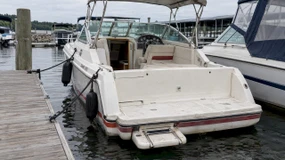
The CDC states that on larger boats CO can build up above the water near the water platform. CO beneath the stern deck, or on and near the swim deck, can kill someone in seconds.
The Coast Guard and Army Corps fact sheet notes that many CO cases have involved teak surfing, which means riding the wake close to the swim platform of an underway vessel. Between 1990 and 2015, the same document reports, there were 832 reported boating-related CO poisonings in the United States, including 174 deaths, according to U.S. Coast Guard recreational boating statistics. It also says many past deaths attributed to drowning or heart attack may have been CO-related.
People in the water are not safe either. A Minnesota DNR river guide relaying a Coast Guard warning describes a swimmer who died near a houseboat’s swim platform while engines or generators were running. People have also been overcome while towed or dragged too near a boat’s stern. The guide advises keeping skiers, tubes and tows at least 20 feet from a motorboat.

For PWC and WaveRunner operators the same logic applies to anyone riding or floating close behind another vessel’s exhaust. Keep your distance from the stern of any gasoline-powered boat that is running, and keep children off rear swim decks and water platforms while engines are on.
Symptoms: why CO poisoning gets mistaken for seasickness
The CDC lists headache, dizziness, weakness, nausea, vomiting, chest pain and confusion as common symptoms of CO poisoning on a boat. The Coast Guard adds that early symptoms include irritated eyes and that they are often confused with seasickness or intoxication. Its guidance is to treat seasickness symptoms as possible CO poisoning and get the person into fresh air immediately.
That guidance matters because the Coast Guard’s Recreational Boating Safety Division notes that victims may not get needed medical attention when symptoms look like a rough day on the water. If you want a plain-language guide to ordinary motion sickness for comparison, read about seasickness symptoms and prevention. When several people on the same boat feel unwell at once, or the feeling started near the engine or generator, assume exhaust first.
Who is at higher risk
The Coast Guard’s CO dangers page says altitude, certain health problems and age increase the effects of CO. Smokers, people who drink alcohol, and people with lung or heart problems are particularly susceptible, and physical exertion speeds the rate at which blood absorbs CO. The CDC warns that a sleeping or intoxicated person can die before having any symptoms, and that CO can make you pass out and drown.
For boaters this means a cabin with sleeping passengers, a generator running overnight and a late afternoon of swimming and drinking at anchor are the situations that deserve the most care.
Marine CO detectors: what to buy, where to put them
Installing and maintaining a working detector is the first item on the CDC’s list. It specifies a detector listed by UL as appropriate for marine use, installed inside the boat. A home detector is not the same product.
| Point | What the standard or agency says |
|---|---|
| Which boats | ABYC A-24 calls for detectors on boats with enclosed accommodation compartments. |
| Testing | Detectors tested by an independent laboratory to UL 2034, including the recreational-boat sections. |
| Coverage | Each contiguous cabin space and each sleeping space separated by solid bulkheads or permanent doors or partitions. |
| Mounting | Away from physical damage, away from air dilution near hatches or vents, and not in dead-air corners. |
| Labeling | Laboratory name, “Marine Carbon Monoxide Alarm” or equivalent, and a replace-by date. |
The table summarizes the ABYC A-24 standard. ABYC’s March 2026 article CO Detectors on Boats repeats the main points: use only detectors tested to UL 2034 for marine use, check them regularly following the manufacturer’s guidance, and replace them before the indicated date.
Older boats and battery units
Coast Guard Boating Safety Circular 86 advises owners of inboard and sterndrive boats built before 1998 to inspect their CO detectors. It says to replace any disconnected unit, or one whose exterior cover does not bear the word “marine”. The circular also points out that the major drawback of internal-battery units is that a dead battery leaves the detector unable to indicate CO. Newer detectors have fault-circuit checks and fewer false alarms.
What a detector cannot cover
ABYC’s TH-22 report states that hazardous CO levels can exist in interior and exterior spaces even with good design and maintenance. It also states that no detectors are currently available for permanent installation in exterior areas. The cockpit, swim platform and the water behind the transom therefore depend on your habits: where people sit, where they swim and how close you anchor to other boats. The report further says engines or generators should not be run on boats with enclosed accommodation compartments unless a functioning marine CO detector complying with A-24 is installed.
When the alarm sounds
ABYC gives the order of action: evacuate, ventilate, investigate, correct. Do not silence the alarm and carry on. Get everyone into fresh air first, open the space up, then find the source before anyone goes back in. Treat a battery chirp or fault light as a failed detector, not a nuisance.

A prevention checklist for every situation
The CDC’s boating guidance and the Coast Guard brochure can be turned into one working routine.
Before leaving the dock
- Check the detector’s replace-by date, test it, and confirm the battery or power connection.
- Look at exhaust clamps and fittings. The Coast Guard’s monthly checklist calls for checking that clamps are secure and looking for rust, black streaking, leaks and corroded or cracked fittings.
- Follow the engine manufacturer’s maintenance schedule.
- Make sure no exhaust outlet is blocked by gear, a dock, a seawall or a rafted boat.
- Request a Vessel Safety Check, a free equipment examination the Coast Guard recommends in its brochure. For the wider launch routine, see our launch checks for recreational boaters.
Underway
- Keep air circulating through cabins and enclosed cockpits.
- Be careful at slow speeds and when stopped with a following wind.
- Keep people off the back deck and swim platform while engines run, and keep children in view if they are near rear platforms.
- Seat children toward the forward part of the boat, away from exhaust.
- Keep tows, tubes and skiers at least 20 feet from the stern.
At anchor, on the beach or at the dock
- Dock, beach or anchor at least 20 feet from the nearest boat running an engine or generator, as the CDC advises.
- If your generator vents through the transom into a stern cavity and you are not underway, do not run it while anyone is swimming near the stern or sitting on the swim platform. This is the Coast Guard warning relayed by the Minnesota DNR.
- Do not go into areas under swim platforms unless they are properly ventilated.
- Minimize idling and cold-engine warm-up while stationary.
- Run the detector overnight with the boat closed up, and keep generators and engines off when people are asleep unless the detector is working.
Fueling and fire safety on the same checklist
CO is one of several exhaust and engine-space hazards. Fuel vapor and fire are the others, and the same pre-departure routine should include them. Our guides to boat fueling safety precautions and fire extinguisher requirements for boats cover those.
What to do if someone may be poisoned
Treat it as an emergency, and do not wait for the symptoms to settle.
- Get the person into fresh air. The CDC advises moving them right away and contacting the nearest emergency services. Michigan’s health department adds to leave the enclosed space, call 911, and stay away until the fire department says it is safe.
- Ventilate if you can do so safely. Open hatches, windows and ports. Shut off the engine or generator if it is safe to reach.
- Watch the person. ABYC’s TH-22 advises observing the affected people and giving oxygen if it is available.
- Call for medical help. Use 911, or VHF channel 16 to reach the Coast Guard if you are on the water and have no phone signal.
- If someone is not breathing, start rescue breathing or CPR as you were trained.
- Find the source before anyone returns, then correct it.
Everyone who goes to the hospital after a suspected exposure should tell the staff it may be CO poisoning. Anyone who has had symptoms, including children, older adults and people with heart or lung conditions, needs a medical evaluation.
Our perspective
Most CO incidents are not caused by an unknown risk. They happen because a boater did not connect a familiar situation, such as kids swimming off the stern while the generator runs, with a hazard that gives no warning.
That is why we treat boating safety education as the starting point and not a box to tick. A state-approved boating safety certificate shows that an operator has been through a structured course taught to a recognized standard. Our courses are taught by State Certified Instructors and USCG-licensed captains using NASBLA-approved material, and students who finish receive their official boating safety certificate.
If you run a boat or a Jet Ski, learn the rules for your state, learn what is around the stern of every vessel including your own, and talk it through with the people who ride with you. A detector in the cabin and a briefing on the swim platform cost very little compared with what they protect.
Richard
Get certified to operate a boat or PWC
CO awareness is one part of being a responsible operator. Many states require a boating safety certificate before you operate a boat or personal watercraft, and we offer state-approved courses in person, online and live on Zoom. Our online boating safety courses cover boaters nationwide. The Zoom Online 1-Day Class is $75, and the NYS Safe Boating Class is $85 (see the class page). A gift certificate for a boating course is $75 to $85. To see how certification fits with the rest of your safety knowledge, read what boating safety education involves.

FAQ
What is the best precaution against carbon monoxide poisoning when boating?
The CDC puts a working CO detector, listed by UL as appropriate for marine use and installed inside the boat, first. Pair it with keeping people away from exhaust outlets, never blocking those outlets, and anchoring at least 20 feet from boats running engines or generators.
Can CO poisoning happen on an open boat or while anchored?
Yes. The Coast Guard says CO can affect you whether you are underway, moored or anchored. Open boats can still trap exhaust near the stern, especially at slow speed or while idling, and another vessel’s exhaust can reach you at anchor.
How fast do CO symptoms appear?
The Coast Guard says CO can make you sick in seconds, and in high concentrations a few breaths can be fatal. Symptoms such as headache, dizziness and nausea look like seasickness, so treat them as possible CO poisoning and move into fresh air at once. A sleeping or intoxicated person can die before showing any symptoms.
Do I need a marine CO detector if my boat has no cabin?
ABYC A-24 applies to boats with enclosed accommodation compartments. ABYC also notes that no detectors are currently available for permanent installation in exterior areas. On an open boat, your protection is distance from exhaust, keeping people off the swim platform while engines run, and good circulation.
Sources
- CDC: About CO Poisoning on Your Boat
- USCG: Carbon Monoxide Accumulation
- USCG: Carbon Monoxide
- USCG: Carbon Monoxide Dangers
- USCG: CO brochure
- USCG Boating Safety Circular 86
- USCG and USACE: Carbon Monoxide Poisoning and Boating Information
- ABYC TH-22: Educational Information About Carbon Monoxide
- ABYC A-24: Installation of Carbon Monoxide Detectors and Alarms
- ABYC: CO Detectors on Boats
- Minnesota DNR: Metro Area Rivers Guide
- Michigan MDHHS: Boating and Carbon Monoxide Poisoning
- Seasickness symptoms and prevention