Michigan Boating License Requirements: Who Needs a Certificate
Michigan does not issue a separate “boating license.” It issues a boating safety certificate, also called a boater education card, and you need one if you were born on or after July 1, 1996 and operate a motorboat over 6 horsepower. Personal watercraft (PWC) such as Jet Skis and WaveRunners have a different cutoff: anyone born after December 31, 1978 needs the certificate. You earn it by completing an approved course and passing the exam. You can take it online through our Michigan boating and PWC certification course.
TL;DR
- Michigan requires a boating safety certificate for motorboat operators born on or after July 1, 1996 (motors over 6 hp).
- PWC operators born after December 31, 1978 need the certificate. The minimum operating age is 14, with supervision, and 16 to operate independently.
- The certificate comes from completing an approved course and passing the exam. Once issued, it is valid for life unless revoked.
- Carry the certificate, or an electronic copy in a department-approved format, whenever you operate. A peace officer can ask for it.
- Registration, life jackets and other gear are separate requirements from the certificate.
Table of Contents
- License or certificate: what Michigan means
- Who needs a boating safety certificate in Michigan
- Age and horsepower rules for young operators
- Jet Ski, WaveRunner and PWC requirements
- How to get your Michigan boating safety certificate
- Other Michigan requirements that apply with or without the certificate
- Common mistakes
- Gift certificates and private instruction
- Our perspective
- Get certified for Michigan waters
- FAQ
- Sources
License or certificate: what Michigan means
Boaters search for a “boating license,” but the document Michigan law describes is a boating safety certificate. State law defines it as one of three things: a certificate issued by the Department of Natural Resources (DNR), a U.S. Coast Guard Auxiliary document certifying completion of a boating safety course, or, for a rented PWC, a written rental agreement valid only on the rental dates. Courses must meet or exceed the national minimum content set by NASBLA (the National Association of State Boating Law Administrators) in October 1996 and be approved by the DNR.
In practice, the certificate and the “license” are the same thing to a boater. There is no renewal test, no road-style exam cycle and no annual fee for the document itself. The DNR issues the certificate to each person who completes a course and passes the department-prescribed exam, and it stays valid for the life of the person unless revoked.
Who needs a boating safety certificate in Michigan
The rule depends on your birth date, the engine size and the type of vessel.
| Operator | Vessel | Certificate required? |
|---|---|---|
| Born before July 1, 1996 | Motorboat | No |
| Born on or after July 1, 1996 | Motorboat over 6 hp | Yes |
| Born after December 31, 1978 | PWC | Yes |
| Born on or before December 31, 1978 | PWC | No |
| Under 12 | Motorboat over 35 hp | Not permitted |
The Michigan DNR boating safety certificate page states the July 1, 1996 cutoff, and MCL 324.80141 puts the same rule into law. If you were born before that date, the certificate is not required for a standard motorboat, but you still follow every other boating rule on the water.
For a deeper look at the cutoff, horsepower and fines, see our guide to Michigan boating age, horsepower and fines. For how other states set their age ranges, our overview of the typical U.S. boating license age range covers the pattern.
A worked example
A 29-year-old who was born in 1997 buys a 90 hp pontoon boat. That operator was born after July 1, 1996, so the certificate is required before operating on Michigan waters. A 52-year-old born in 1974 buying the same boat is not required to hold one, though a course still covers right-of-way, navigation aids and safe fueling. The same 52-year-old on a Jet Ski is also exempt, because the PWC cutoff is December 31, 1978. A 40-year-old born in 1986 is exempt from the motorboat rule but needs the certificate for a PWC.
Age and horsepower rules for young operators
Michigan also limits what children may operate, regardless of the certificate. The DNR age-restrictions page sets these limits for children under 12:
- Up to 6 hp: allowed without restrictions.
- Over 6 hp up to 35 hp: allowed only with a valid certificate on board and direct supervision by someone at least 16 years old.
- Over 35 hp: not allowed under any circumstances.
Parents buying a first boat for a family should check the motor size before the first outing. A 40 hp outboard is outside what a child under 12 may operate at all, certificate or not.
Jet Ski, WaveRunner and PWC requirements
Michigan treats PWCs more strictly than motorboats. The law is known as Ashleigh Iserman’s Law, and its graduated age provisions took effect October 1, 2011. Per the DNR:
- No one under 14 may operate a PWC.
- Operators who are 14 or 15 need a valid boating safety certificate. They must ride with a parent, legal guardian or designated adult 21 or older, or operate within 100 feet of such an adult who is also operating a PWC.
- Operators 16 or older who were born after December 31, 1978 need the certificate.
- Operators born on or before that date may operate without restriction.
Renting a PWC has its own rule. State law bars a boat livery from renting a PWC to anyone under 14, or to anyone who cannot show the required certificate, unless the renter first receives PWC training from the livery. Violations are misdemeanors, punishable by up to 90 days in jail or fines of $100 to $500, with higher penalties for repeat offenses. A certificate earned in advance means no gap at the rental counter.
Equipment rules apply to every PWC rider as well. The Michigan boating handbook requires all PWC riders and towed persons to wear a USCG-approved Type I, II or III life jacket (inflatables are not allowed). A PWC also needs an engine cut-off switch and a Type B-I fire extinguisher where the stated conditions apply.
How to get your Michigan boating safety certificate
The DNR lists three routes: classroom courses found through its zip-code search tool, approved online courses, and an interactive online program with a virtual instructor and on-the-water simulations. The steps are the same whichever you choose.
- Confirm that you need it. Use your birth date and the vessel type from the table above.
- Choose a format. Online courses fit a fast turnaround and self-paced study. Classroom and live-instructor formats suit people who learn better by asking questions.
- Complete the course. Topics include navigation rules, right-of-way, safety equipment, fueling and emergency procedures. Allow a full session so you are not rushing the exam.
- Pass the exam. The exam is part of the course, and the certificate is issued only to those who pass.
- Keep proof with you. Under state law, the operator or the supervising person must present the certificate on demand to a peace officer. An electronic copy in a department-approved format is acceptable, and showing it does not mean you consent to a search of your device.
Our Michigan course covers certification for both boats and personal watercraft in one online program. The Michigan Boating & PWC Certification Course Online is built for boaters who need the certificate before launch day. Our instructors are State Certified Instructors and USCG-Licensed Captains, and our courses use NASBLA-approved safety content.
We also teach nationwide, so if you boat in more than one state, our online boating safety courses are the place to start. Neighboring states set their own cutoffs: see our guides for Indiana and Ohio if you cross state lines.
Other Michigan requirements that apply with or without the certificate
The certificate says you have completed boating education. It does not cover registration or gear.
Registration
Per the DNR rules page, watercraft must be registered with the Michigan Department of State unless exempt, and they must display a registration decal. Registrations expire March 31 in the third year of issuance.
Life jackets and sound signals
The Michigan administrative code requires life jackets to be USCG-approved, appropriately sized, readily accessible and in good condition. For an outboard motorboat 16 to 26 feet long, that means:
- One Type I, II or III life jacket for each person on board
- One Type IV throwable device
- A whistle audible at least one-half mile
- A Type B-I fire extinguisher where flammable-gas compartments exist
The state boating handbook adds that children under 6 must wear a Type I or II life jacket on the open deck while underway, and that vessels 16 feet or longer must carry a readily accessible throwable device. On the Great Lakes and connected waters, it also lists a horn, whistle or bell and visual distress signals.
A quick pre-launch check
- Certificate or electronic copy on board for every operator who needs one
- Registration decal displayed
- One properly sized life jacket per person, plus a throwable device on boats 16 feet or longer
- Fire extinguisher and sound signal in place
- Engine cut-off lanyard attached to the operator on a PWC
Common mistakes
Assuming the birth-year rule is the whole rule. It is the rule for the certificate. Age and horsepower limits for children, PWC minimum ages and rental rules apply on top of it.
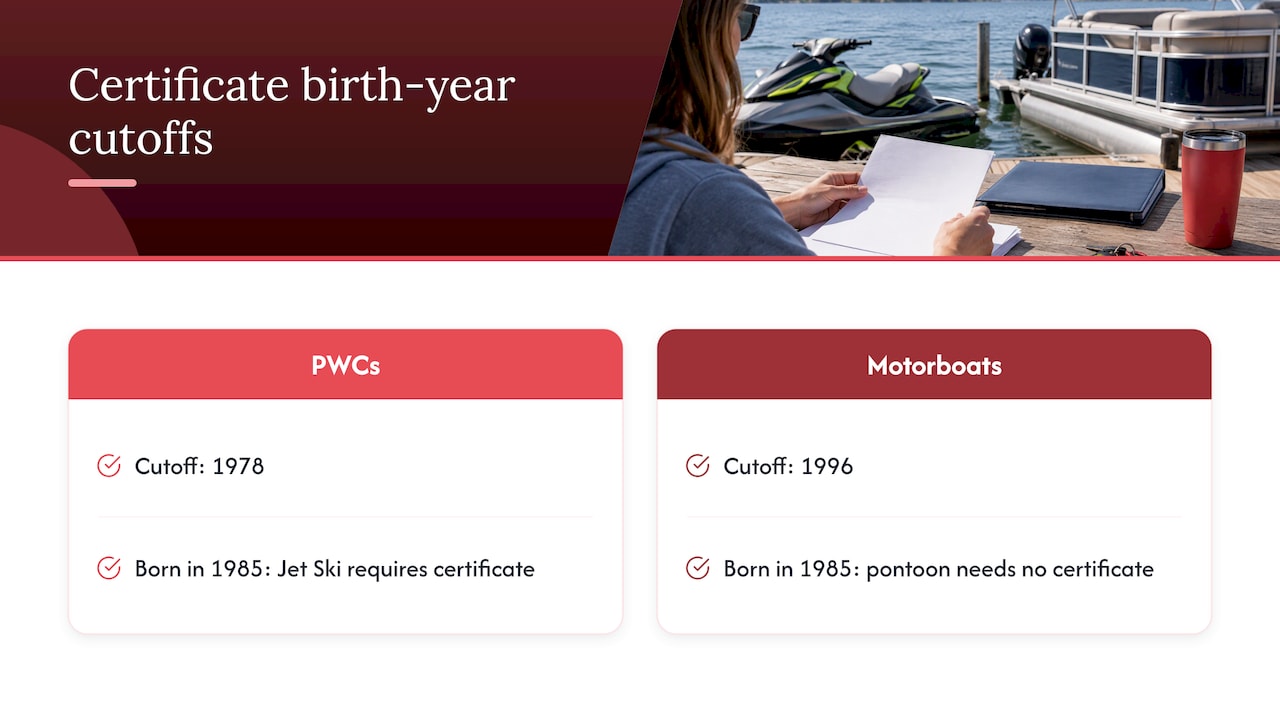
Mixing up the motorboat and PWC cutoffs. They are 17 years apart (1978 for PWCs, 1996 for motorboats). Someone born in 1985 needs a certificate for a Jet Ski but not for a pontoon boat.
Waiting until the day of the trip. The course and the exam take time. Finish them well before a rental or a first outing, especially for a teenager who must show the certificate to ride.
Skipping proof on the water. Operating without the certificate when it is required, or being unable to show it, brings a stop and a possible citation. Keep a copy where you can reach it.
Gift certificates and private instruction
For a teen who is about to ride, or a new owner in the family, our gift certificates cover a boating safety course. They are listed at $75 to $85. Our live Zoom class page also lists private classes, on-water training, practical navigation and chart reading, and captain’s license training and testing for boaters who want more than the minimum.
Our perspective
The certificate is the start of boating competence, not the finish. In our classes, we put the emphasis on the situations that cause the most trouble: crossing paths, docking in wind, and operating a PWC close to other boaters.
Michigan’s rules reward preparation. The July 1, 1996 and December 31, 1978 cutoffs are easy to look up, but families get caught by the details: a 14-year-old needing a supervising adult within 100 feet, or a rental counter asking for proof at the dock. A course taken before the season removes those surprises.
We teach with State Certified Instructors and USCG-Licensed Captains, using NASBLA-approved content, in online, live Zoom and in-person formats. Boaters who want to go further can add on-water training or navigation and chart reading. Most Michigan boaters start with the online course, because it can be done from home and finished in one sitting.
Richard
Get certified for Michigan waters
If you need the certificate, the fastest route is our online Michigan program, which covers both boats and PWCs and is designed to satisfy state boating education requirements. Start with the Michigan Boating & PWC Certification Course Online, or see everything we offer at Safe Boating America.
FAQ
Do you need a boating license in Michigan?
Michigan requires a boating safety certificate rather than a license. You need it if you were born on or after July 1, 1996 and operate a motorboat over 6 hp. For a PWC, the cutoff is anyone born after December 31, 1978.
Does the Michigan boating safety certificate expire?
No. State law makes the certificate valid for the life of the person who earned it, unless it is revoked. There is no renewal exam. Keep a copy or electronic version for when an officer asks.
How old do you have to be to drive a Jet Ski in Michigan?
You must be at least 14. Operators aged 14 and 15 need the certificate and must ride with, or stay within 100 feet of, a parent, guardian or designated adult 21 or older. At 16, you may operate independently, provided you hold the certificate if you were born after December 31, 1978.
Can I use my certificate from another state in Michigan?
The Michigan DNR certificate and the other documents listed in state law qualify, including a U.S. Coast Guard Auxiliary course document. The law requires that the course meet NASBLA minimum content and be DNR-approved. Our nationwide courses are built on NASBLA-approved content, so if you are unsure which certificate suits your situation, start with our Michigan course.
Is a boating certificate different from a boating license?
In everyday use, no. Boaters say license, but the document is a boating safety certificate, which shows you completed an approved course and passed the exam. It does not replace registration or required gear.
Sources
- Michigan DNR: Boating safety certificate
- Michigan DNR: Boat operator age restrictions
- Michigan DNR: Boating rules and regulations
- MCL 324.80201
- MCL 324.80141
- MCL 324.80212
- MCL 324.80215
- MCL 324.44522
- Michigan administrative code on boating equipment
- Michigan Boating Laws and Responsibilities handbook