
Georgia Boating License: Requirements and How to Get Certified
Anyone born on or after January 1, 1998 must complete a DNR-approved boater education course before legally operating a motorized vessel on Georgia waters. Georgia does not issue a separate “boating license.” It issues a lifetime Boater Education Certificate, and you can add an optional anchor indicator to your Georgia driver’s license through the Department of Driver Services if you want quick proof in hand.
Here’s the immediate action plan:
- Pick an approved course format: DNR classroom or a NASBLA-approved online provider.
- Complete the coursework and pass the final exam.
- Keep your original certificate somewhere safe. It never expires.
- If you want the DDS boating indicator, follow the DNR submission steps before visiting a DDS office.
Key Takeaways
Georgia requires anyone born on or after January 1, 1998 to hold a DNR-approved Boater Education Certificate before operating a motorized vessel, and the certificate process determines whether the DDS license indicator step goes smoothly.
| Point | Details |
|---|---|
| Birthdate rule | Anyone born on or after January 1, 1998 must complete a DNR-approved course before operating a motorized vessel. |
| Certificate vs. license | Georgia issues a lifetime Boater Education Certificate, not a separate boating license; the DDS indicator is optional proof. |
| Course length | Online courses typically take 3 to 5 hours and require passing a final exam. |
| Endorsement timing | Online course holders must present the original certificate to DNR and wait about 24 hours before visiting DDS. |
| Recommended provider | Safeboatingamerica offers NASBLA-approved Georgia courses online, via Zoom, or in person, with support for certificate handling. |
Table of Contents
- How Do I Get a Georgia Boater Education Certificate?
- Who Needs Boater Education in Georgia?
- What Are the Best Course Options for Georgia Boaters?
- How Do I Add the Boating Indicator to My License?
- Why Choose Safe Boating America for Georgia Certification?
- An Editorial Take on Georgia’s Certification Process
- Get Certified With Safe Boating America
- Sources
- FAQ
How Do I Get a Georgia Boater Education Certificate?
Getting certified is a straightforward process, but the order of operations matters, especially if you want the DDS indicator added later.
- Check your birthdate against the rule. If you were born on or after January 1, 1998, and you plan to operate a motorized vessel, including a Jet Ski or WaveRunner, you need the certificate. Grab a photo ID before you start; some providers ask for it during registration.
- Choose your course format. Options include DNR classroom sessions, NASBLA-approved online providers, USCG Auxiliary classes, and Power Squadrons courses. Online formats typically run 3 to 5 hours and end with a final exam you must pass to receive your certificate.
- Finish the exam and get your certificate. Most online providers issue a printable certificate instantly after you pass. DNR classroom courses log completions through GoOutdoorsGeorgia, Georgia’s outdoor recreation licensing system.
- Decide if you want the DDS license indicator. If your course was a DNR classroom course, the completion often submits electronically to DDS, no extra step needed. If you completed an online course, you’ll need to bring the original certificate to DNR first.
- Wait roughly 24 hours after DNR processing, then visit a DDS Customer Service Center with your ID and certificate to have the anchor indicator added.
Pro Tip: Snap a photo of your certificate the day you receive it and store the original in a folder with your boat registration. DDS wants the original document, not a screenshot, so keep the paper copy somewhere you won’t lose it.
Who Needs Boater Education in Georgia?
The birthdate rule is the trigger, but age also determines what a person can legally operate.
- Born on or after January 1, 1998: you need the certificate before operating any motorized vessel, PWC included.
- Under 12 years old: may only operate a vessel under specific horsepower limits and generally must be accompanied by a competent adult.
- Ages 12 to 15: can operate without direct supervision if certified, subject to the same horsepower and vessel-size restrictions under O.C.G.A. Title 52, Chapter 7.
- 16 and older: may operate most recreational vessels once certified, with no adult supervision required.
- PWC operators must be at least 16, or 12 to 15 if accompanied by a competent adult aboard the same craft.
A competent adult is defined as 18 or older, not impaired, and carrying valid identification. Exemptions exist for U.S. Coast Guard master license holders, nonresidents who can show NASBLA-approved proof of completion from another state, and operators on certain private lakes or ponds. Verify your specific situation on the DNR’s official pages, since exemptions can shift with vessel type and location.
What Are the Best Course Options for Georgia Boaters?
You have real choices here, and the right one depends on your schedule, budget, and whether you plan to add the DDS indicator afterward.
- DNR classroom courses are often free and scheduled through GoOutdoorsGeorgia. These tend to submit completions electronically to DDS, which simplifies the endorsement step later.
- USCG Auxiliary and Power Squadrons offer in-person instruction for boaters who prefer a live classroom setting with direct Q&A.
- The BoatUS Foundation offers a free, state-approved online course, the only no-cost online option carrying full DNR approval.
DNR classroom courses are usually free, while online providers may charge a course fee, though the BoatUS Foundation option removes that cost entirely. The certificate-handling difference matters more than most people expect: classroom completions often flow to DDS automatically, but online certificates require you to personally bring the original document to DNR before DDS will add the indicator.
How Do I Add the Boating Indicator to My License?
The workflow splits depending on where you took your course, and mixing up the order costs you a wasted trip.
- DNR classroom graduates: your completion typically transmits electronically to DDS, so you may be able to request the indicator directly at a DDS Customer Service Center without extra paperwork.
- Online course graduates: bring your original certificate to DNR first. DNR needs to process and confirm it before DDS can act.
- Wait about 24 hours after DNR processing before heading to DDS.
- Visit a DDS Customer Service Center with your government-issued ID and the original certificate in hand. Ask specifically for the boating indicator, sometimes called the anchor icon, on your license or ID.
Lost your certificate? If you completed a DNR classroom course, log into your GoOutdoorsGeorgia account and print a free replacement card. If your course came from a private online provider, you’ll need to contact that company directly since DNR doesn’t hold those records.
Why Choose Safe Boating America for Georgia Certification?
Safeboatingamerica offers state-approved boating license and safety certification courses in online, Zoom, and in-person formats built to satisfy Georgia’s DNR requirements. Courses use NASBLA-approved materials and are taught by state-certified instructors and USCG-licensed captains, covering navigation rules, PWC safety, and required equipment.
- Same-day certification for most online completions.
- Support with the certificate handling step needed before your DDS visit.
- Flexible scheduling across online, Zoom, and in-person formats.
- Materials that cover speed limits, alcohol restrictions, and life jacket rules enforced statewide.
Georgia’s boating fatality data consistently shows that a large share of incidents involve operators with no formal safety training, which is exactly the gap mandatory boater education exists to close.
Pro Tip: If you’re planning to add the DDS indicator, ask your course provider whether they issue the original certificate by mail or as an instant download. Some Georgia DDS offices want the physical original, not a printout of a PDF, so confirm before you drive over.
An Editorial Take on Georgia’s Certification Process
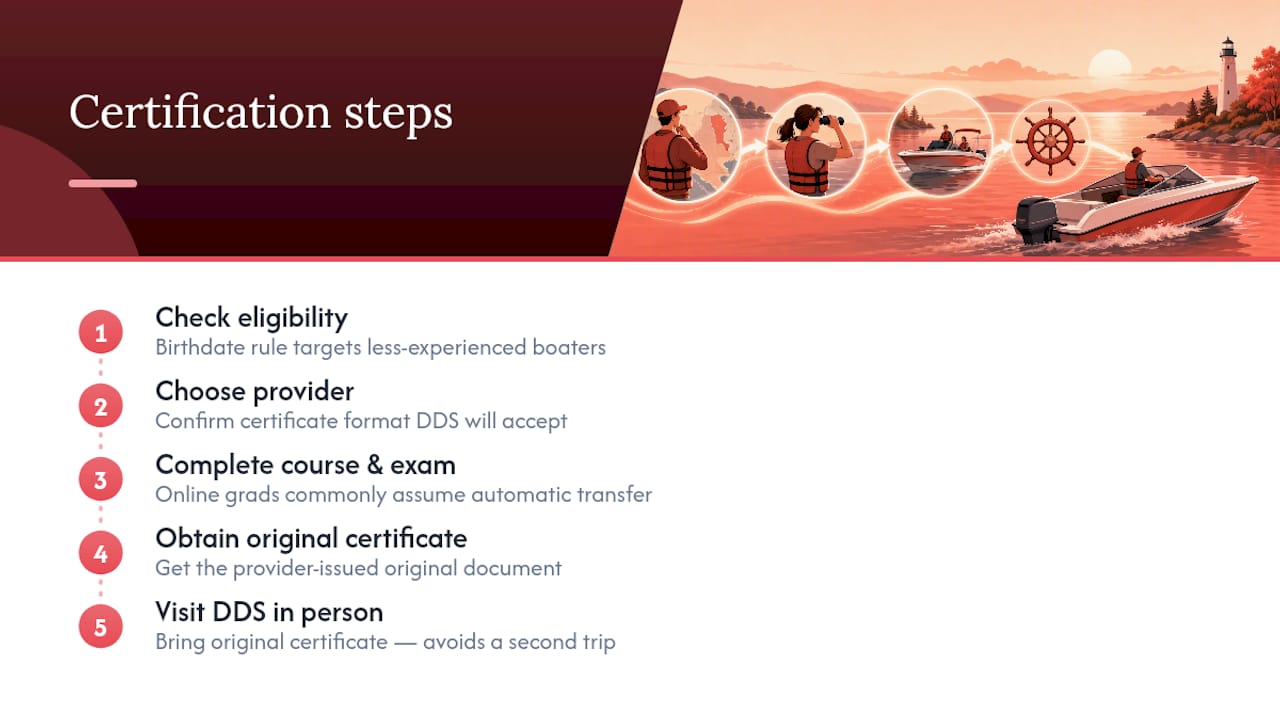
The conventional advice on this topic treats the boater education requirement like a bureaucratic box to check, and that framing undersells what’s actually at stake. The birthdate rule isn’t arbitrary. It targets the generation of boaters who never grew up around water safety instruction the way older operators often did, and the data backing mandatory education programs nationally supports that gap in experience translating into real risk on the water.
Where most guides fall short is glossing over the DNR-to-DDS handoff. That two-step process, especially for online course graduates, trips people up constantly. The instinct is to assume your certificate automatically appears on your license the moment you pass an exam. It doesn’t. You have to physically show up with the original document, and skipping that step is the single most common reason people end up making two trips instead of one.
If you take away one thing, prioritize the certificate format decision before you enroll. Ask whether the provider issues something DDS will accept without friction, because that choice matters more than which course looks fastest online.
— Richard
Get Certified With Safe Boating America
Safeboatingamerica gives Georgia boaters a faster path to certification than piecing together DNR classroom schedules or hunting for a free online slot on your own. You choose online, live Zoom, or in-person instruction, and most online completions issue a certificate the same day you pass, so you’re not waiting on mail delivery before you can head to DDS.
The courses cover exactly what Georgia’s DNR requires: navigation rules, PWC operation, required safety equipment, and the state-specific rules examiners expect you to know. If you’re a parent certifying a teenager, a first-time boat owner, or someone who just bought a Jet Ski for the season, the Georgia certification course walks you through registration, the exam, and what to do with your certificate once you pass. Visit Safe Boating America to pick your course format and get your certificate before your next trip on the water.
Sources
- Boating education — Georgia Department of Natural Resources
- Boater endorsement — Georgia Department of Driver Services
- Free Georgia State Boating Safety Course — BoatUS Foundation
FAQ
Do I Need a Boating License to Drive a Boat in Georgia?
Georgia doesn’t issue a “license” in the traditional sense. If you were born on or after January 1, 1998, you need a DNR-approved Boater Education Certificate to legally operate a motorized vessel.
Can I Use My Georgia Boating Certificate in Florida?
Many states, including Florida, accept NASBLA-approved boater education certificates from other states, but always confirm current reciprocity rules with the destination state’s boating authority before you travel.
Is a Boater Education Certificate Valid in All States?
Most states honor NASBLA-approved certificates from other states as proof of completion, though a few states have additional requirements for nonresidents, so check the specific state’s boating agency if you’re unsure.
How Long Does It Take to Get a Boating License in Georgia?
Online courses typically take 3 to 5 hours to complete, and many providers, including Safeboatingamerica, issue your certificate the same day you pass the final exam.
Does My Georgia Boater Education Certificate Expire?
No. Georgia’s Boater Education Certificate is a lifetime credential once issued, with no renewal requirement.
What Happens if I Operate a Boat Without Completing the Required Course?
Operating a motorized vessel without the required certificate when you fall under the birthdate rule can result in citations and fines under Georgia’s boating statutes, so completing an approved course before you’re on the water is the only way to avoid that risk.