Do You Need a North Carolina Boating License?
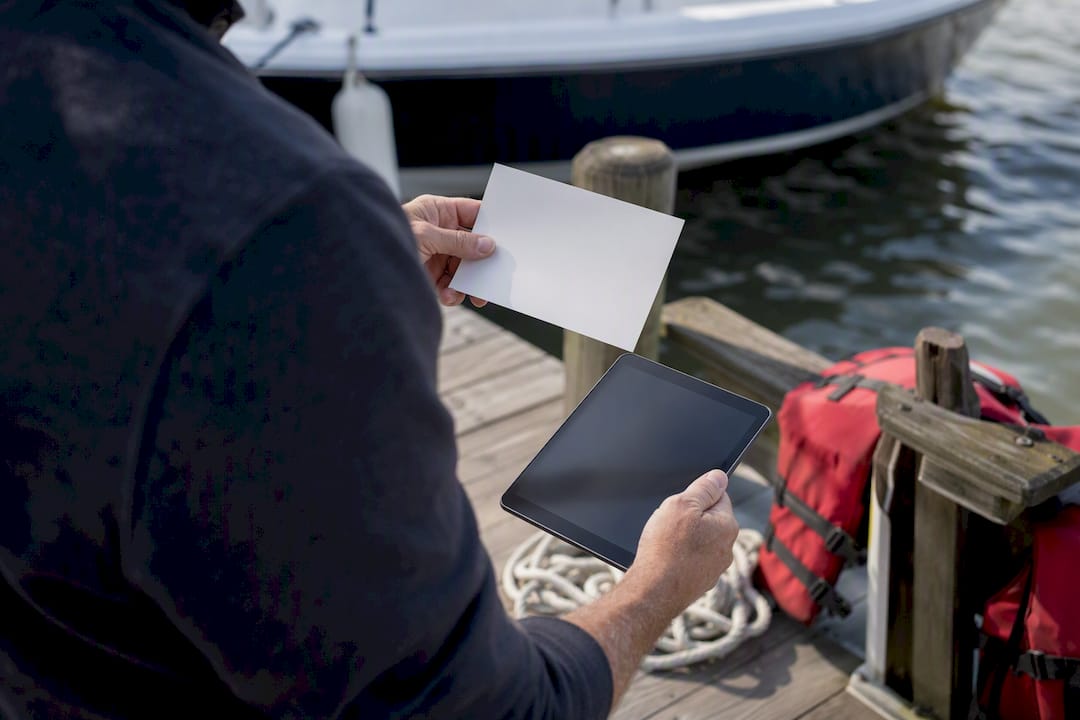
Yes. If you were born on or after January 1, 1988, and you plan to operate a motorboat of 10 horsepower or more on North Carolina public waters, you must meet the state’s boating safety education requirement before you head out.
North Carolina doesn’t issue a plastic “boating license” the way it issues a driver’s license. What you need is a Boating Safety Education Certificate, and the state accepts several routes to get one:
- Complete a North Carolina Wildlife Resources Commission (NCWRC) course
- Take a NASBLA-approved third-party course, online or in person
- Pass a proctored equivalency exam
- Hold a valid or expired U.S. Coast Guard (USCG) license
- Use a temporary 90-day certificate issued at the point of a vessel sale
Officers can stop you for a routine safety check, and a noncompliance fine of $50 applies if you can’t show proof. Personal watercraft (PWC) operators face an added age rule, covered further down.
Key Takeaways
North Carolina requires boaters born on or after January 1, 1988 to hold a NASBLA-approved education certificate before operating a motorized vessel of 10 horsepower or more.
| Point | Details |
|---|---|
| Birthdate determines eligibility | Anyone born on or after January 1, 1988 must complete an approved course before operating a 10+ HP motorboat. |
| Multiple compliance routes exist | NCWRC courses, NASBLA-approved third-party courses, equivalency exams, USCG licenses, and temporary certificates all satisfy the law. |
| Carry proof every time you’re on the water | Officers can stop vessels for safety checks, and noncompliance carries a $50 fine. |
| Records depend on your provider | NCWRC only keeps records for courses it runs directly, so third-party students must contact that provider for replacements. |
| Safe Boating America offers a direct path | Its NASBLA-aligned NC courses run online, via Zoom, or in person, with same-day certification and help recovering lost records. |
Table of Contents
- What Is the North Carolina Boating License Age Requirement?
- How to Get Your Boating License in NC
- What to Carry on Board After You Pass
- Personal Watercraft Rules: Minimum Age and Proof
- Enforcement and How to Avoid a Citation
- Where to Verify North Carolina Boating Regulations
- Get Certified Through Safe Boating America
- Sources
- FAQ
What Is the North Carolina Boating License Age Requirement?
The rule hinges on your birth date, not your current age. Anyone born on or after January 1, 1988 falls under the education mandate the moment they operate a motorized vessel rated at 10 horsepower or higher. Someone born in 1987 or earlier is exempt from the education requirement entirely, even on the same lake, same boat, same day.
“Public waters” means the requirement applies to lakes, rivers, sounds, and coastal waters open to the public. It generally does not reach small private ponds with no public access. Horsepower is the trigger for motorized vessels. A trolling motor or a small outboard under 10 horsepower doesn’t require the certificate, though many boaters take the course anyway for the safety content alone.
A few practical notes worth flagging:
- Nonresidents can use a valid boating education card from another state that NASBLA recognizes as equivalent.
- A 90-day temporary operator’s certificate, issued when you buy a vessel, covers you while you complete a full course.
- Some marinas, lakes, or rental outfits layer on their own stricter rules, so it pays to ask before you cast off.
How to Get Your Boating License in NC
You have more flexibility than most new boaters realize. Here’s how the accepted paths stack up.
- Take the NCWRC-administered course. This is often free and comes with a built-in advantage: the state keeps your record. If you ever lose your card, NCWRC can retrieve it because it administered the course directly.
- Enroll in a NASBLA-approved third-party course. Providers like Safe Boating America run state-approved NC boating and PWC certification courses online, live via Zoom, and in person. Before you pay for any third-party course, confirm it carries NASBLA approval and that NCWRC accepts it.
- Sit for a proctored equivalency exam. State statute allows this route for boaters who already know the material and just need the credential.
- Substitute a valid or expired USCG license. The statute recognizes this automatically, no separate NC course needed.
- Use a 90-day temporary certificate issued when you buy a boat, or documentation tied to a rental or supervised onboard operation, if the statute’s conditions apply to your situation.
If you need to be on the water today, the temporary certificate or a rental provider’s documentation gets you moving fastest. If you’d rather not think about this again, the NCWRC course or a well-documented NASBLA provider gives you a record you can actually retrieve later.
Pro Tip: Pick a provider based on what happens if you lose your card two years from now, not just on what’s cheapest today. A course that keeps accessible records saves you a scramble later.
What to Carry on Board After You Pass
Passing the course is only half the job. What you do next determines whether a routine stop goes smoothly.
- Print your temporary certificate immediately after finishing, and request your permanent card if the provider issues one on the spot.
- Keep either the temporary certificate or the printed card on board, along with a valid photo ID, any time you’re operating.
- A digital copy on your phone typically satisfies an officer during a check, but a printed backup avoids dead-battery problems.
- If you took a third-party course, that provider holds your record, not NCWRC. NCWRC only retains records for courses it administers directly.
- Lost your card? Contact the course provider first. If NCWRC administered your original course, reach out to the commission directly for a replacement.
Pro Tip: Save your certificate as a PDF in a cloud folder the day you earn it. Providers change contact information over the years, and a saved copy beats a support ticket.
Personal Watercraft Rules: Minimum Age and Proof
PWC operation carries its own age floor that sits on top of the general education requirement. Nobody under 14 may operate a personal watercraft in North Carolina, period.
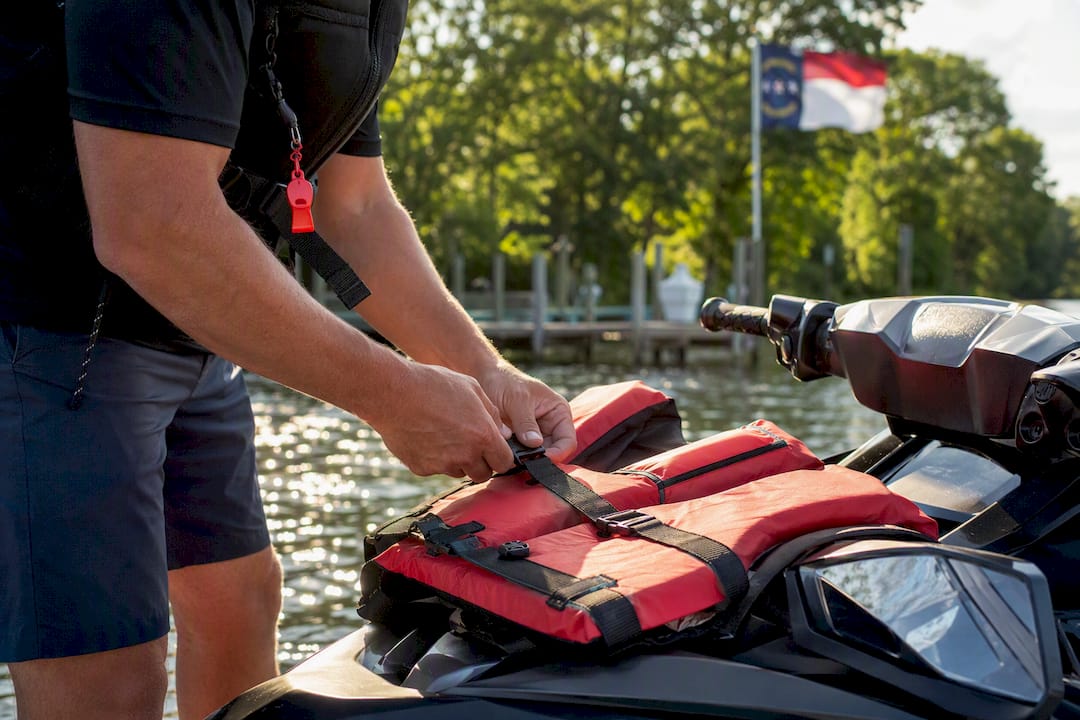
Riders age 14 to 16 can operate a PWC only if they hold a certificate of competency from a NASBLA-approved course and carry ID, or if they’re accompanied by an adult 18 or older who meets the state’s requirements. There’s no minimum age to take the underlying boating safety course itself. The exam just has to be completed unassisted by the student.
If you’re supervising a teenager on a PWC, treat their certificate the same way you’d treat your own: printed or saved, and on the water with them every time.
Enforcement and How to Avoid a Citation
NCWRC officers can stop vessels for safety checks and ask for proof of your boating education, no probable cause required beyond the check itself. This isn’t rare or aggressive enforcement; it’s a routine part of how the state maintains water safety.
Get caught without your certificate and you’re looking at a $50 fine, per state law. The fix is almost embarrassingly simple:
- Keep your certificate, physical or digital, on board every time you operate.
- Store a backup copy somewhere you can access without cell signal.
- Know that children under 13 have separate personal flotation device requirements, and officers check those too.
- Confirm any lake- or marina-specific rules before you launch in unfamiliar water.
Where to Verify North Carolina Boating Regulations
Three sources settle almost any question about your requirement. NCWRC’s boater education page lists every currently approved course and how to enroll. The full text of G.S. 75A-16.2 spells out every accepted compliance method in the state’s own legal language. The Vessel Operator’s Guide condenses state boating rules into one compact reference, including local exceptions.
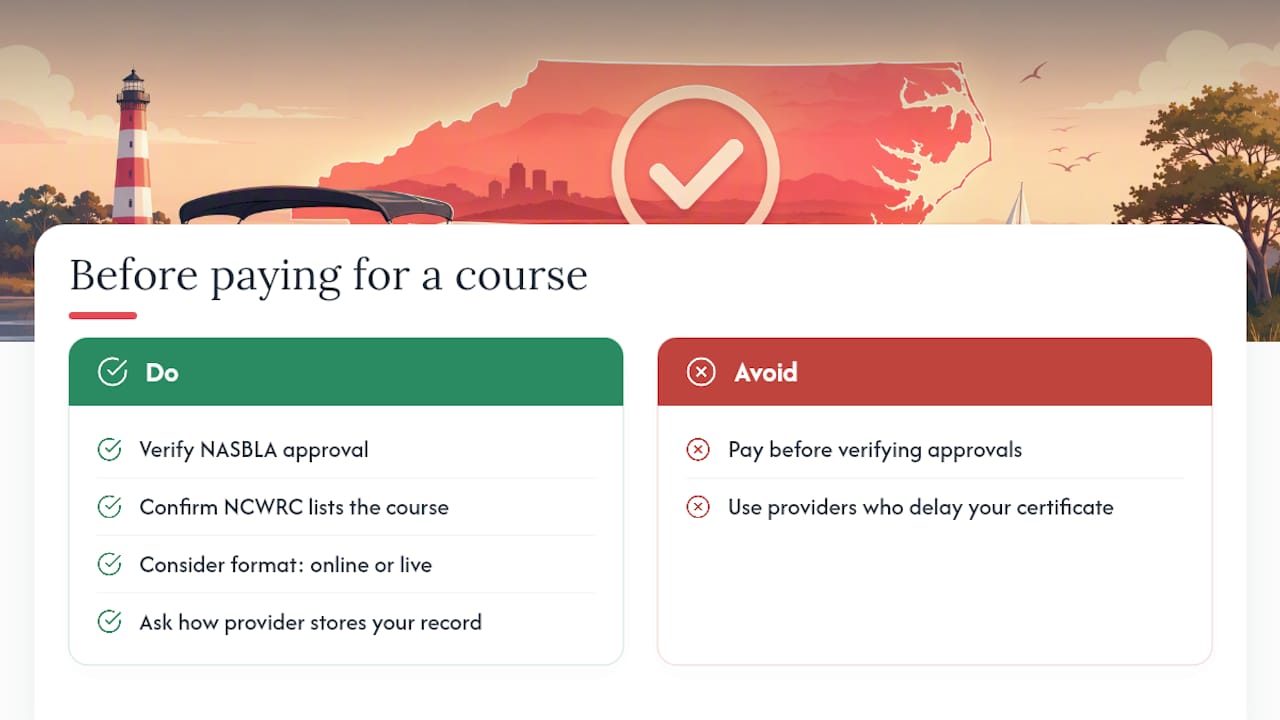
Before paying for a course, check two things: does it carry genuine NASBLA approval, and does NCWRC list it as accepted. Then weigh format (online, live, in-person), how the provider stores your record, and how fast they turn around proof once you finish. A provider that hands you a certificate the same day beats one that makes you wait a week for paperwork you need this weekend.
Why certification matters beyond the fine
The $50 fine is the least interesting reason to get certified. A NASBLA-approved course covers collision avoidance, capsizing response, and weather judgment, the stuff that actually keeps people alive on North Carolina’s lakes and sounds. Safe Boating America builds its NC courses on state-approved materials and helps students track down course records when a provider mix-up would otherwise leave them stranded without proof. Preparedness, not paperwork, is the real payoff.
— Richard
Get Certified Through Safe Boating America
Safe Boating America runs its North Carolina course to satisfy the state’s exact requirement, built on NASBLA-aligned material and taught by state-certified instructors. You choose the format: fully online at your own pace, live over Zoom with a real instructor, or in person if you’d rather learn face to face.
Same-day certification is available once you complete and pass the course, so you’re not left waiting on a card while your weekend on the water slips away. If you ever need help tracking down your record later, Safe Boating America supports that retrieval directly instead of leaving you to chase down an old email. Enrollment takes a few minutes: visit the Safe Boating America course page to pick your format and get your North Carolina certificate started today.
Sources
- Boating | NC Wildlife Resources Commission — Laws & safety
- § 75A‑16.2. Boating safety education required. — North Carolina General Statutes
FAQ
Is a North Carolina Boating License Valid in Other States?
Generally yes. NASBLA-approved certificates are recognized across states that honor the NASBLA standard, though you should confirm acceptance with the destination state before you travel with your boat.
Do You Need a Boating License in North Carolina?
Yes, if you were born on or after January 1, 1988 and plan to operate a motorized vessel of 10 horsepower or greater on public waters. Boaters born before that date are exempt from the education requirement.
Can You Drink a Beer While Driving a Boat in North Carolina?
North Carolina treats boating under the influence as a serious offense, and enforcement includes routine safety stops where officers check for compliance issues broadly. The safest and legally sound approach is to avoid alcohol entirely while operating any vessel.
How Much Does an NC Boating License Cost?
NCWRC-administered courses are often free, while NASBLA-approved third-party providers, including Safe Boating America, may charge a course fee that varies by format and provider. Failing to carry proof of a completed course can also cost you a $50 fine during a safety check.